By Mark Rubinstein
Editor’s Note: This excerpt from Mark Rubinstein’s Costa’s War follows a young soldier’s arrival in Vietnam in 1968 and the first moments of a war that will change him for life.
Prologue
I went to Vietnam thinking I understood danger—the way a man thinks he understands fire because he’s felt the heat of a match.
But Vietnam was a wildfire burning wherever it pleased. Four weeks into the bush, it happened—the one thing I never talked about in full, not to my parents, not to my friends, not even to my wife. What happened bored itself into me, settled deeply in my heart. And over the years, it hasn’t faded. It shaped me. Irrevocably. It left me walking through life with a shadow just over my shoulder—a reminder that the man I became was born in the jungle, under a sky full of blood, smoke, and fire.
June 1968: Arrival
I stepped off the plane at Da Nang feeling it was an assault on my senses.
The first thing that struck me wasn’t the sight of the jungle or the noise of engines—it was the air. It wrapped around me like a wet towel: thick, heavy, stinking of jet fuel, rot, and sweat. The humidity was so dense, it felt alive, pressing against my skin, filling my lungs until breathing seemed like a chore. The temperature was nearly a hundred degrees; it was wet heat, and it clung to me, crawled beneath my fatigues, and wouldn’t let go.
The runway shimmered under the brilliance of the sun, with heat waves rising off the tarmac. There was the smell of diesel, of damp vegetation, and burning trash, with something sweet and rotten in the air, along with the odor of human feces carried in from the perimeter of the airfield. The noise was constant, and the air buzzed like it was alive—trucks grinding, sergeants barking orders, distant booms that might have been thunder or artillery. Beyond the perimeter fences was a wall of green.
I knew it was the jungle, dense, waiting.
I was aware of peril; I felt it in my gut.
I adjusted my pack, swallowed hard, and stepped onto the rampway, knowing I was taking my first steps into war.
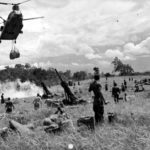
I followed the line of draftees down the ramp; the sound of boots thudding on metal was strange, unnerving. My fatigues were suddenly plastered to my back. A chopper thumped directly overhead, its blades beating the sky like a warning.
A buck sergeant herded us toward a line of idling, open-backed deuce-and-a-halfs, army trucks with their engines coughing black smoke into the air. I felt like I was choking.
“Let’s move it, cherries!” he shouted, waving us toward the rear gates of the waiting trucks.
We newbies were called “cherries,” a name we would lose if we managed to survive twelve months in a combat zone.
Along with the other cherries, I climbed onto an open truck bed. The metal was so hot, I felt I was burning up. The wooden slats reeked of the sweat, oil, and fear that had seeped in from the newbies who’d been transported before us.
The convoy started up, jolting forward. Dust rose in thick clouds, clinging to the sweat on our faces.
We passed sandbagged bunkers and tin-roof shacks. Kids scurried about, most of them barefoot in the mud and dirt. They ran alongside the trucks, waving and shouting, “GI! GI!” Women watched from the doorways of those shacks. They seemed wary as we rolled past them.
I felt the truck’s rumble through my boots, into my shinbones. As I clutched my M16 between my knees, it felt slick from the vaporous humidity. The weapon would be my constant companion for the year I’d be spending in the boonies—if I lived that long.
The deuce-and-a-half’s engine sent a hard, steady vibration into my bones. Red dust curled up behind us and hung in the air like a veil, and we newbies—keeping quiet, trying not to look scared—said very little, feeling apprehensive. I kept thinking back to my time at Fort Jackson and Fort Benning, especially the advanced infantry training, AIT, as it was colloquially known. Drill sergeants barked orders, and there was the predictable cadence of the army, with clear lines drawn between right and wrong, smart and stupid.
I knew that in combat there would be no lines like that. The men I’d be joining weren’t fresh recruits like I was. They were combat veterans, guys who’d been living with death close enough to have its stench on them. They would measure me differently—by how I acted in battle, whether I flinched at sudden sounds, whether I tried too hard to impress an officer or didn’t try at all. I didn’t know what to expect, only that whatever was waiting at base camp would be real in a way nothing back in the States had ever been.
My stomach clenched as I thought of “humping the bush,” as trekking through the jungle was called. I’d heard that phrase at Fort Benning. This was it, the real thing. Not mock combat scenarios. Not simulated ambushes. Not live-fire exercises with rifles, machine guns, and grenades in controlled scenarios at an army fort in South Carolina or Georgia. Yes, this was a new and very lethal reality. One I would have to endure.
I’m in it now. There’s no turning back. I could be dead within a week, or sooner.
Turning away from what lay ahead, I thought of my parents, living in Buffalo, New York, along with my younger sister, Doloris. I thought of my father, busting balls in the Republic Steel mills while my mother, a lunchroom lady at Cazenovia High School, dished out slop to snotty teenage kids who hated everything in their little lives.
Thinking about life back home, I recalled how I couldn’t stand school at the University of Buffalo. We “townies” were looked down upon by the students who came from places in the state beyond Buffalo. I’d toughed it out to keep my student deferment going until I graduated. Then, at twenty-one years old, I was sucked into the maw of the army. With a low draft number, I’d suddenly become a grunt.
And I thought about Basia, the girl I’d been seeing before the draft notice came. I wondered what she was doing, having left Buffalo for New York City to begin work as a graphic designer at an ad agency on Madison Avenue. Knowing she would write to me, I thought it was amazing that mail would somehow reach me in the heart of the jungle, thousands of miles from her Manhattan sublet on East Thirty-Third Street.
My time with Basia had come to a life-altering halt, along with deferred status, when I’d graduated from college.
Within weeks, Uncle Sam came calling.
The truck rumbled onward.
The farther toward the interior we went, the more the jungle seemed to close in on us. Palms, vines, and bushes thickened, looking like they would choke the road. The air seemed darker and wetter. The truck’s engine noise took on a hollow, echoing quality. I glanced toward the dense foliage. It seemed so still.
That was where the war was, somewhere in that morass.
The enemy would be crouched low and waiting.
And here I was. About to hump the bush in Vietnam.
© 2027 by Mark Rubinstein
Excerpted from Costa’s War by Mark Rubinstein (Thunder Lake Press)

_____________________________
Mark Rubinstein is an award-winning author, former forensic psychiatrist, and U.S. Army veteran. After earning a degree in business administration from NYU, he served in the U.S. Army as a field medic caring for paratroopers of the 82nd Airborne Division. Following his military service, he returned to school, earned his medical degree, and became a psychiatrist.
Rubinstein went on to practice forensic psychiatry, serving as an expert witness in numerous trials. He was also an attending psychiatrist at New York-Presbyterian Hospital and a clinical assistant professor of psychiatry at Cornell, where he taught psychiatric residents, psychologists, and social workers while maintaining his psychiatric practice.
Mark Rubinstein is the author or co-author of 26 books, both fiction and non-fiction. His novella The Foot Soldier won a Silver Benjamin Franklin Award, Return to Sandara received a Gold IPPY Award for Suspense/Fiction, and The Lovers’ Tango won a Gold Benjamin Franklin Award for Popular Fiction. His most recent works include A Lethal Question, Peril on West Tenth, and Costa’s War.
As the Voice of the Veteran Community, The Havok Journal seeks to publish a variety of perspectives on a number of sensitive subjects. Unless specifically noted otherwise, nothing we publish is an official point of view of The Havok Journal or any part of the U.S. government.
Buy Me A Coffee
The Havok Journal seeks to serve as a voice of the Veteran and First Responder communities through a focus on current affairs and articles of interest to the public in general, and the veteran community in particular. We strive to offer timely, current, and informative content, with the occasional piece focused on entertainment. We are continually expanding and striving to improve the readers’ experience.
© 2026 The Havok Journal
The Havok Journal welcomes re-posting of our original content as long as it is done in compliance with our Terms of Use.