Canada’s federal gun “buyback” program, once touted as a cornerstone of Prime Minister Justin Trudeau’s gun control agenda, has increasingly come to resemble a policy failure in slow motion. Years after its announcement, the program is plagued by delays, ballooning costs, and most critically, a startling lack of participation from the very population it was designed to target.
At the heart of the issue is a simple, inconvenient truth: compliance is far lower than expected. In fact, it’s hovering around negligible levels in key pilot efforts and is broadly estimated to be only a small fraction of eligible firearms.
A Program Built on Ambition, Not Reality
Gun “buyback” programs are fundamentally misnamed, because they imply that the government owned the weapons in the first place. They didn’t. It would be more accurate to describe them as “buy-away,” because it’s the government that attempted to buy private property away from its citizens. But, to avoid confusion, I’ll use “buyback” instead.
The buyback initiative in question emerged in 2020 following the Nova Scotia mass shooting, when Ottawa banned over 1,500 models of so-called “assault-style” firearms, which was later expanded to more than 2,500. The plan was straightforward in theory: prohibit certain firearms, compensate lawful owners, and remove the weapons from circulation.
But theory has collided with reality.
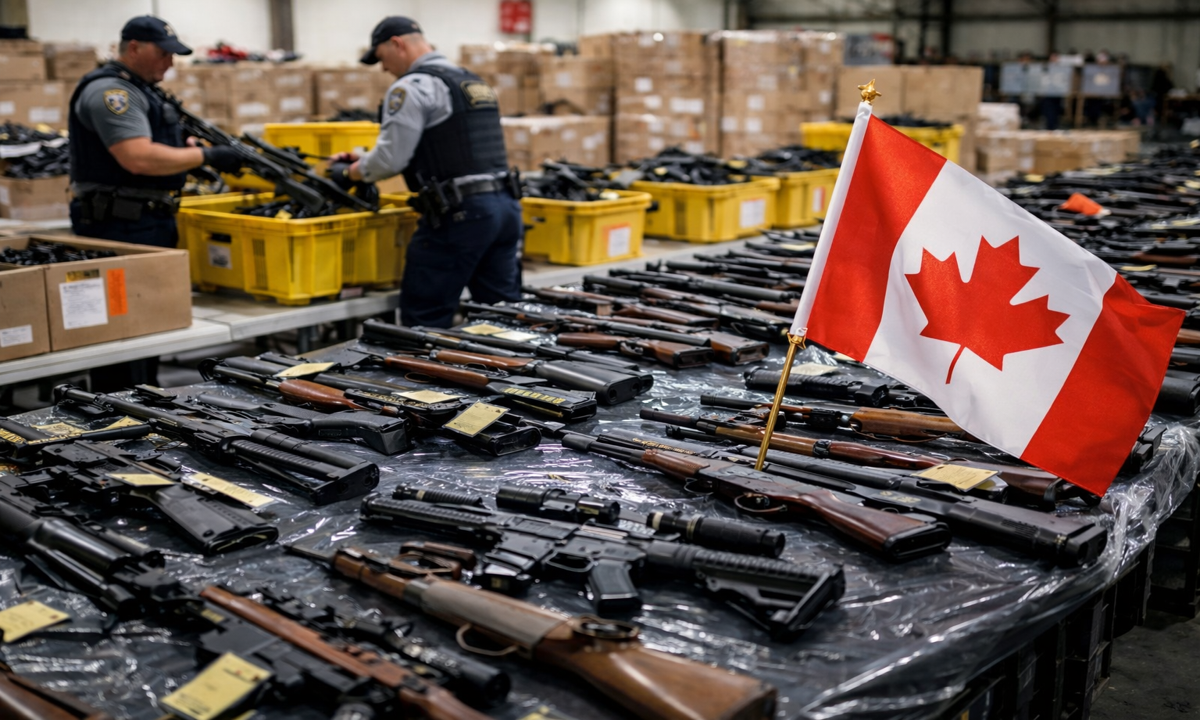
As of recent reports, the government has spent hundreds of millions of dollars while collecting only about 12,000 firearms, out of an estimated pool that could range into the hundreds of thousands. That gap alone signals a compliance problem on a massive scale.
More telling, early pilot programs have produced abysmal results. In one Nova Scotia trial, only 25 firearms were surrendered out of a target of 200. This is a compliance rate barely exceeding 10%, and in some interpretations closer to just a few percentage points when scaled nationally.
Here’s one take on the situation:
The 2% Problem
While official nationwide compliance figures remain opaque, multiple analyses and pilot data suggest participation rates are extremely low—often cited in the low single digits.
Whether framed as 2% or even marginally higher, the implication is the same: the overwhelming majority of affected firearm owners are choosing not to participate.
This matters because the entire premise of a voluntary buyback hinges on participation. Without it, the program becomes less a public safety initiative and more a symbolic gesture—expensive, politically charged, and operationally ineffective.
Voluntary in Name, Mandatory in Theory
The government maintains that while participation in the buyback is voluntary, compliance with the law is not. Firearm owners must eventually surrender, deactivate, or otherwise dispose of prohibited weapons before the amnesty period expires in October 2026, or face criminal penalties.
But enforcement remains a glaring weakness.
Officials themselves have expressed doubts about the feasibility of enforcing compliance at scale. With potentially hundreds of thousands of firearms dispersed across a vast country, meaningful enforcement would require resources and political will that appear absent.
In practice, this creates a policy contradiction: a “voluntary” program with mandatory consequences that the government may be unable—or unwilling—to enforce.
Cost Overruns and Diminishing Returns
If low compliance weren’t enough, the financial side of the program raises further concerns.
Initial estimates placed costs in the hundreds of millions. More recent projections suggest total expenditures could climb into the billions. Meanwhile, the cost per firearm collected has skyrocketed, reaching tens of thousands of dollars per gun in some estimates.
That’s a staggering price tag for a program that has yet to demonstrate measurable impact on crime.
Critics point out that the vast majority of gun crime in Canada involves illegal firearms (often smuggled from the United States) rather than the legally owned weapons targeted by the buyback.
If true, the program is not only inefficient but misaligned with the actual drivers of gun violence.
Political Optics vs. Practical Outcomes
The buyback program exists at the intersection of policy and politics. It signals action, responsiveness, and a commitment to public safety. But signaling is not the same as solving.
Even within government ranks, skepticism has surfaced. Leaked comments from officials have questioned the program’s effectiveness and feasibility, suggesting it is being pursued more for political reasons than practical ones.
At the provincial level, resistance is also growing, with some jurisdictions refusing to participate or cooperate—further undermining national implementation.
A Policy at Odds With Its Own Premise
Gun buyback programs can work—maybe—but only under specific conditions: high compliance, clear enforcement mechanisms, and alignment with the sources of criminal gun use.
Canada’s program currently meets none of these criteria.
Instead, it is characterized by:
- Minimal participation (often estimated in the low single digits)
- Escalating costs with limited returns
- Enforcement challenges bordering on impractical
- A disconnect between targeted firearms and actual crime trends
Conclusion: When Policy Meets Reality
Canada’s gun buyback program was conceived as a bold step toward reducing gun violence. But boldness without practicality is a recipe for failure.
With compliance rates hovering near negligible levels—again, reportedly around 2% in some contexts—the program is struggling to achieve even its most basic objective: getting firearms off the streets.
What remains is an expensive, controversial initiative that may ultimately serve as a case study, not in effective policy, but in the limits of top-down solutions divorced from on-the-ground realities.
If the goal is public safety, the question policymakers must now confront is simple:
Is this program actually making Canadians safer—or just making headlines?
I think we all know the answer…
Charles served over 27 years in the US Army, which included seven combat tours in Iraq and Afghanistan with various Special Operations Forces units and two stints as an instructor at the United States Military Academy at West Point. He also completed operational tours in Egypt, the Philippines, and the Republic of Korea and earned a Doctor of Business Administration from Temple University as well as a Master of Arts in International Relations from Yale University. He is the owner of The Havok Journal, and the views expressed herein are his own and do not reflect those of the US Government or any other person or entity.
As the Voice of the Veteran Community, The Havok Journal seeks to publish a variety of perspectives on a number of sensitive subjects. Unless specifically noted otherwise, nothing we publish is an official point of view of The Havok Journal or any part of the U.S. government.
Buy Me A Coffee
The Havok Journal seeks to serve as a voice of the Veteran and First Responder communities through a focus on current affairs and articles of interest to the public in general, and the veteran community in particular. We strive to offer timely, current, and informative content, with the occasional piece focused on entertainment. We are continually expanding and striving to improve the readers’ experience.
© 2026 The Havok Journal
The Havok Journal welcomes re-posting of our original content as long as it is done in compliance with our Terms of Use.