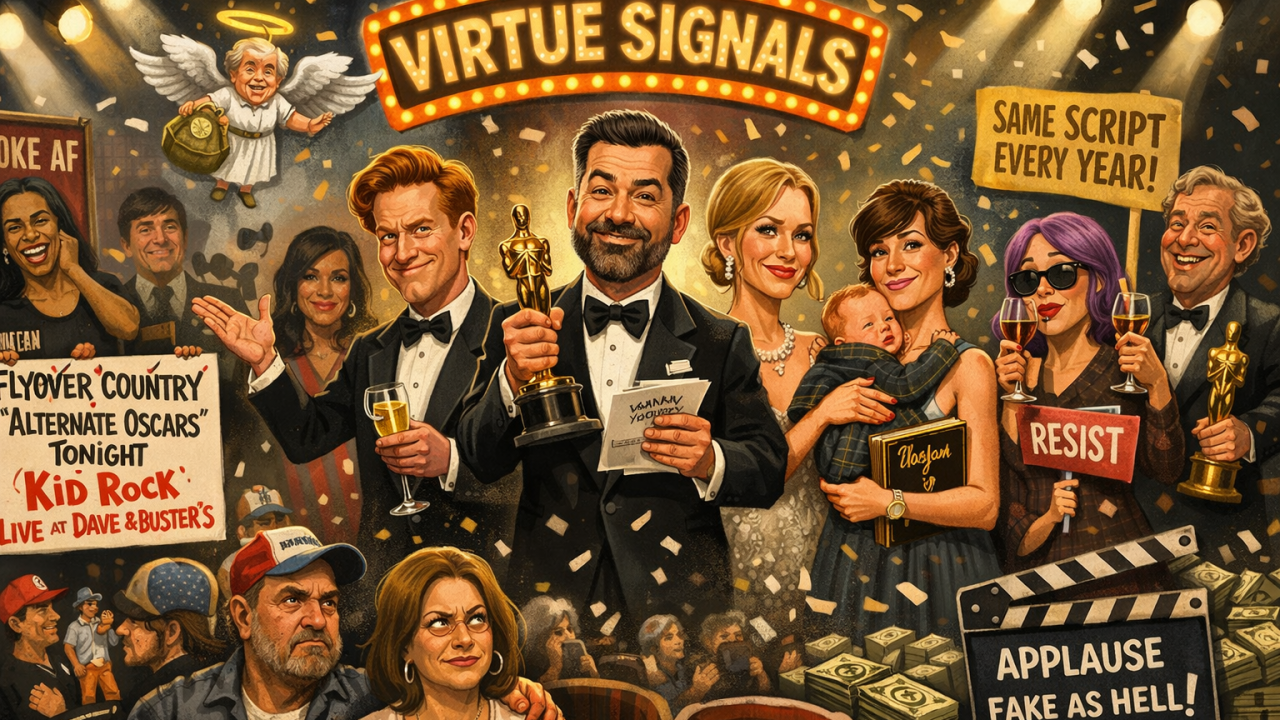
Every year the Oscars arrive like a scented candle in a power outage, expensive, performative, and somehow making everything worse.
It is the one night Hollywood gathers to congratulate itself for being brave enough to have opinions that are already printed on the cocktail napkins at every party in Beverly Hills. And this year did not disappoint, if by “did not disappoint” you mean it delivered exactly the kind of lacquered, predictable, politically housebroken smugness that makes normal people want to scrub their souls with a Brillo pad.
Take Jimmy Kimmel, a man who approaches a microphone the way a raccoon approaches a garbage can, as if there simply must be something nasty to paw through. Asked, effectively, to do the grown-up job of presenting a category, he instead reached for the easiest currency in Hollywood, cheap political sniping disguised as moral sophistication. There he was, lobbing a sneer at the First Lady because of course he did. In that room, taking a shot at a Republican-adjacent woman is not bravery. It is karaoke. It is the safest act available outside of thanking your agent and pretending Ozempic is “just portion control.”
That is the disease, by the way. Not merely bias. Bias is human. The disease is the absolute narcotic certainty that their bias is heroism.
Hollywood loves to imagine itself as the French Resistance with better lighting. A room full of people whose biggest professional risk is wearing last season’s couture still speaks as though they are smuggling forbidden pamphlets past a dictatorship. Please. If your opinion is shared by every studio executive, every late-night writer, every entertainment journalist, every awards consultant, every assistant carrying an oat milk latte within a three-mile radius, you are not speaking truth to power. You are reading the office Slack out loud in a tuxedo.
Then came Conan O’Brien, another man who confuses being glib with being incisive. He took a shot at conservative counterprogramming with the usual coastal sneer, as though mocking people outside the velvet rope is the highest form of wit. The joke, apparently, is that if ordinary Americans do not enjoy being lectured by celebrities between luxury watch commercials, they must be rubes at a Dave & Buster’s. Ah yes, the timeless humor of elite contempt. Nothing says “I am a sophisticated satirist” like implying half the country is tacky because they do not clap on cue when a comedian in a custom suit tells them their values are embarrassing.
What makes it especially stale is how lazy it is. There is no surprise in it. No danger. No actual observation. Just the same old factory-farmed sarcasm, harvested from the fields of affluent certainty and served lukewarm. These men are not court jesters skewering kings. They are palace employees mocking the peasants for not appreciating the drapes.
And yet, in between the ideological throat-clearing and self-satisfied little applause spasms, something weird happened. A few people walked on stage and behaved like members of the human race.
Nicole Kidman casually mentioning church on a Sunday caused the kind of visible discomfort usually reserved for someone announcing a norovirus outbreak at brunch. It was marvelous. You could practically hear the room’s nervous system short-circuit. Church? Publicly? At the Oscars? How dare she introduce an ancient, mainstream religious practice into this carefully managed pagan pageant of serum, sequins, and strategic indignation?
Then came Jesse Buckley, who used her moment not to issue a manifesto, not to workshop a partisan clap line, not to audition for the role of Conscience of the Republic, but to speak about motherhood, love, family, and the strange overwhelming beauty of being a parent. It was heartfelt, feminine, unguarded, and therefore practically subversive in a room that usually treats motherhood like a niche documentary subject narrated by Cate Blanchett over minimalist piano.
And Michael B. Jordan got up there, thanked God, loved on his family, honored his parents, and sounded grounded, grateful, and sane. Which, in modern awards-show terms, is basically radicalism. He did not act like the statue had confirmed his sainthood. He did not perform moral superiority in a rented bow tie. He simply expressed gratitude like a person who understands that talent is not self-created and success is not an argument for your own divinity.
That was the real contrast of the night. Not left versus right. Not red state versus blue state. Not art versus commerce. It was emptiness versus substance.
On one side, the usual professional sneer merchants, those eternal hall monitors of acceptable thought, still mistaking contempt for intelligence and applause for truth. On the other, a few grown adults who remembered that gratitude is more compelling than vanity, that faith is more interesting than fashionable nihilism, and that loving your family on live television is somehow more rebellious now than wearing a political slogan on a designer lapel.
That is the joke at the heart of Hollywood. The people who believe they are the boldest are usually the most obedient. The people who think they are smashing norms are almost always reciting them. And the rare person who says “I love my spouse,” “I love my child,” “I thank God,” or “I went to church” lands with the force of a Molotov cocktail because authenticity terrifies an industry built on controlled illusion.
The Oscars are not an awards show so much as an annual hostage video from the Church of Approved Opinion, interrupted occasionally by flashes of actual humanity. The hosts strut out, all smirk and lacquer, delivering lines engineered to thrill people who already agree with them. Then, every so often, someone ruins the mood by sounding sincere, and suddenly the room remembers that real life exists beyond the after-party perimeter.
Hollywood can keep the smugness. Give me the mother talking about her baby. Give me the actor thanking God. Give me the movie star admitting she went to church. At least those people sound like they have met a human being who was not holding a gift bag.
_____________________________
Tammy Pondsmith is a recovering awards-show anthropologist who once escaped a celebrity fundraiser by disguising herself as a valet and has distrusted standing ovations ever since.
As the Voice of the Veteran Community, The Havok Journal seeks to publish a variety of perspectives on a number of sensitive subjects. Unless specifically noted otherwise, nothing we publish is an official point of view of The Havok Journal or any part of the U.S. government.
Buy Me A Coffee
The Havok Journal seeks to serve as a voice of the Veteran and First Responder communities through a focus on current affairs and articles of interest to the public in general, and the veteran community in particular. We strive to offer timely, current, and informative content, with the occasional piece focused on entertainment. We are continually expanding and striving to improve the readers’ experience.
© 2026 The Havok Journal
The Havok Journal welcomes re-posting of our original content as long as it is done in compliance with our Terms of Use.

