
For years, Americans have watched the southern border crisis unfold like a slow-motion national security failure. Drugs poured in. Cartels grew richer. Communities paid the price. Families buried loved ones. And while Washington argued over definitions and talking points, narco-terror networks expanded, moving product, laundering money, bribing officials, and exploiting weak governance throughout the Caribbean Basin.
But something has changed.
Operation Southern Spear represents a shift in posture: a U.S.-led mission in the Caribbean that treats narco-terrorism not as a routine criminal issue but as what it truly is: a direct threat to American security, stability, and sovereignty.
This is what decisive leadership looks like when the United States stops reacting and starts controlling the environment.
The Mission: Deny the Routes, Break the Network, Restore Deterrence
At its core, Operation Southern Spear is about denying narco-terror organizations the freedom of movement they rely on to survive. The Caribbean has long served as a maritime highway for trafficking operations: fast boats, transshipment hubs, and “gray zone” smuggling routes that blur the line between organized crime and hostile action.
The mission is not simply to seize drugs at sea. It is to disrupt the entire pipeline that moves narcotics toward the United States. That means choking off routes, pressuring facilitators, and forcing traffickers to operate under constant surveillance and risk. In practical terms, it turns what was once a predictable business model into a dangerous and unstable gamble.
And that’s the point.
Because cartels don’t stop because we ask them to. They stop when the cost becomes too high and the operational space becomes too hostile to survive.

Narco-Terrorism Isn’t Just Crime. It’s Warfare by Other Means.
For too long, Washington treated cartel violence as a law enforcement issue alone, something to be handled after the damage was done. That view is outdated.
Modern narco-terror networks behave like insurgencies. They control territory, fund armed groups, intimidate populations, corrupt institutions, and destabilize economies. They don’t just traffic drugs. They traffic fear, influence, and disorder. And when a criminal enterprise has the money and power to challenge legitimate governance, it becomes something far more dangerous than “organized crime.”
Operation Southern Spear acknowledges this reality. It reflects a more honest national security mindset: the United States is not facing a simple smuggling problem. It is facing a hostile networked threat that thrives in the seams between weak enforcement, corrupt officials, and international hesitation.
The solution isn’t hand-wringing. The solution is pressure.
The Instruments of National Power: How America Used DIME to Win
One of the strongest features of Operation Southern Spear is that it wasn’t executed as a one-dimensional military mission. It reflects a coordinated application of American national power, the kind of whole-of-government effort the U.S. can deliver when it chooses to act with seriousness and purpose.
Diplomatic Power: Coalition Building Without Apology
Diplomacy, when done correctly, is not about soft language. It’s about leverage and alignment. Operation Southern Spear demonstrated that the United States can build regional cooperation without surrendering strength or credibility.
By working with Caribbean and regional partners, the U.S. reinforced a simple truth: narco-terrorism threatens everyone. It erodes sovereignty, fuels corruption, and turns maritime corridors into criminal supply chains. Through coordination and partnership, the operation helped tighten enforcement, improve information-sharing, and reduce the ability of traffickers to hide behind borders or jurisdictional gaps.
It also sent a message to any regime tempted to tolerate trafficking or profit from it: the Caribbean is not a sanctuary.
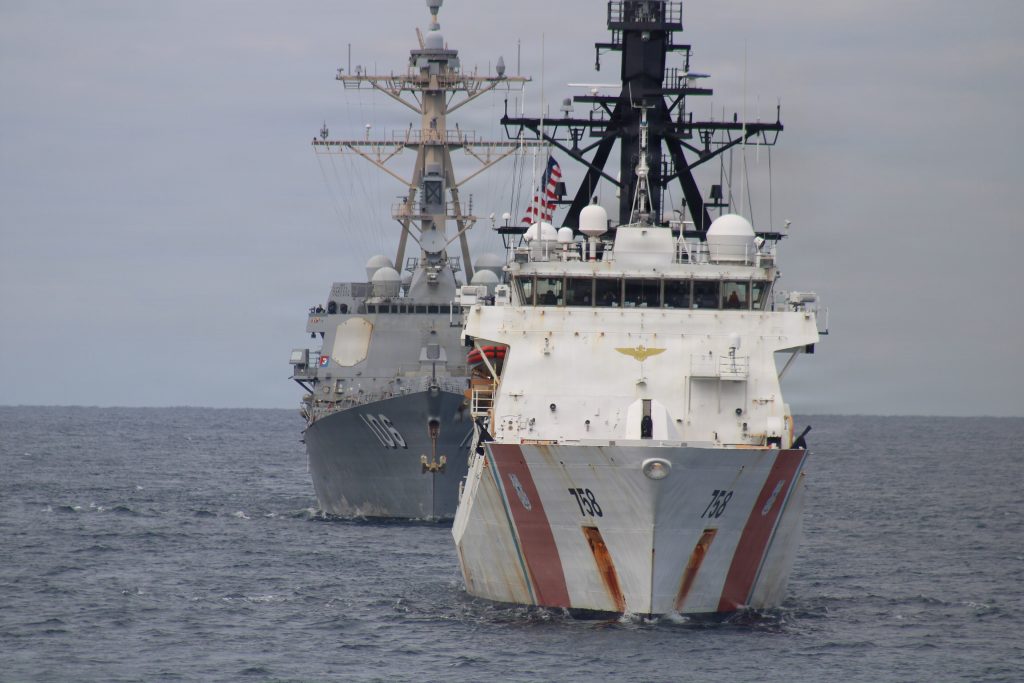
Information Power: Exposing the Enemy and Rebuilding Confidence
Narco-terror networks survive in the shadows. They rely on intimidation and corruption, but they also rely on the belief that nothing can stop them. That perception is one of their most powerful weapons.
Operation Southern Spear attacked that advantage by making results visible. When interdictions happen, when routes are exposed, and when consequences are demonstrated, the narrative shifts. The public sees that enforcement is possible. Partner nations see that cooperation works. Traffickers see that their freedom of movement is shrinking.
This isn’t propaganda. It’s strategic messaging backed by action. And it matters because the cartel business model depends on the idea that they are untouchable.
Operations like this prove they are not.
Military Power: Presence, Persistence, and Precision
The military component of Operation Southern Spear is where deterrence becomes real. It’s one thing to announce a mission. It’s another thing to maintain operational tempo and force adversaries to change their behavior.
A persistent presence in the maritime environment changes everything. It compresses timelines, disrupts planning, and increases risk. Traffickers are forced into more desperate routes, riskier transfers, and weaker coordination. Over time, that pressure does more than intercept shipments. It destabilizes the network.
This is the conservative lesson that has been proven over and over again: peace and security don’t come from good intentions. They come from credible capability and the willingness to use it.
Economic Power: Cutting the Money That Fuels the Machine
Drugs are poison, but for cartels they are also profit. Narco-terror networks exist because the revenue is massive and the enforcement risk is often too low.
Operation Southern Spear reinforced a strategy that understands the real center of gravity: the money. When shipments are seized, routes are disrupted, and networks are pressured, profits decline. When profits decline, recruitment weakens. When recruitment weakens, corruption becomes harder to sustain. And when corruption becomes harder to sustain, the network begins to fracture.
This is how you defeat an enemy that is built like a business. You don’t negotiate with it. You bankrupt it.
Systematic Targeting: The Cartels Aren’t Being “Managed.” They’re Being Dismantled.
The most important aspect of Operation Southern Spear is that it reflects systematic disruption rather than reactive enforcement. Narco-terror networks depend on more than smugglers with boats. They rely on financiers, facilitators, corrupt officials, transshipment hubs, safe routes, and predictable timing.
When you apply pressure across that entire system, the network begins to collapse under its own weight. It becomes harder to move product, harder to coordinate, harder to launder money, and harder to trust internal actors who may be compromised or desperate.
That is what real strategy looks like.
Not random seizures. Not symbolic enforcement. But deliberate dismantling of the enemy’s operational capacity.
Why You Should Support This Mission
Operation Southern Spear reflects a return to first principles. A nation has a responsibility to protect its citizens. It has an obligation to defend its approaches. And it cannot allow hostile criminal networks to operate freely in the hemisphere while Americans pay the price in overdose deaths, violence, and instability.
This mission also proves something many Americans have wanted to see again: competence. Coordination. Purpose. Strength. It shows that the United States can still act decisively, still lead coalitions, and still impose consequences on those who threaten American safety.
Narco-terror organizations have spent years betting that America was too distracted, too divided, and too hesitant to respond with sustained force.
Operation Southern Spear proves that bet was wrong.
The Bottom Line: This Is What National Defense Looks Like
Operation Southern Spear isn’t about optics. It’s about outcomes. It’s about denying traffickers the routes they rely on and dismantling the networks that profit from American suffering.
It sends a clear signal: the United States is no longer content to absorb the damage and debate the problem afterward. We are taking the fight to the source, applying national power with purpose, and restoring deterrence where it has been absent for far too long.
And if we remain committed and keep pressure on the routes, the money, and the leadership, Operation Southern Spear won’t just be a successful mission. It will be a turning point.

_____________________________
Sergeant Major (Retired) Daniel L. Dodds is a Military Police Senior Noncommissioned Officer. He has served in every leadership position from Patrolman to Battalion Command Sergeant Major. He is currently assigned as the Director of Operations Sergeant Major for the United States Disciplinary Barracks, the only Level III maximum-security prison in the Department of Defense. His civilian education includes an associate’s degree from Excelsior University and a Bachelor of Arts in Leadership and Workforce Development from the Army Command and General Staff College (CGSC). He is pursuing a Master of Public Administration from Excelsior University.
As the Voice of the Veteran Community, The Havok Journal seeks to publish a variety of perspectives on a number of sensitive subjects. Unless specifically noted otherwise, nothing we publish is an official point of view of The Havok Journal or any part of the U.S. government.
Buy Me A Coffee
The Havok Journal seeks to serve as a voice of the Veteran and First Responder communities through a focus on current affairs and articles of interest to the public in general, and the veteran community in particular. We strive to offer timely, current, and informative content, with the occasional piece focused on entertainment. We are continually expanding and striving to improve the readers’ experience.
© 2026 The Havok Journal
The Havok Journal welcomes re-posting of our original content as long as it is done in compliance with our Terms of Use.


