Volume 2, Issue 6
If you served in the military no matter what branch of service you were in, you learned at some point the importance of having space to maneuver. Whether you were maneuvering pairs of boots, a tank, a ship, or a fighter jet, having adequate physical space was essential to executing maneuver smoothly and safely. Likewise, when we encounter challenges in life, our minds need maneuver space to mentally negotiate difficult moments. This series will highlight each month a different brief cognitive tool that you can use in your daily life to potentially create more maneuver space. Remember having maneuver space, or space to think, is a gift in life. Once you create it, use it to your advantage!
Past, Present, Future
Victor Frankl once stated, “Between stimulus and response there is a space. In that spaceis our power to choose our response. In our response lies our growth and our freedom.”[1] Perhaps the challenge to achieving this is that as humans, we often struggle to keep our minds in the present. Military members and Veterans certainly struggle with this also, impacted by traumas from their past military service and potential fears of an uncertain, fearful, and potentially hopeless future. We forget that we have choice, constantly stuck in past ruminations, or pushed forward into future anxieties. This makes it very hard to maneuver mentally, particularly when there are triggers in the present moment that make us feel even less in control.
Humans Struggle to Live in the Moment
Frequently, those that experience the symptoms of Post Traumatic Stress Disorder (PTSD) often feel their past seems to be in the present, where unprocessed memories are the basis for negative responses, attitudes, and behaviors. These stored memories can also create rigid perceptions of our present. Likewise, looking into the future consciously and unconsciously, is a central function of our brain and often referred to as prospection. Prospection enables us to become wise not just from our own experiences, but also by learning from others. While some are able to be optimistic, those that suffer from depression or anxiety often have a hopeless or bleak view of the future.[2] The below is a possible model to further illustrate why living in the moment is a struggle for many.
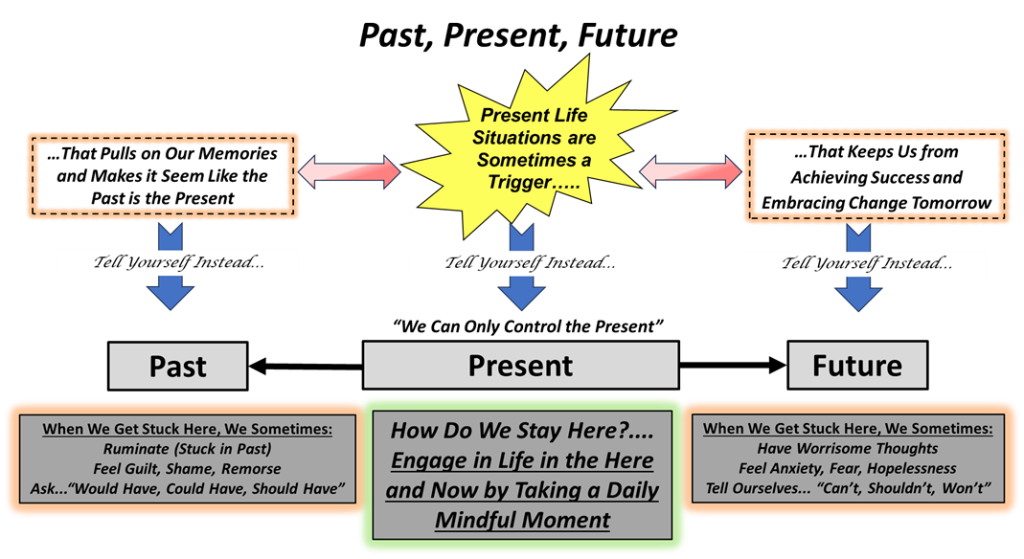
Engage in Life in the Here and Now by Taking a Daily Mindful Moment[3]
Here and now awareness can be seen as paying attention nonjudgmentally, on purpose, in the present moment. A mindful moment invites us to briefly pause our busy daily lives as an opportunity to make a wise choice instead of a mindless reaction. As you tune into what’s happening right here right now, your thoughts, emotions, and sensations become clearer. The body and mind begin to relax and from this quieter place, you have more strength to choose a response aligned with your values. Three simple techniques to help achieve a daily mindful moment include:
- STOP: Stop, Take a Breath, Observe, Proceed
- PNC: Pause, Notice, Choose
- 3 C’s: Catch It, Check It, Change It
Work on Present Awareness Fundamentals, Then Mastery
As we become more aware of the present, we start to feel more comfortable with the fundamentals of awareness. These have been around for ages and are linked commonly to all humanity. We receive a lot of training in life on how to think, just remember the many years you went to school, yet we get very little training on how to be aware. As we begin to master awareness, we may notice that we can shift from awareness of our thoughts to full body awareness. Perhaps we can even then search for the center and periphery of our own awareness.[4] Present awareness builds mental maneuver space, and the clarity it brings helps us confront daily challenges with poise and control.
About the Author: Mr. Bongioanni is a licensed mental health counselor who alsoworks for the U.S. Department of Veterans Affairs. He is also a senior leader in the U.S. Army Reserve. His professional interests include human behavior, applied psychology, and military cultural competence. The views expressed are those of the author and do not necessarily reflect the official policy or position of the U.S. Department of Veterans Affairs, the U.S. Department of Defense, or the U.S. Government.
[1] Viktor E. Frankl Quotes. (n.d.). BrainyQuote.com. Retrieved July 12, 2024, from BrainyQuote.com Web site: https://www.brainyquote.com/quotes/viktor_e_frankl_160380
[2] Seligman, M. and Tierney, J. We Aren’t Built to Live in the Moment. The New York Times, May 19th, 2017. https://www.nytimes.com/2017/05/19/opinion/sunday/why-the-future-is-always-on-your-mind.html
[3] U.S. Department of Veterans Affairs District of Columbia (DC) War Related Illness and Injury Study Center, Integrative Health and Wellness Mindfulness Exercise. Retrieved from https://www.warrelatedillness.va.gov/WARRELATEDILLNESS/clinical/integrative-health/dc/Mindful-Pause-Tool.pdf July 12th, 2024.
[4] Kabat-Zinn, J. (Mar 27, 2015). The Power of Mindfulness as Practice: Making It Real Right Now. PESI. https://catalog.pesi.com/item/the-power-mindfulness-practice-making-real-jon-kabatzinn-11793#tabDescription
As the Voice of the Veteran Community, The Havok Journal seeks to publish a variety of perspectives on a number of sensitive subjects. Unless specifically noted otherwise, nothing we publish is an official point of view of The Havok Journal or any part of the U.S. government.
Buy Me A Coffee
The Havok Journal seeks to serve as a voice of the Veteran and First Responder communities through a focus on current affairs and articles of interest to the public in general, and the veteran community in particular. We strive to offer timely, current, and informative content, with the occasional piece focused on entertainment. We are continually expanding and striving to improve the readers’ experience.
© 2026 The Havok Journal
The Havok Journal welcomes re-posting of our original content as long as it is done in compliance with our Terms of Use.


