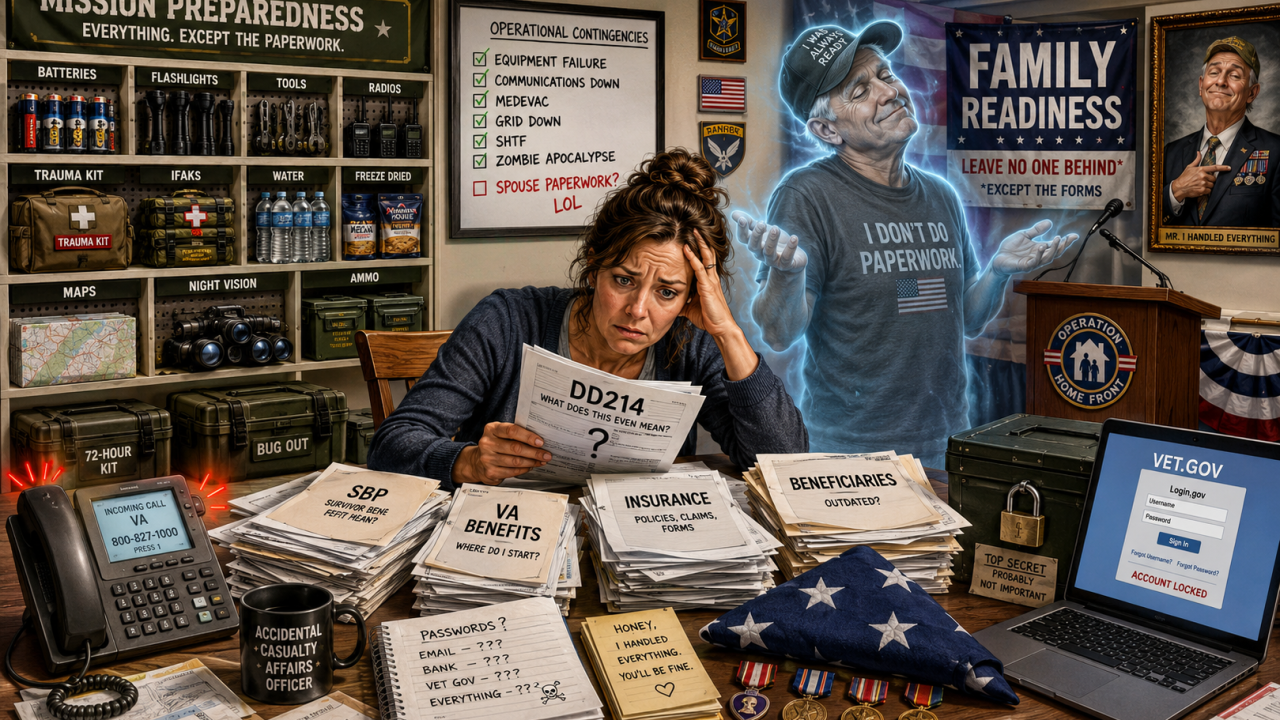
Veterans love readiness. They label cables, rotate supplies, memorize obscure acronyms, and keep enough batteries to power a minor coup. Some of them can still describe the location of a trauma kit in a vehicle they sold twelve years ago.
Then they die and leave their spouse a shoebox containing an expired ID card, two unusable passwords, a mysterious key, and a DD214 last observed during the second Bush administration.
Outstanding work, operator.
Here’s the uncomfortable truth: plenty of veterans are more prepared for a flat tire in rural Wyoming than for the administrative consequences of their own death. Some call this privacy, independence, or “I handle that stuff.” Your family will call it Wednesday afternoon at the dining-room table, crying into a pile of federal forms while trying to determine whether “SBP” is money, a disease, or a satellite.
Grief is a terrible project manager. It forgets passwords. It loses marriage certificates. It can’t remember which insurance company bought the other insurance company. It has no patience for websites that ask for an account created in 2014 and secured with the name of a childhood pet nobody liked.
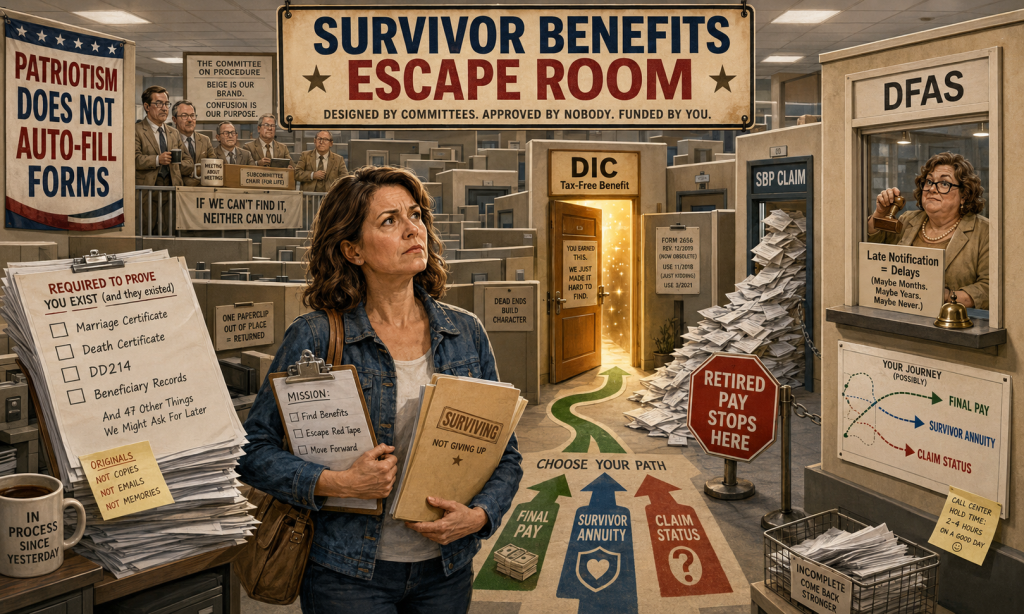
Meanwhile, survivor benefits don’t show up by patriotic instinct. VA Dependency and Indemnity Compensation may provide tax-free payments to eligible survivors. Military retired pay stops when the retiree dies, while Survivor Benefit Plan coverage requires its own claim. DFAS warns that late notification can delay final pay and survivor annuities. The government has built real benefits, then hidden them inside a procedural escape room designed by committees that consider beige a personality.
The veteran community talks endlessly about “taking care of our own.” But sometimes “our own” means everyone except the person who shares our mortgage and will someday have to identify our pension administrator from a faded deduction on an old bank statement.
The solution is painfully simple: create a survivor-ready file. Give it an unmistakable name, such as “WHEN I BECOME PERMANENTLY UNAVAILABLE FOR COMMENT.” Keep one physical copy in a secure place and one encrypted digital copy. Tell two trusted adults where it is. Mystery has its place. Your household finances aren’t that place.

The file needs six sections:
- Service proof. Include the DD214, retirement orders, VA claim number, current disability decision letters, and contact information for a trusted accredited veterans service officer. The National Archives explains how veterans and next of kin can request military records, but obtaining them while alive is considerably less theatrical.
- Family proof. Add marriage, divorce, birth, adoption, and prior death documents that could affect eligibility. Bureaucracies adore proof almost as much as they adore asking for proof they already possess.
- Benefit map. List VA compensation, military retirement, SBP election, TSP, Social Security, life insurance, pensions, and employer benefits. Include account identifiers, official contact pages, and the names of beneficiaries. The TSP warns that an old beneficiary designation may survive divorce and remarriage, because paperwork has the emotional intelligence of a parking meter.
- Legal and medical instructions. Include the will, advance directive, executor information, attorney contact, burial wishes, and any pre-need cemetery decision. VA already publishes a Survivors and Burial Benefits Kit specifically for planning and record storage. Download it, complete it, and place it where your family can find it without excavating the garage.
- Money map. List banks, debts, recurring charges, property, vehicles, and where tax records live. Never scatter raw passwords across paper like birdseed. Use a reputable password manager with emergency-access instructions and make sure the designated person understands the process before the emergency.
- First-call sheet. Put one page on top naming the first contacts: funeral home, VA, DFAS for retirees, Social Security, insurance carriers, employer or pension office, attorney, and veterans service officer. Social Security maintains a dedicated page explaining death reporting and survivor benefits.
Then conduct an annual ten-minute drill. Hand the file to your spouse or trusted person and ask three questions: Can you locate the DD214? Can you identify every major benefit? Do you know the first three calls? Any answer involving guessing means the plan has failed inspection.
Update the file after marriage, divorce, a birth, a death, a move, a new rating, retirement, or a major account change. Review beneficiaries every year. A will cannot rescue every stale beneficiary designation, and affection is a poor filing system.
This isn’t morbid. Morbid is leaving someone you love to discover, during the worst week of their life, that your administrative philosophy was “the information exists somewhere.”
Veterans understand continuity of operations. They understand succession, redundancy, and the danger of keeping essential knowledge inside one person’s head. Apply that wisdom at home. The final act of service may be a labeled folder, a current beneficiary form, and the humility to admit that dying doesn’t make your paperwork somebody else’s fault.

- VA, Planning Your Legacy: VA Survivors and Burial Benefits Kit
https://benefits.va.gov/BENEFITS/docs/VASurvivorsKit.pdf - VA, Dependency and Indemnity Compensation
https://www.va.gov/family-and-caregiver-benefits/survivor-compensation/dependency-indemnity-compensation/ - VA, Burial Benefits and Memorial Items
https://www.va.gov/burials-memorials/ - DFAS, Report a Retiree’s Death
https://www.dfas.mil/retiredmilitary/survivors/retiree-death/ - National Archives, Request Military Service Records
https://www.archives.gov/veterans/military-service-records - Thrift Savings Plan, Designating Beneficiaries
https://www.tsp.gov/tsp-basics/designating-beneficiaries/ - Social Security Administration, What to Do When Someone Dies
https://www.ssa.gov/personal-record/when-someone-dies
_____________________________
Tammy Pondsmith is the acting Undersecretary for Posthumous Adult Supervision, a federal office she founded after discovering that half the nation’s estate plans consist of a spouse’s first name followed by “she knows where everything is.”
As the Voice of the Veteran Community, The Havok Journal seeks to publish a variety of perspectives on a number of sensitive subjects. Unless specifically noted otherwise, nothing we publish is an official point of view of The Havok Journal or any part of the U.S. government.
Buy Me A Coffee
The Havok Journal seeks to serve as a voice of the Veteran and First Responder communities through a focus on current affairs and articles of interest to the public in general, and the veteran community in particular. We strive to offer timely, current, and informative content, with the occasional piece focused on entertainment. We are continually expanding and striving to improve the readers’ experience.
© 2026 The Havok Journal
The Havok Journal welcomes re-posting of our original content as long as it is done in compliance with our Terms of Use.


