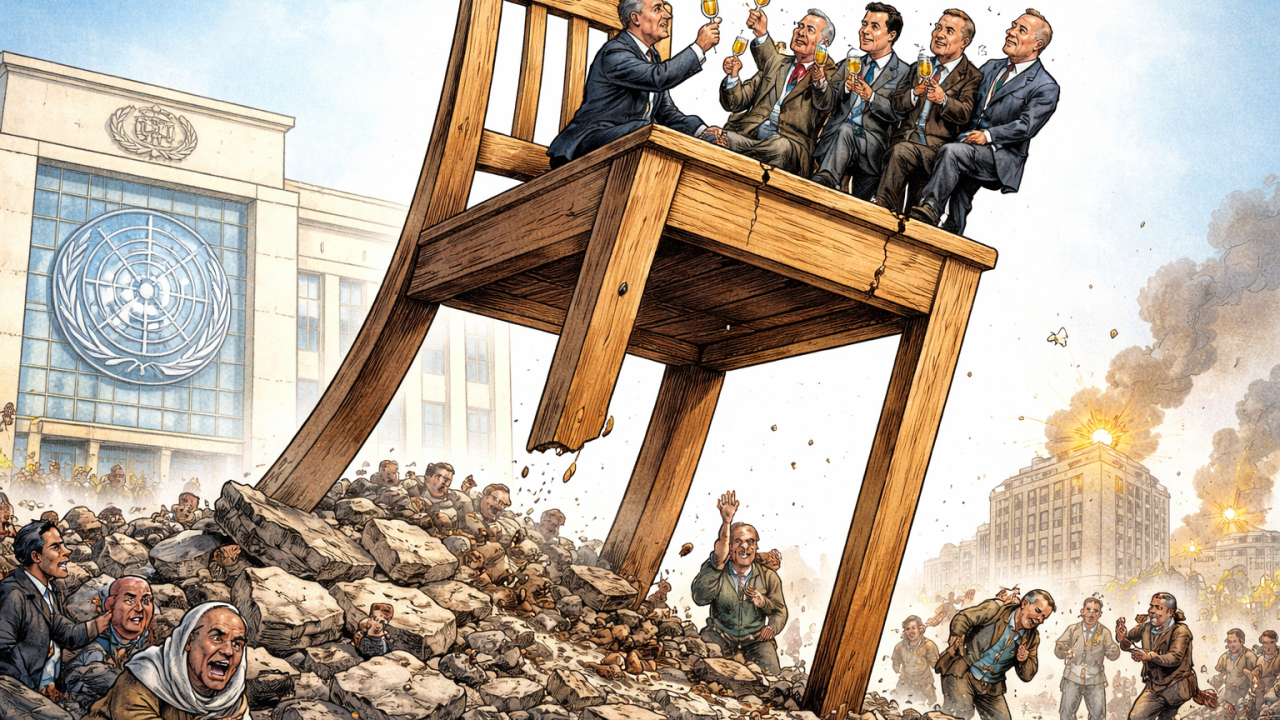
There’s a giant broken chair sitting outside the United Nations in Geneva, and for once public art accidentally told the truth. One leg blown off, still standing, permanently posing as stability. You could not design a better emblem for the UN if you locked a committee of cynical sculptors in a room with a grant budget and three bottles of Swiss wine.
The central lie of the United Nations is not that it fails. Of course it fails. Everything made by governments fails eventually, usually after first issuing a statement about its commitment to excellence. The real lie is the branding. The UN presents itself as the conscience of the international order when it is, in practice, a velvet rope around the crime scene. It does not restrain power so much as choreograph it. It gives empire a podium, tyranny a translation headset, and mass death the dignity of procedural review.
That’s why the place is so infuriating. It was founded on a genuinely sane premise. After the world turned itself into a charnel house, maybe countries should talk before setting continents on fire again. Fine. Sensible. Civilized, even. If you’ve just survived a global bloodbath, “let’s try meetings” is not the dumbest instinct humanity has ever had. The problem is that the mechanism built to prevent catastrophe was wired, right from the start, to flatter the strongest arsonists in the room.
Enter the Security Council, that exquisite museum piece where world history goes to die under antique management. Five permanent members, each armed with a veto, because apparently the future of seven billion people should remain hostage to a seating arrangement frozen sometime between the death of fascism and the invention of decent kitchen appliances. It’s a marvelous system if your goal is to ensure that no serious collective action survives contact with the strategic preferences of a major power. It’s less compelling if you were hoping for justice, consistency, or any recognizable adult supervision.
The veto is always described in sober institutional language, which is adorable. As if this were a constitutional mechanism rather than the standing right of five states to inform the rest of the planet that law is for other people. One raised hand and the whole apparatus jams. Not because the facts are unclear. Not because the bodies aren’t real enough. Because someone powerful has an ally to protect, a client to indulge, a proxy to preserve, or an old imperial twitch flaring up under the diplomatic tailoring. It is the geopolitical equivalent of appointing five habitual drunk drivers to run traffic safety and then acting surprised when the guardrails keep getting hit.
So the ritual repeats. Atrocity. Emergency session. Grave little faces. Language about concern, restraint, escalation, norms. Always norms. The international class loves “norms” because it sounds so much cleaner than “we’re not going to stop this.” Then the speeches begin, that endless pageant of moral cosmetics. Countries with civilian blood on their own hands lament civilian blood. Occupiers discover the sanctity of sovereignty when occupied by criticism. Democracies suddenly find nuance when their bombs are involved. Autocracies become experts in legal principle the minute it is useful as a stick to poke somebody else with. Everybody arrives draped in civilization and leaves having defended the ancient right of power to do whatever it can get away with.
And yet, maddeningly, the UN is not useless. That’s the part people hate because it ruins the cleaner fantasy. It would be satisfying if the whole thing were just a chandeliered fraud staffed by multilingual undertakers. But no. Buried underneath the ceremonial hypocrisy are agencies doing work that matters. Vaccines get delivered. Refugees get fed. Disease outbreaks get tracked. Children get immunized. Cultural heritage gets protected from war and looting and fanatic idiots with explosives. The institution is ridiculous at the top and necessary in the plumbing. It is a sanctimonious casino built over an emergency room.
Which is why the usual arguments about it are so stupid. The pious defenders talk as if criticizing the UN is an assault on peace itself. Please. Peace does not become more real because a Norwegian diplomat says “multilateral framework” in a room with good lighting. Then the opposite camp talks as if the answer is to sneer at the whole edifice and let raw power dispense with the costume. That’s not realism. That’s just cutting the oxygen line because you’ve noticed the hospital administrator is corrupt.
The truth is nastier and less convenient. The UN is indispensable precisely because the world is run by governments that cannot be trusted with anything important. It remains necessary not because it has solved the problem of power, but because it is one of the few places where power still has to put on pants before entering the room. Yes, those pants are often on fire. Yes, the room stinks of hypocrisy. But there are moments when delay matters, when inspection matters, when aid corridors matter, when a dull report with careful numbers matters more than another thunderous speech from some patriotic imbecile auditioning for history.
People love calling for reform, and fair enough. Expand the council. End the veto. Drag the institution out of its postwar amber and into the century it keeps pretending to govern. Lovely ideas. The only catch is that reform requires the consent of the powers whose privilege would be reduced by reform. So what we really have is an eternal symposium on the need to fix a system overseen by the very men most invested in keeping it broken. They’ll schedule a panel on courage right after lunch.
So there sits the broken chair, which has more honesty in its missing leg than most of the building across from it. The United Nations is not the guardian of world order. It is the stage set where world order explains itself while standing ankle-deep in rubble. Necessary, compromised, faintly absurd, and still somehow preferable to letting the same predators dispense with the pretense altogether. That’s the joke. The world’s great peace institution cannot reliably stop war. It can only document the blast radius, hand out blankets, and ask the men holding the matches whether they’d care to comment.
_____________________________
Tammy Pondsmith is a geopolitical irritant, black-belt eye-roller, and unlicensed custodian of elite delusions who once got thrown out of a think tank for asking whether “rules-based order” was just Latin for “because we said so.”
As the Voice of the Veteran Community, The Havok Journal seeks to publish a variety of perspectives on a number of sensitive subjects. Unless specifically noted otherwise, nothing we publish is an official point of view of The Havok Journal or any part of the U.S. government.
Buy Me A Coffee
The Havok Journal seeks to serve as a voice of the Veteran and First Responder communities through a focus on current affairs and articles of interest to the public in general, and the veteran community in particular. We strive to offer timely, current, and informative content, with the occasional piece focused on entertainment. We are continually expanding and striving to improve the readers’ experience.
© 2026 The Havok Journal
The Havok Journal welcomes re-posting of our original content as long as it is done in compliance with our Terms of Use.


