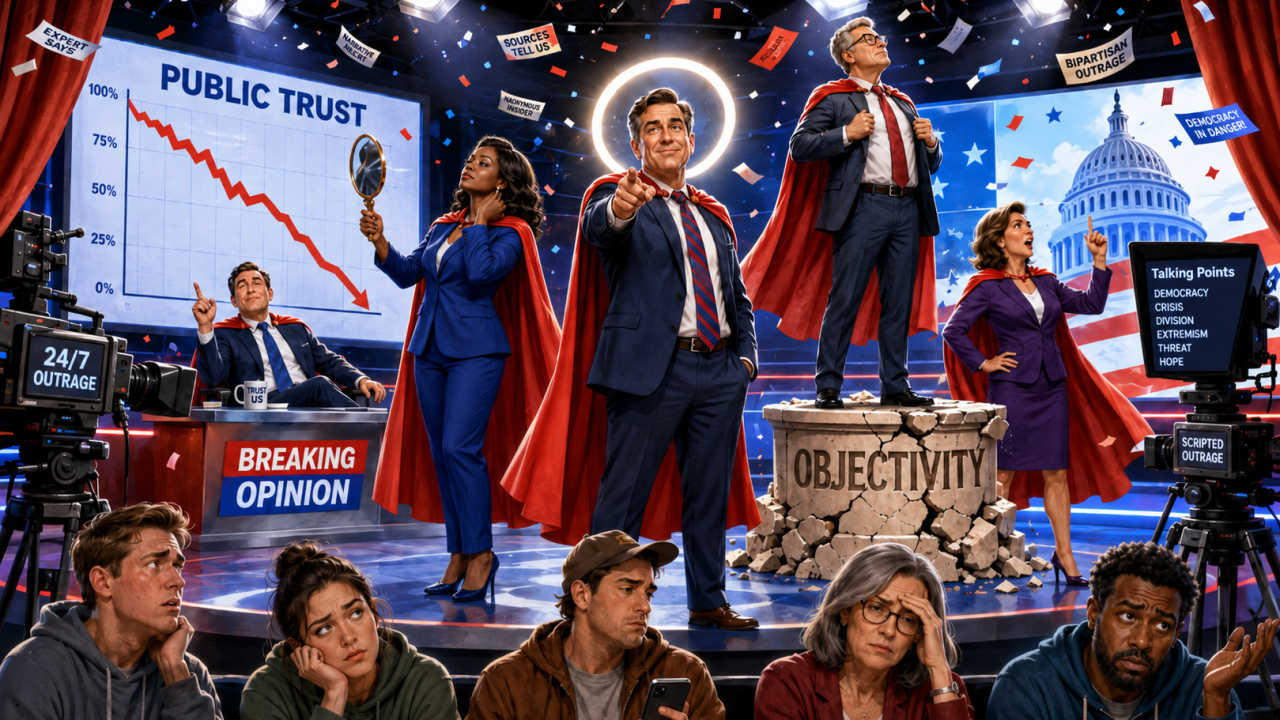
There was a time when a television journalist’s job was to tell viewers what happened, explain what could be verified, and then resist the overpowering biological urge to stare into Camera Two like democracy had personally chosen them for the final round of American Idol.
That era apparently ended when political reporters discovered that solemn facial expressions could be converted into book deals, speaking fees, cable contracts, and enough social-media applause to power a small coastal republic.
Today’s prestige political press has developed the self-awareness of a peacock trapped inside a mirrored elevator. Its stars don’t merely cover the national drama. They audition for sainthood during every commercial break. They speak of “protecting democracy” with the hushed gravity of battlefield surgeons, except battlefield surgeons generally don’t pause halfway through an operation to check whether their monologue is trending.
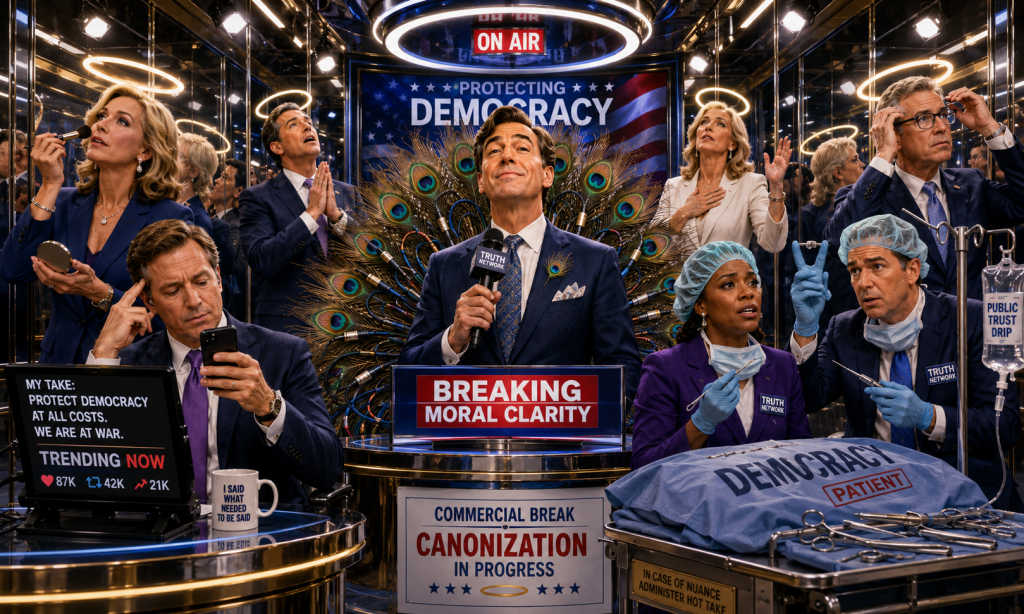
Here’s the uncomfortable part. Donald Trump didn’t create this condition. He exposed it, fed it, mocked it, exploited it, and gave it excellent ratings. Plenty of his statements deserved ruthless scrutiny. Plenty still do. Yet scrutiny became obsession, analysis became liturgy, and reporters who once claimed neutrality began performing emotional weather reports from inside their own nervous systems.
The result wasn’t courageous journalism. It was political theater wearing a press credential and asking to be thanked for its service.
Americans noticed. Gallup reported in 2025 that trust in mass media had fallen to 28 percent, the lowest level in its polling history. That isn’t a small public-relations bruise. That’s the audience filing for emotional separation and leaving the newsroom the commemorative tote bag.
Naturally, many media personalities responded to this collapse with the intellectual curiosity of a parking boot. They concluded the public had become ignorant, manipulated, authoritarian, or mysteriously allergic to excellence. It rarely occurred to them that viewers might object to being lectured by people who confuse sharing their politics with possessing superior eyesight.
The phrase “I’m independent, but I see things clearly” is especially adorable. It’s the journalistic equivalent of saying, “I don’t belong to a religion, but God keeps forwarding me His talking points.” When every conclusion lands exactly where one political tribe was already standing, independence starts looking less like a principle and more like a novelty mustache.
And yes, conservative media has its own carnival barkers, partisan mascots, professional grievance merchants, and those who appear to have been assembled entirely from cuff links and unresolved custody disputes. The difference is that much of conservative media admits it has a viewpoint. The prestige press still wants to sell ideological advocacy in a package labeled “plain sparkling fact,” then becomes wounded when customers read the ingredients.
That distinction matters. Opinion isn’t a contaminant. Hidden opinion is. Advocacy can be honorable. Advocacy disguised as neutral reporting is a confidence trick with a chyron.
So how does journalism crawl out of the crater it keeps calling a studio?

First, label everything honestly. News, analysis, commentary, advocacy, and speculation should be unmistakable at a glance. Trusting News specifically recommends making opinion content easy for casual readers to identify. Apparently, this revolutionary technology is called telling people what they’re reading.
Second, publish a visible corrections record. Don’t quietly replace a paragraph at 2:13 a.m. and pretend the factual fairy handled it. State what was wrong, who corrected it, when it changed, and how the error happened. Research-backed newsroom guidance recommends public corrections policies and consistent disclosure. Accountability becomes believable when it leaves a paper trail.
Third, disclose conflicts and biographies that matter. If a commentator worked for an administration, campaign, party, lobbying shop, activist group, or ideological institution, place that fact beside the segment. Viewers can handle context. What they can’t handle forever is discovering context after someone has spent six months impersonating an untouched mountain spring.
Fourth, show the reporting. Link source documents. Explain how claims were verified. Publish interview transcripts when practical. Identify what remains unknown. The American Press Institute has long argued that transparency about sourcing, methods, and editorial decisions helps establish credibility. Mystery may sell perfume. It’s a disastrous operating system for journalism.
Fifth, hire editors whose main qualification isn’t nodding at the same dinner parties. A newsroom without serious ideological disagreement becomes a terrarium. Everyone inside thinks the climate is normal because they’re all breathing the same expensive fog.
Finally, stop treating criticism as an attack on democracy. The Society of Professional Journalists says ethical journalism should be accurate, fair, thorough, accountable, and independent. Those standards aren’t harassment. They’re the job description.
A free press is indispensable. A self-worshipping press is exhausting. Journalists don’t need to become timid, polite, or bipartisan wallpaper. They need to become precise, transparent, skeptical of power, and equally skeptical of the flattering little voice telling them they are power’s heroic opposite.
The public doesn’t owe the media trust. The media owes the public conduct worthy of it.
And veterans should care especially because people who’ve actually served under consequential orders understand that inflated rhetoric, selective facts, and institutional vanity can cost far more than a television host’s dignity.

Tammy’s Suggested Reading for People Who Prefer Evidence to Cable-News Aromatherapy
- Gallup, Trust in Media at New Low of 28% in U.S.
https://news.gallup.com/poll/695762/trust-media-new-low.aspx - Pew Research Center, Americans’ Views of 2024 Election News
https://www.pewresearch.org/journalism/2024/10/10/americans-views-of-2024-election-news/ - Associated Press and AP-NORC, News Organizations Have Trust Issues
https://apnews.com/article/18235eaef4fdfbdc9c1f7e8693744b21 - Society of Professional Journalists, SPJ Code of Ethics
https://www.spj.org/spj-code-of-ethics/ - Trusting News, Corrections
https://trustingnews.org/trustkits/corrections/ - Trusting News, Opinion
https://trustingnews.org/trustkits/opinion/ - American Press Institute, How Publishers Should Build Credibility Through Transparency
https://americanpressinstitute.org/transparency-credibility/
_____________________________
Tammy Pondsmith is a semiretired etiquette consultant who was banned from three cable-news greenrooms after demonstrating that a panel of paid narcissists could survive six consecutive minutes without interrupting one another, pronouncing the republic terminal, or confusing a basic-cable booking with a summons to defend Cicero before the Continental Congress.
As the Voice of the Veteran Community, The Havok Journal seeks to publish a variety of perspectives on a number of sensitive subjects. Unless specifically noted otherwise, nothing we publish is an official point of view of The Havok Journal or any part of the U.S. government.
Buy Me A Coffee
The Havok Journal seeks to serve as a voice of the Veteran and First Responder communities through a focus on current affairs and articles of interest to the public in general, and the veteran community in particular. We strive to offer timely, current, and informative content, with the occasional piece focused on entertainment. We are continually expanding and striving to improve the readers’ experience.
© 2026 The Havok Journal
The Havok Journal welcomes re-posting of our original content as long as it is done in compliance with our Terms of Use.


