The modern political poll is no longer a thermometer. It’s a sausage machine wearing a lab coat, grinding assumptions, incentives, and audience flattery into one neat headline, then asking you to admire its scientific posture while stepping over the casing on the floor.
That’s the trick. The public is told that “the country believes” something, when what actually happened is that a particular group of people, selected by a particular method, answered particular questions in a particular order under particular conditions. Then the delicate little footnotes are stuffed into the methodological basement, next to the copier toner and the last remaining intern with a soul.
The central fraud isn’t that polls are always fake. That would be too easy, and sadly, reality prefers paperwork. The problem is that polling is treated as objective revelation when it is often closer to institutional portraiture. Change the frame and you change the face. Survey registered voters instead of all adults. Screen for likely voters instead of people with enough spare time to click through a questionnaire for pocket change. Weight one partisan group differently. Phrase a foreign policy question with “protect American lives” in it and watch the flag unfurl itself in the respondent’s nervous system.

None of that is magic. It’s plumbing. But our media class presents the faucet like it discovered water.
This is how respectable manipulation works now. Nobody needs to forge ballots in a smoky room. Too crude. Too sweaty. Instead, you hire professionals, publish charts, use a sober font, and let the headline do the mugging. “Voters Sour on X.” “Public Rejects Y.” “Support Collapses for Z.” By the time anyone reads the methodology, assuming it’s even readable without a lantern and a graduate certificate in statistical archaeology, the talking point has already put on a tie and booked cable hits.
And everyone involved gets to feel clean. The pollster says the crosstabs were available. The newsroom says it merely reported the findings. The pundit says it was following the data. The politician says the people have spoken. Lovely. A four-car pileup where every driver claims to be the weather.
The deeper sickness is that institutions have learned to hide judgment inside procedure. They don’t say, “We prefer this narrative.” They say, “Our model indicates.” They don’t say, “We asked a weirdly convenient group of people.” They say, “A representative sample.” Representative of what, exactly? The nation? The electorate? The chronically online? The bored? The unemployed lunch break? The sacred order of people who answer unknown numbers?
If you want to know whether Americans approve of a president, a war, an economic plan, or Congress, the first question should not be, “What’s the number?” It should be, “Who got counted?” Second: “Who got diluted?” Third: “Who benefits from the headline?” That little sequence would improve public literacy more than half the civics curriculum, which currently seems designed to produce citizens who can name three branches of government but can’t spot a rhetorical shiv in a bar graph.
The fix is not to ban polling, or to pretend gut feelings are nobler than data. That’s how you end up governed by vibes, cable rage, and men who say “common sense” right before proposing a bonfire. Polling can be useful. It can reveal real shifts. It can puncture elite fantasies. It can warn politicians that the public is not, in fact, thrilled to be lectured by overpaid hall monitors with foundation grants.
But useful tools need rules. First, every poll story should lead with the sample before the result. Not buried, not linked, not hidden in a PDF dungeon. The first sentence should tell readers whether the survey measured adults, registered voters, likely voters, party identifiers, or some magical gumbo of “respondents.” If that ruins the drama, good. Drama is not analysis. It’s journalism wearing a feather boa.
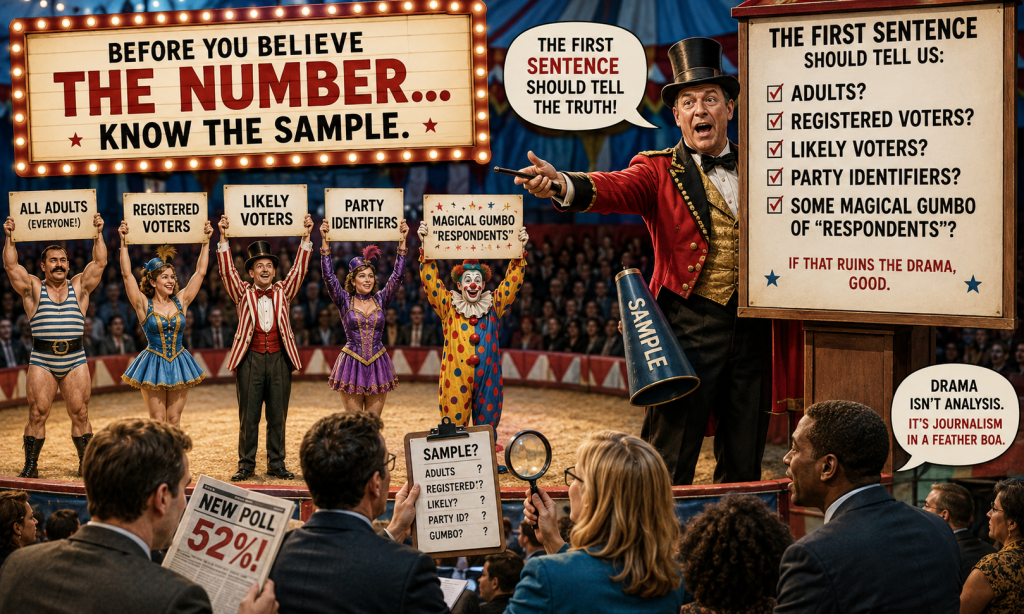
Second, outlets should publish a plain-English credibility label with every poll: sample type, mode, dates, weighting targets, margin of error, sponsor, and exact question wording. Put it in a box near the headline. If a newspaper has room for celebrity divorce timelines and interactive maps of sandwich prices, it has room for the ingredients list on democracy pudding.
Third, stop reporting single polls like divine thunderbolts. One poll is a snapshot. Averages and trends matter more, especially when institutions are asking the public to believe that the national mood has suddenly sprinted into a ditch. Show comparable polls. Explain differences in sample design. Say when a result is an outlier. Adults can handle uncertainty. What they can’t handle is being fed certainty by people who confuse confidence with honesty.
Fourth, disclose partisan and financial incentives without coy little winks. A campaign poll is not automatically worthless, and a media poll is not automatically holy. But both come from institutions with interests. Pretending otherwise is how grown people end up worshiping spreadsheets with donor fingerprints on them.
Finally, pundits should be required, by decency if not law, to stop saying “Americans believe” when they mean “our preferred slice of respondents, after adjustment, produced a useful number.” It’s less punchy, sure. So is the truth. The truth rarely comes with theme music.
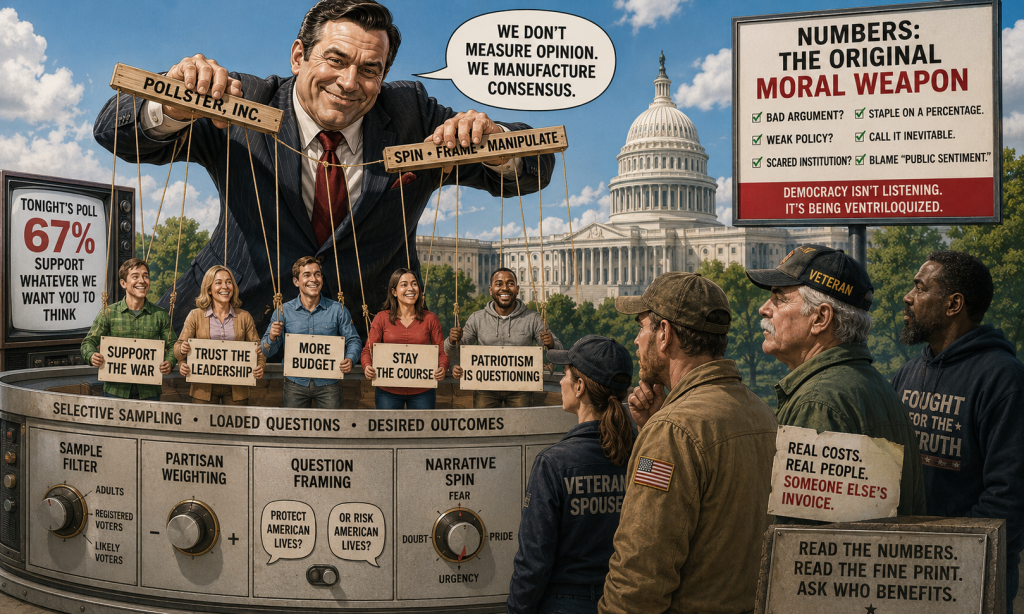
The polling racket matters because numbers have become moral weapons. A bad argument can survive if someone stapled a percentage to it. A weak policy can be sold as inevitable if a chart nods along. A frightened institution can launder cowardice through “public sentiment” and call it responsiveness. That’s not democracy listening. That’s democracy being ventriloquized by a focus group with a press badge.
So read the numbers. Then read the fine print. Then ask why the fine print was treated like a family shame. Veterans especially should care, because when institutions manipulate public opinion about war, sacrifice, and national resolve, it’s usually somebody else’s kid, spouse, or former squad mate who gets volunteered to pay the invoice.
_____________________________
Tammy Pondsmith is the Chief Contempt Officer at the Bureau of Unpaid Reality Checks, where she studies how powerful adults turn cowardice into policy and invoice the public for the stationery.
As the Voice of the Veteran Community, The Havok Journal seeks to publish a variety of perspectives on a number of sensitive subjects. Unless specifically noted otherwise, nothing we publish is an official point of view of The Havok Journal or any part of the U.S. government.
Buy Me A Coffee
The Havok Journal seeks to serve as a voice of the Veteran and First Responder communities through a focus on current affairs and articles of interest to the public in general, and the veteran community in particular. We strive to offer timely, current, and informative content, with the occasional piece focused on entertainment. We are continually expanding and striving to improve the readers’ experience.
© 2026 The Havok Journal
The Havok Journal welcomes re-posting of our original content as long as it is done in compliance with our Terms of Use.