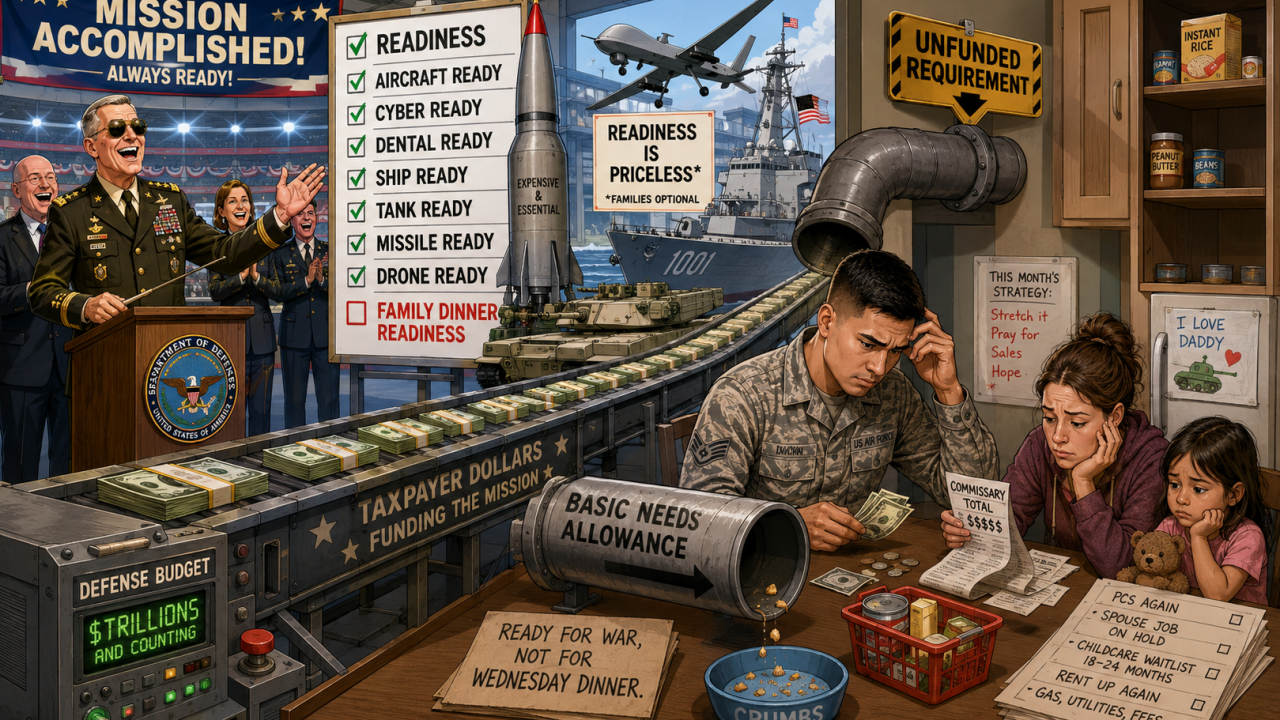
The United States military is obsessed with readiness.
Aircraft readiness. Medical readiness. Cyber readiness. Dental readiness. Physical readiness. Weapons readiness. Personnel readiness. Somewhere in a windowless office, there’s probably a lieutenant colonel measuring stapler readiness against FY27 projected stapling requirements.
But apparently “Can Sergeant Johnson Afford Groceries on Thursday Readiness” remains an emerging concept.
The Military Family Advisory Network’s 2025 Military Family 360° survey collected responses from 10,089 people across the military community. Among currently serving family respondents, 47.2 percent reported food insecurity. Among enlisted-family respondents, the figure was 57 percent. Officer-family respondents came in at 13.7 percent.
Fifty-seven percent.
That’s no longer an awkward anecdote whispered outside the commissary. That’s a number wearing combat boots and kicking the conference-room door open.
We’re talking about families attached to an institution capable of moving an armored brigade across a continent, tracking objects in orbit, operating nuclear submarines for months underwater, and delivering a pallet of precision-guided unpleasantness to somebody’s coordinates from another hemisphere.
Dinner, however, has apparently exceeded logistical capacity.
The Pentagon does provide Basic Allowance for Subsistence. There’s one adorable little administrative detail. Pentagon guidance explicitly says BAS is intended to offset food costs for the service member and isn’t intended to cover meals for family members.
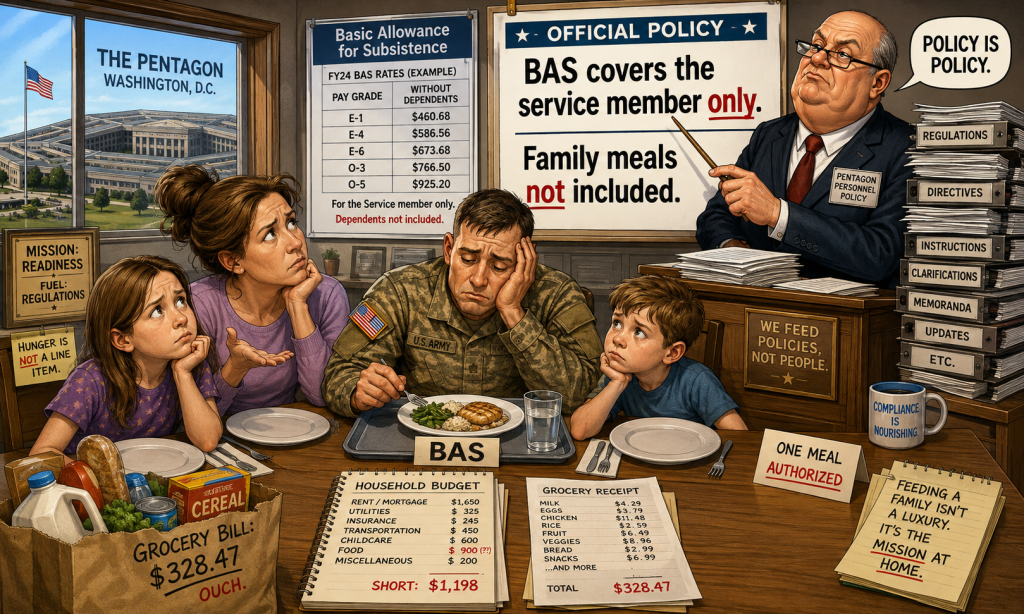
Excellent.
Your spouse and children apparently enlisted in a different branch of biology.
The government also has a Basic Needs Allowance for qualifying low-income active-duty households with dependents. The services screen members for potential eligibility, after which the member may apply. And yes, DFAS says the allowance is taxable income.
America has created a poverty supplement for military families and then found a way to get a little of it back.
That’s efficiency.
The temptation here is to scream, “PAY THE TROOPS MORE,” launch three patriotic memes, and declare strategic victory before lunch.
The real problem is uglier.
RAND examined military food insecurity using earlier Defense Department survey data and estimated a rate around 25 percent in 2018 and 2020. Researchers found higher monthly cash compensation was associated with a reduction in food insecurity, but the estimated effect was small. Differences in demographics and survey screening also failed to explain why reported military food insecurity exceeded civilian rates.
Translation: money matters, because we have heroically discovered groceries remain susceptible to currency, but this isn’t merely a paycheck problem.
It’s a military-life economics problem.
MFAN found that 84.4 percent of its 2025 respondents experienced some level of housing burden. Among active-duty family respondents, 59.3 percent said their monthly housing and utility costs exceeded their Basic Allowance for Housing.
Then there’s military spouse employment.
MFAN reported a 29.9 percent unemployment rate among active-duty spouse respondents seeking work. Among those job seekers, 45.3 percent had experienced a permanent change of station during the previous year.
It turns out repeatedly relocating a household can interfere with careers.
Who knew?
Besides every military spouse since Rome.

A PCS can mean somebody leaves a job, hunts for another one, transfers licenses, finds child care, pays deposits, replaces things movers transformed into abstract sculpture, waits on reimbursements, discovers the local housing market has mistaken itself for Monaco, and begins reconstructing a household while the service member reports to work immediately.
Then we gaze upon the resulting financial instability like archaeologists discovering a mysterious vanished civilization.
Military OneSource itself lists lower enlisted rank, spouse unemployment, lack of child care, recent PCS moves, large families, and financial strain among factors increasing food-insecurity risk.
So perhaps the Pentagon could quit treating these as six unrelated PowerPoint slides.
Here are some ideas radical enough to terrify a working group.
Turn the existing Basic Needs Allowance screening into a pre-populated application requiring minimal additional action from potentially eligible members. If the government already knows enough to identify someone who may qualify, making that person reconstruct the government’s own information should qualify as recreational bureaucracy.
Publish annual BNA numbers showing how many members were screened, notified, applied, qualified, received payments, and dropped out of the process. Programs intended to solve hunger shouldn’t become statistical escape rooms.
Measure PCS costs beyond moving trucks. Track lost spouse income, child-care disruption, temporary housing expenses, reimbursement delays, and other predictable household shocks. Military OneSource already acknowledges PCS and spouse unemployment as risk factors. Start treating them as readiness costs.
Audit BAH against what families actually spend around high-burden installations. If 59.3 percent of active-duty family respondents in MFAN’s survey reported paying beyond their housing allowance for housing and utilities, somebody should investigate the gap before creating another resilience seminar.
And commanders should routinely identify food insecurity through confidential screening, then connect families to assistance without turning the request into a character evaluation. Military OneSource already provides leaders with screening questions and resources. Use them.
Financial education is useful. Budgeting matters. Adults make bad financial decisions.
But you cannot counsel rent downward.
You cannot teach a spouse’s employer to remain conveniently located after a PCS.
You cannot seminar a child into requiring fewer calories.
Food insecurity inside the force is ultimately a readiness problem because a service member worried about groceries, housing, child care, and a spouse’s lost income isn’t magically relieved of those concerns after formation.
The military understands this principle everywhere else. Equipment requires maintenance. Ammunition requires resupply. Vehicles require fuel. Aircraft require parts.
People apparently require another study.
If America wants a professional all-volunteer force, then military family economics cannot remain the household’s private hobby while Washington measures readiness everywhere except the refrigerator.
The Pentagon knows how to feed a war.
It’s time somebody checked whether the corporal’s kids ate too.
References
For readers who prefer their absurdity government-certified, here’s the paperwork:

Military Family Advisory Network, 2025 Military Family 360° Report Executive Summary
https://www.mfan.org/wp-content/uploads/2026/06/2025-MFAN-MilFam360-Report_ExecSummary_Final-1.pdf
RAND Corporation, Military Compensation and Food Insecurity
https://www.rand.org/pubs/research_reports/RRA2923-1.html
Defense Finance and Accounting Service, Basic Needs Allowance
https://www.dfas.mil/MilitaryMembers/payentitlements/bna/
Military Compensation, Basic Allowance for Subsistence
https://militarypay.defense.gov/PAY/allowances/bas.aspx
Military OneSource, Food Security Access for Military Families
https://www.militaryonesource.mil/health-wellness/fitness-nutrition/food-security-access/
_____________________________
Tammy Pondsmith interrogates Pentagon logic, cross-examines acronyms, and keeps one ceremonial fork sharpened whenever readiness enters PowerPoint.
As the Voice of the Veteran Community, The Havok Journal seeks to publish a variety of perspectives on a number of sensitive subjects. Unless specifically noted otherwise, nothing we publish is an official point of view of The Havok Journal or any part of the U.S. government.
Buy Me A Coffee
The Havok Journal seeks to serve as a voice of the Veteran and First Responder communities through a focus on current affairs and articles of interest to the public in general, and the veteran community in particular. We strive to offer timely, current, and informative content, with the occasional piece focused on entertainment. We are continually expanding and striving to improve the readers’ experience.
© 2026 The Havok Journal
The Havok Journal welcomes re-posting of our original content as long as it is done in compliance with our Terms of Use.


