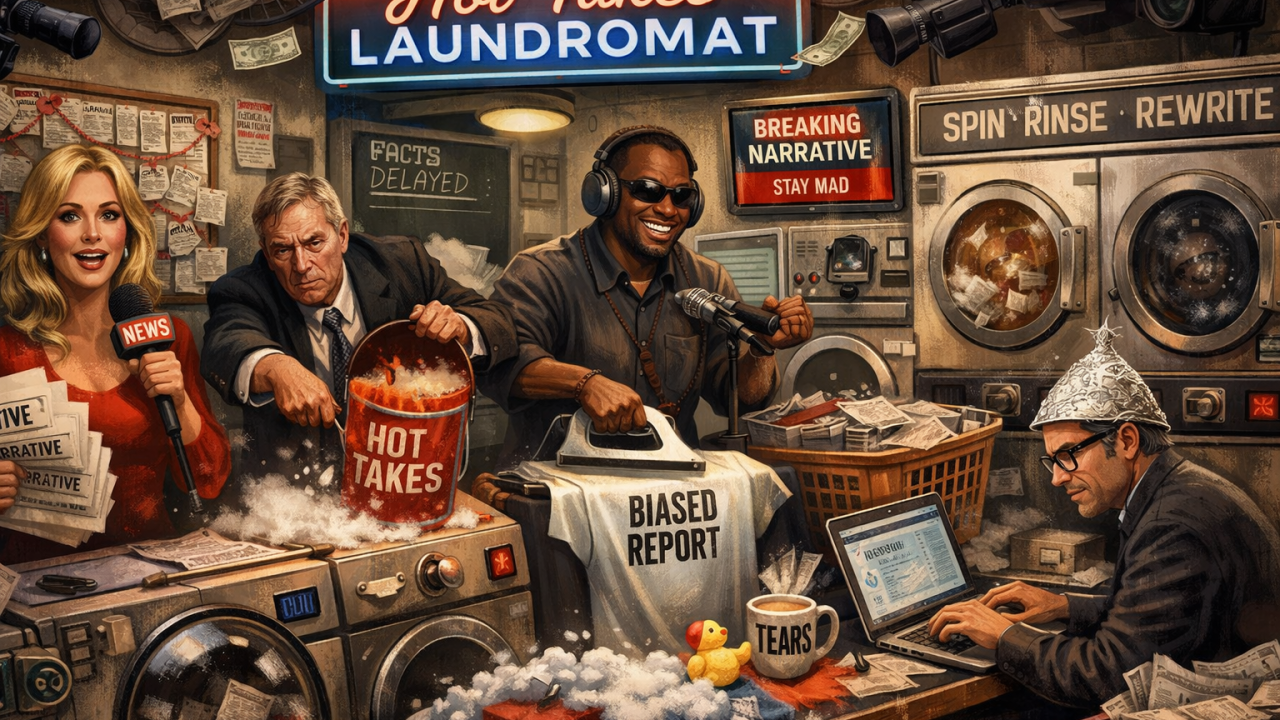
Nothing in modern public life is more impressive than the speed with which allegedly serious people can convert ignorance into certainty. Give them a crisis, a scandal, a war, a market panic, a public health mess, a campus implosion, a technology stampede, and before the dust has time to land on a windowsill, half the ruling class is already on television explaining that events have vindicated whatever they planned to say anyway. Facts arrive later, like interns carrying coffee for a meeting that has already gone wrong.
That is the real pathology. We do not have an information problem nearly as much as we have an incentive problem. Whole institutions now exist to reward emotional usefulness over accuracy. The job is not to find out what happened. The job is to make sure what happened can be fitted, quickly and with a solemn face, into the approved moral screenplay. If reality cooperates, terrific. If not, reality is encouraged to sit quietly in the corner until the panel discussion is over.
The contemporary expert class does not analyze events. It auditions loyalties. Every emergency becomes a Rorschach test for factional appetite. People aren’t asking, “What do we know? What remains uncertain? What would count as evidence that I’m wrong?” They’re asking the only question that matters in decadent institutions: “Who gets credit if this succeeds, and who can I blame if it fails?” From there the rest writes itself. Analysis becomes costume jewelry for motives too grubby to wear in public.

And this is why so many “informed” people sound deranged during fast-moving events. They are not actually reacting to the event. They are reacting to the possibility that the event might benefit the wrong people. That’s what gives the whole performance its overheated, twitchy, end-of-civilization flavor. The panic is often less about danger than about authorship. The nightmare is not merely that something bad might happen. It is that something effective might be done by someone they already despise, which in elite circles is considered much worse than failure. Failure can be managed. Failure keeps the right committees funded. Success by the wrong tribe is an unforgivable theological error.
So the same people who claim to worship data suddenly develop an intense spiritual attachment to vibes. The same institutions that preach standards turn into mood rings with office space. “We need context” means “Please stall until our preferred storyline is assembled.” “This raises troubling questions” means “I hate where this is going.” “Experts warn” usually means three people from the same professional petting zoo have agreed to panic in unison. The language is always upholstered, because cowardice loves nice fabric.
And the media ecosystem makes this worse because it pays by the minute for heat and almost never for accuracy. The first liar gets the lower-third graphic. The second liar gets a podcast. The one person saying, “We need three days, six primary sources, and a working definition of success,” gets treated like an eccentric uncle who still balances a checkbook. Restraint is terrible television. Humility does not trend. A sentence beginning with “It’s too early to know” has all the commercial appeal of a tax seminar held in a dentist’s waiting room.
The result is a civilization run by preloaded conclusions. We now have prestige systems built around never absorbing new information in a way that might inconvenience your brand. People call this conviction. It is usually just vanity with a media trainer. If a prediction fails, no problem. The tape disappears into the swamp. If the facts change, they don’t revise. They reword. They slide from certainty to ambiguity without ever paying the social price of having been spectacularly wrong in public. It’s less analysis than dry cleaning for reputations. Stains out, ego pressed, ready by five.
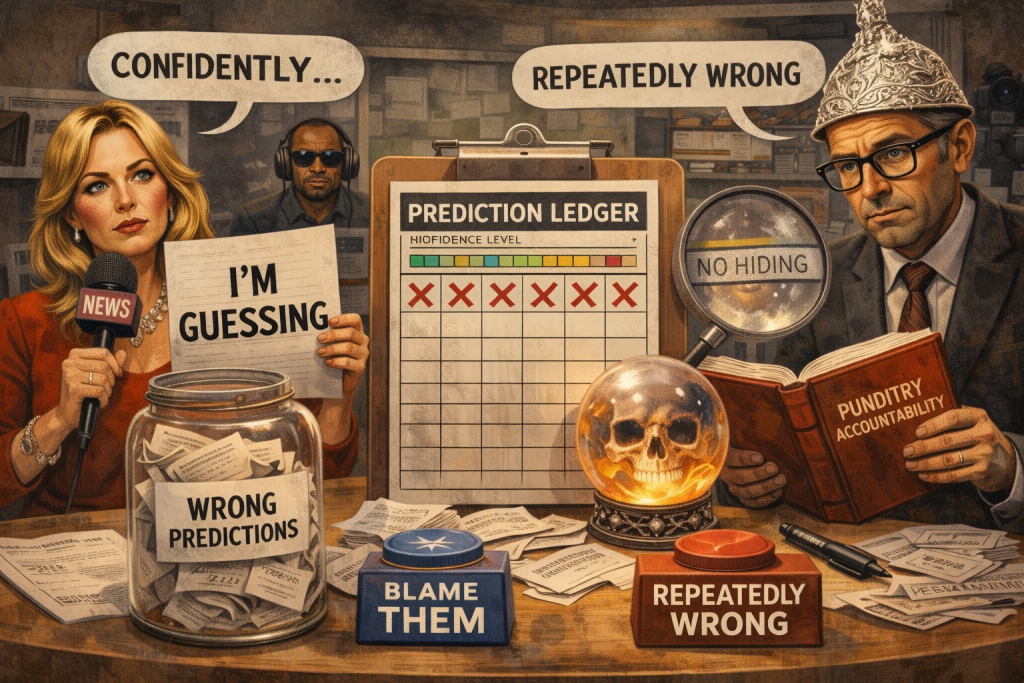
There are solutions. They’re just humiliating to the sort of people who’ve been dining out for years on confident nonsense. First, every major outlet should require analysts and opinion writers to rate their own claims before publication: high confidence, moderate confidence, low confidence, or straight speculation. Put it at the top. In plain English. Not “sources suggest a fluid landscape.” Say, “This is an early read and may be wrong.” The public is not confused by honesty. The public is confused by professional liars using upholstery fabric as prose.
Second, every network, paper, and major pundit should maintain a public prediction archive. Searchable. Permanent. Date-stamped. What was claimed, how strongly it was claimed, and what actually happened six weeks or six months later. No deleting clips. No stealth edits. No “what I was really saying” after the wreckage is smoking in the ditch. If someone keeps missing the ball, stop introducing him like a prophet. He’s not an oracle. He’s a malfunctioning airport departure board with a headshot.
Third, editors need a mandatory cooling-off rule for fast-moving events. For the first stretch of a breaking story, run verified facts only and label all interpretation as provisional. No grand moral verdicts before the basic reporting is in. No apocalyptic prose because three people on social media are vibrating at once. The grown-up rule should be simple: if the facts are still moving, your certainty should not be standing at parade rest.
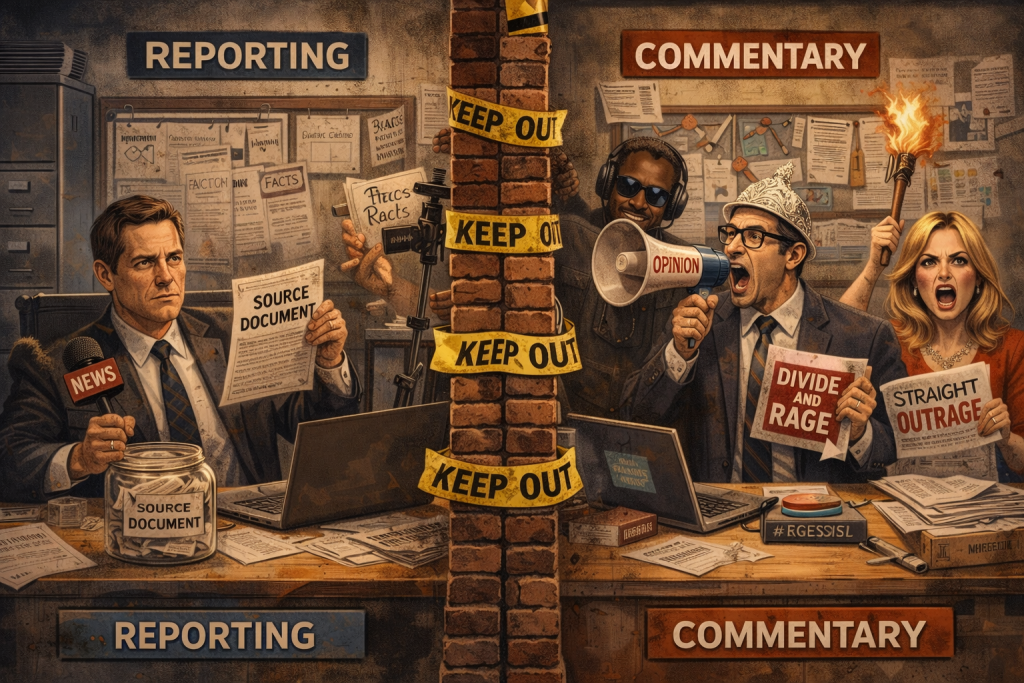
Fourth, newsrooms need a harder wall between reporting and commentary. Reporters report. Opinion people interpret. Analysts analyze. Activists can go start a Substack and scream into the decorative void like everyone else. But the same institution should not present ideological wish fulfillment as neutral explanation and then act offended when readers notice the fingerprints. If you are selecting facts mainly for their usefulness in a factional argument, that is not journalism. That is prosecutorial fan fiction.
Finally, reward correction instead of performance. Promotions, prime slots, and prestige should go to people who update their views cleanly, cite evidence, and admit error without needing a hostage negotiator. Build that into the culture. Build it into performance reviews. Build it into editorial standards. Right now the incentive is to be first, loud, and emotionally useful to your tribe. That’s how you get a public square full of peacocks with Wi-Fi. Change the incentive, and some of the insanity dies on its own.
Until then, expect more of this elegant fraud. More impeccably dressed hysteria. More people pretending their tribal reflexes are a form of scholarship. More panels of human weather vanes swiveling furiously and calling it courage. We have built a culture in which being wrong is survivable, being boring is fatal, and being honest is treated as a weird boutique hobby.
No wonder everything sounds insane. The asylum isn’t run by madmen. It’s run by careerists with microphones, laundering preference into principle while the rest of us are told to applaud the spin cycle.
_____________________________
Tammy Pondsmith is Senior Vice President of Institutional Nonsense Disposal, which means she spends her days identifying which public frauds are malicious, which are stupid, and which have somehow earned tenure.
As the Voice of the Veteran Community, The Havok Journal seeks to publish a variety of perspectives on a number of sensitive subjects. Unless specifically noted otherwise, nothing we publish is an official point of view of The Havok Journal or any part of the U.S. government.
Buy Me A Coffee
The Havok Journal seeks to serve as a voice of the Veteran and First Responder communities through a focus on current affairs and articles of interest to the public in general, and the veteran community in particular. We strive to offer timely, current, and informative content, with the occasional piece focused on entertainment. We are continually expanding and striving to improve the readers’ experience.
© 2026 The Havok Journal
The Havok Journal welcomes re-posting of our original content as long as it is done in compliance with our Terms of Use.


