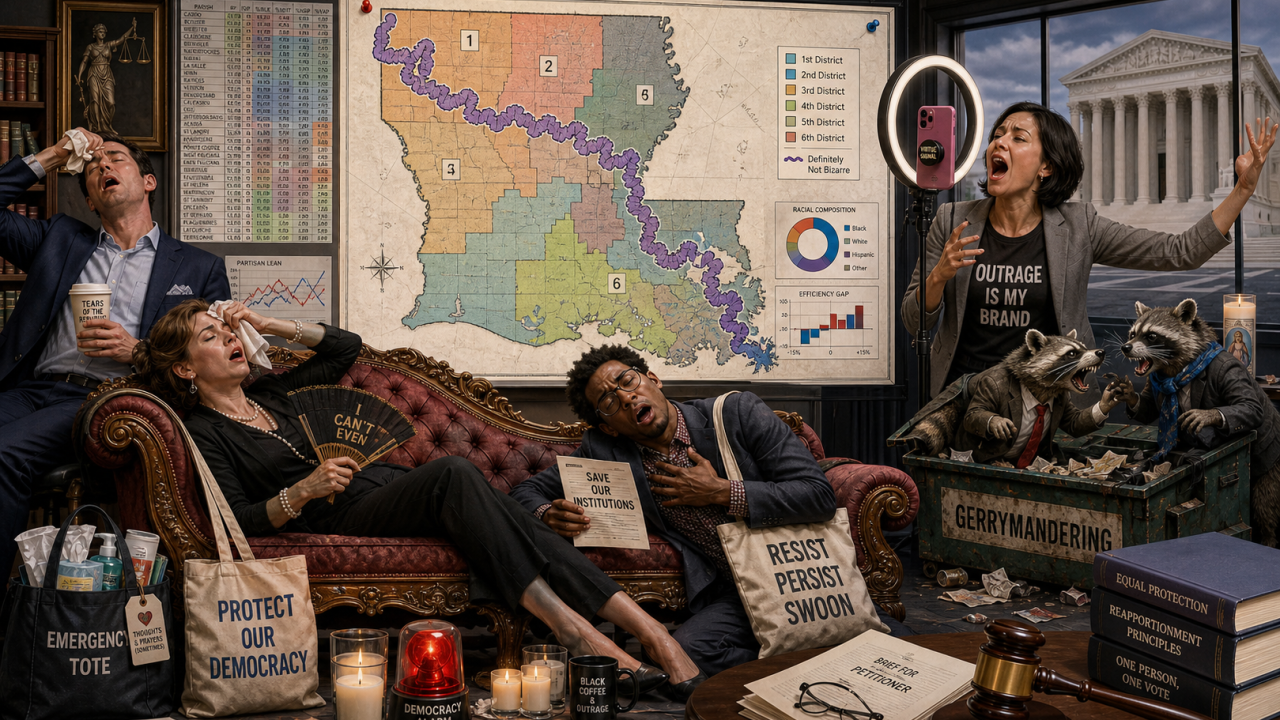
Well, break out the smelling salts and emergency tote bags, because the democracy fainting couch has once again been rolled into the national living room. The Supreme Court ruled on a Louisiana congressional map, and suddenly we’re being told America has turned into a sepia-toned villain montage where every state legislator is twirling a mustache, clutching a compass, and whispering, “At last, racial oppression by spreadsheet.”
Please.
Here’s the part nobody wants to say out loud because it ruins the candlelight vigil: the Voting Rights Act is not a racial seat-allocation machine. It’s not a congressional Groupon where every demographic gets punched into a laminated card until proportional representation falls out like a casino voucher. Section 2 protects equal opportunity to participate in the political process and elect candidates of choice. That matters. It’s sacred. It’s also not the same thing as saying every racial group is entitled to districts engineered with the delicacy of a hostage negotiation and the geometry of a drunk squid.
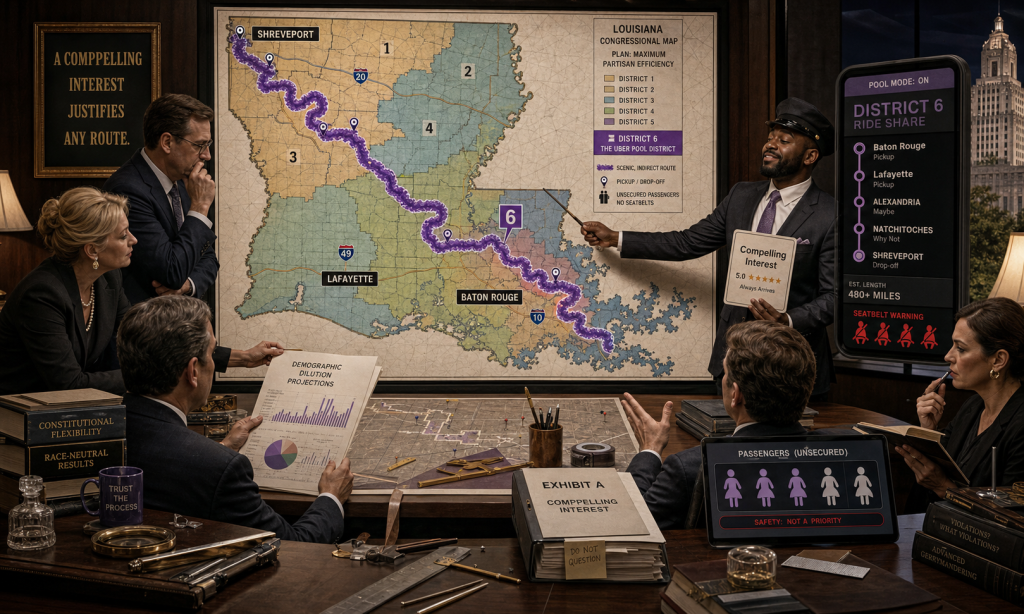
Louisiana’s map wasn’t some innocent little civic doodle. The state created a second majority-Black district after prior litigation, then stretched District 6 across roughly half the known universe, connecting far-flung Black populations like a political Uber Pool with no seatbelts and a driver named “Compelling Interest.” It ran from Baton Rouge and Lafayette toward Shreveport, because apparently communities of interest now include “people who share a race and a long interstate.”
And when the Court said, “Maybe government shouldn’t sort citizens by race unless the law truly requires it,” the response from the professional hysteria caucus was, naturally, “Democracy has been murdered in the conservatory with an originalist candlestick.”
Spare me the theatrical autopsy.
Here’s an uncomfortable truth, delivered without a foam finger or donor email attached: racial discrimination in voting has existed, does exist, and must be fought hard. But the cure for racial discrimination cannot be a government spreadsheet that treats voters primarily as racial inventory. That’s not equality. That’s a boutique form of segregation wearing a justice-themed lapel pin.
Another uncomfortable truth: both parties love gerrymandering. They adore it. They cradle it like a rescue ferret. Republicans do it in red states, Democrats do it in blue states, and both sides suddenly discover constitutional purity only when the other team gets better at the dark arts. Watching partisan operatives complain about gerrymandering is like watching raccoons file a noise complaint against the dumpster.
So when the outrage brigade says this decision allows states to dilute minority votes by calling racial gerrymanders “partisan,” there’s a real issue buried under the mountain of press-release confetti. Race and party are correlated in many places. That creates hard cases. Fine. Grown-ups can admit that. But the answer can’t be to let judges bless racial sorting whenever the desired partisan outcome happens to arrive wrapped in civil-rights tissue paper.
The Constitution is supposed to protect individuals, not political consultants with demographic dashboards. The state should not be able to say, “We’re moving these people because they’re Black,” then act shocked when someone asks whether that’s race-based decision-making. That’s not a trap. That’s the entire question.
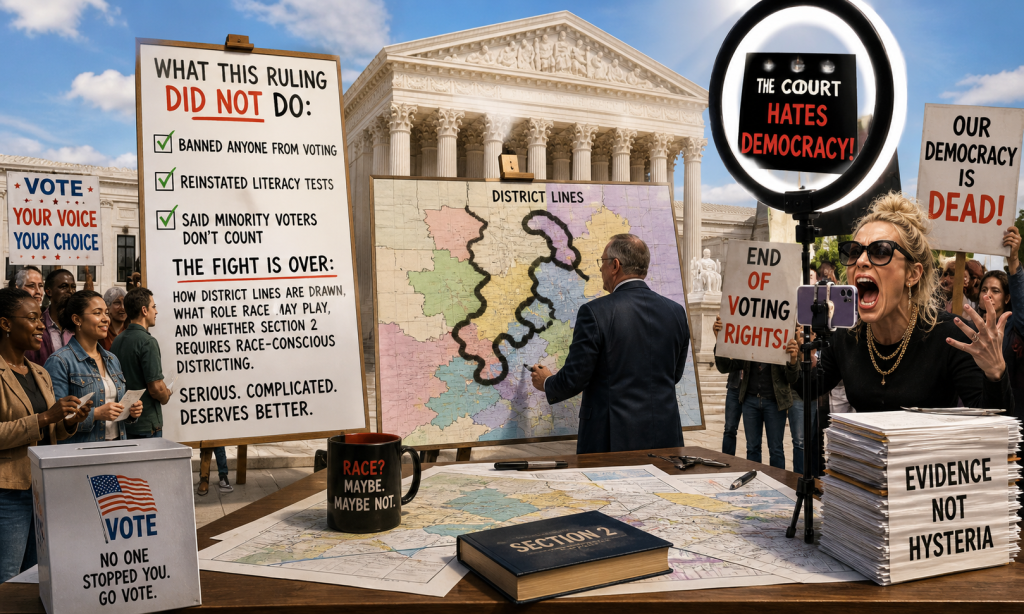
And can we stop pretending that every setback in court means citizens have lost the right to vote? Nobody in this ruling barred anyone from casting a ballot; the fight is over vote dilution, district design, and what Section 2 requires. Nobody reinstated literacy tests. Nobody said minority voters don’t count. The fight is over how district lines are drawn, what role race may play, and whether Section 2 requires race-conscious districting in this situation. That’s serious. It’s complicated. It deserves more than “the Court hates democracy” shouted through a ring light.
Now for the part that makes everyone equally annoyed, which usually means we’re getting close to honesty: if you hate gerrymandering, stop defending your side’s gerrymandering with better adjectives.
Real solutions exist. Pass independent redistricting commissions in every state that allows ballot initiatives. Require compactness, contiguity, respect for municipal boundaries, and transparent public mapping data. Ban mid-decade partisan redraws unless courts require them. Make legislatures publish all map drafts, communications, data inputs, and partisan performance estimates before votes. Let citizens submit competing maps. Use ranked-choice voting where legal. For gerrymandering itself, explore multi-member districts with proportional or semi-proportional methods where Congress permits them. And yes, Congress can act under the Elections Clause to set national standards for congressional redistricting, assuming it can stop performing interpretive dance for lobbyists long enough to legislate.
Also, build actual political power. Register voters. Recruit candidates. Win school boards, county commissions, secretary of state races, and state legislative seats. Fund election lawyers before the crisis, not after the emergency tweet. Train local observers. Challenge intentional discrimination with evidence, not vibes wearing mascara. Support state voting-rights acts that are carefully written, constitutional, and focused on access rather than racial bean-counting.
Because here’s the brutal little secret hiding under the outrage duvet: courts are not a substitute for politics. They never were. If your democracy strategy depends on nine lawyers in robes rescuing you from every ugly map, your strategy is a piñata in a hurricane.

The Supreme Court did not declare racism over. That would be idiotic. America has enough racial baggage to bankrupt an airport. But the Court did say something that shouldn’t be scandalous: the government needs a very good reason to sort voters by race. That’s not Jim Crow. That’s constitutional adulthood.
So yes, fight voter suppression. Fight racial discrimination. Fight shameless partisan cartography, whether it comes with a red tie, blue scarf, or nonprofit logo printed on recycled righteousness. But don’t call every rejection of race-based line-drawing the death of democracy.
Democracy isn’t dead. It’s just sick of being dragged out in a body bag every time the Supreme Court reminds people that the Voting Rights Act is a statute, not a Build-A-District workshop with a civil-rights punch card.
_____________________________
Tammy Pondsmith is a part-time constitutional grief counselor, full-time nonsense exterminator, and the only woman in America banned from a NPR tote-bag fundraiser for saying “read the statute” before the oat milk settled.
As the Voice of the Veteran Community, The Havok Journal seeks to publish a variety of perspectives on a number of sensitive subjects. Unless specifically noted otherwise, nothing we publish is an official point of view of The Havok Journal or any part of the U.S. government.
Buy Me A Coffee
The Havok Journal seeks to serve as a voice of the Veteran and First Responder communities through a focus on current affairs and articles of interest to the public in general, and the veteran community in particular. We strive to offer timely, current, and informative content, with the occasional piece focused on entertainment. We are continually expanding and striving to improve the readers’ experience.
© 2026 The Havok Journal
The Havok Journal welcomes re-posting of our original content as long as it is done in compliance with our Terms of Use.


