
by Hugh Jashol, for Article 107 News*
Somewhere between the slow-motion replay on cable news and the third thread posted by a guy whose profile picture includes wraparound Oakleys and a truck dashboard, America did it. We finally crossed the threshold. Every citizen is now a certified expert on police use of force.
It happened fast. One minute, people were struggling to explain the difference between a felony and a Filet-O-Fish. The next, they were confidently citing Supreme Court precedent, departmental policy, biomechanics, psychology, constitutional law, and “what my cousin would’ve done,” all while typing with one thumb.
Article 107 News can confirm: the nation is now fully qualified.
The transformation is remarkable. A country that once panicked at the sight of a self-checkout machine now calmly explains, in great detail, how a split-second decision made during a violent encounter was obviously incorrect. These analyses are delivered with the authority of someone who once watched a YouTube video titled “Cops DESTROYED by Logic and Facts.”
What makes this golden age of expertise even more impressive is that it requires no experience whatsoever. No academy. No patrol time. No exposure to unpredictable humans at 2 a.m. Just vibes, outrage, and the benefit of hindsight.
In the military, we used to call this “armchair generalship.” The civilian version has evolved into something far more advanced: the Tactical Facebook Commenter. This elite class can break down a use-of-force encounter frame by frame, pausing video footage to say things like, “Right there. That’s where he should’ve de-escalated.”
This assessment is usually made from a couch, under optimal lighting, with snacks available,
And, most importantly, zero threat to personal safety.
Downrange, we we tried to avoid “What I would’ve done,” unless we had been in that exact situation, under those exact conditions. Because unless you had, you reaaalllly have no business opining. But in America 2026, “what I would’ve done” is now considered a peer-reviewed publication in terms of credibility.
Police work, much like military operations, exists in the realm of the imperfect. Information is incomplete. Time is compressed. Stress is maximal. People don’t behave according to training slides or Twitter expectations. Yet the public discussion treats every incident as if it occurred on a soundstage with a director yelling “Cut!” between bad decisions.
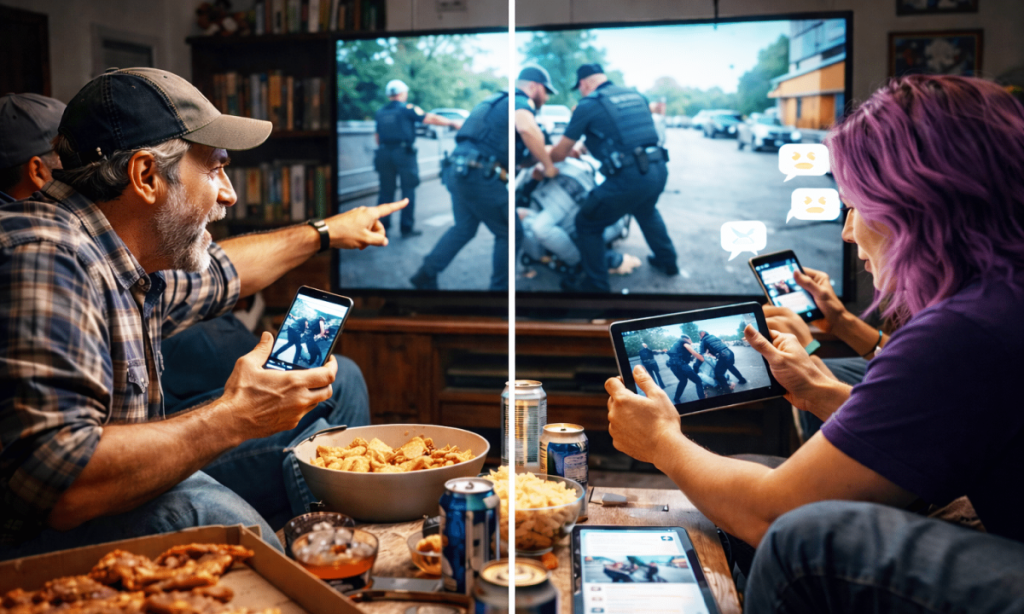
The phrase “use of force continuum” has entered the national vocabulary, though few can define it without also contradicting it in the same sentence. Everyone agrees force should be “appropriate,” which apparently means “whatever I decided after watching a 12-second clip that started halfway through the incident,” combined with “whatever interpretation suits my personal biases.”
Context is inconvenient. So is the fact that officers are human beings operating under physiological stress responses that science has been documenting for decades. Heart rate spikes. Fine motor skills degrade. Time perception distorts. But none of that plays well on a chyron.
In the military, we learned that war looks nothing like the briefing. Rules of engagement are clear until they aren’t. The enemy doesn’t read the script. Civilians don’t move where you expect them to. And every action is judged later by people who were never required to act at all. “The enemy has a vote.” “No plan survives first contact with the enemy.”
Sound familiar?
We used to joke that everyone becomes a counterinsurgency expert the moment a war starts. Police work has now joined that club. America treats law enforcement encounters like pop-up exams where the officer is graded in real time by millions of spectators who are immune to consequence.
If the officer hesitates, they’re incompetent. If they act decisively, they’re reckless. If they survive, they should’ve done better. If they don’t, the conversation pivots to policy recommendations that will be forgotten by next week.
Meanwhile, the loudest voices demand perfection from people operating in chaos, while excusing chaos in their own lives as “just a bad day.”
What’s missing from the national conversation isn’t accountability—there is no shortage of that—but humility. The humility to admit that watching violence is not the same as confronting it. That reviewing footage is not the same as making decisions under threat. That certainty is cheap when risk is outsourced.
The military learned, painfully, that distance breeds confidence. The farther you are from the blast radius, the more convinced you are that you would’ve handled it better. Police officers live inside that blast radius every shift.
None of this is an argument against reform, oversight, or discipline where it’s warranted. Just as the military holds its own accountable, law enforcement must do the same. But accountability requires understanding, not performance outrage.
Until then, America will continue to produce experts at an astonishing rate. Every viral clip will graduate another class. Diplomas issued instantly. No prerequisites required.
And somewhere, a young officer or soldier will do their job knowing that no matter what happens, millions of certified professionals—armed with hindsight and zero risk—are standing by to explain exactly how it should’ve gone.
Welcome to the academy. Tuition is free. Experience is optional. Consequences are for someone else.

_____________________________
Hugh is an imaginary former junior enlisted soldier in the US Army, who retired as an E4 after 10 years of service in the National Guard. He automatically assumes that he’s immediately an expert on any topic after reading about it for five minutes on Wikipedia.
This article is a production of Article 107 News. Article 107 of the Uniform Code of Military Justice covers “false official statements.” Make of that what you will.
As the Voice of the Veteran Community, The Havok Journal seeks to publish a variety of perspectives on a number of sensitive subjects. Unless specifically noted otherwise, nothing we publish is an official point of view of The Havok Journal or any part of the U.S. government.
Buy Me A Coffee
The Havok Journal seeks to serve as a voice of the Veteran and First Responder communities through a focus on current affairs and articles of interest to the public in general, and the veteran community in particular. We strive to offer timely, current, and informative content, with the occasional piece focused on entertainment. We are continually expanding and striving to improve the readers’ experience.
© 2026 The Havok Journal
The Havok Journal welcomes re-posting of our original content as long as it is done in compliance with our Terms of Use.


