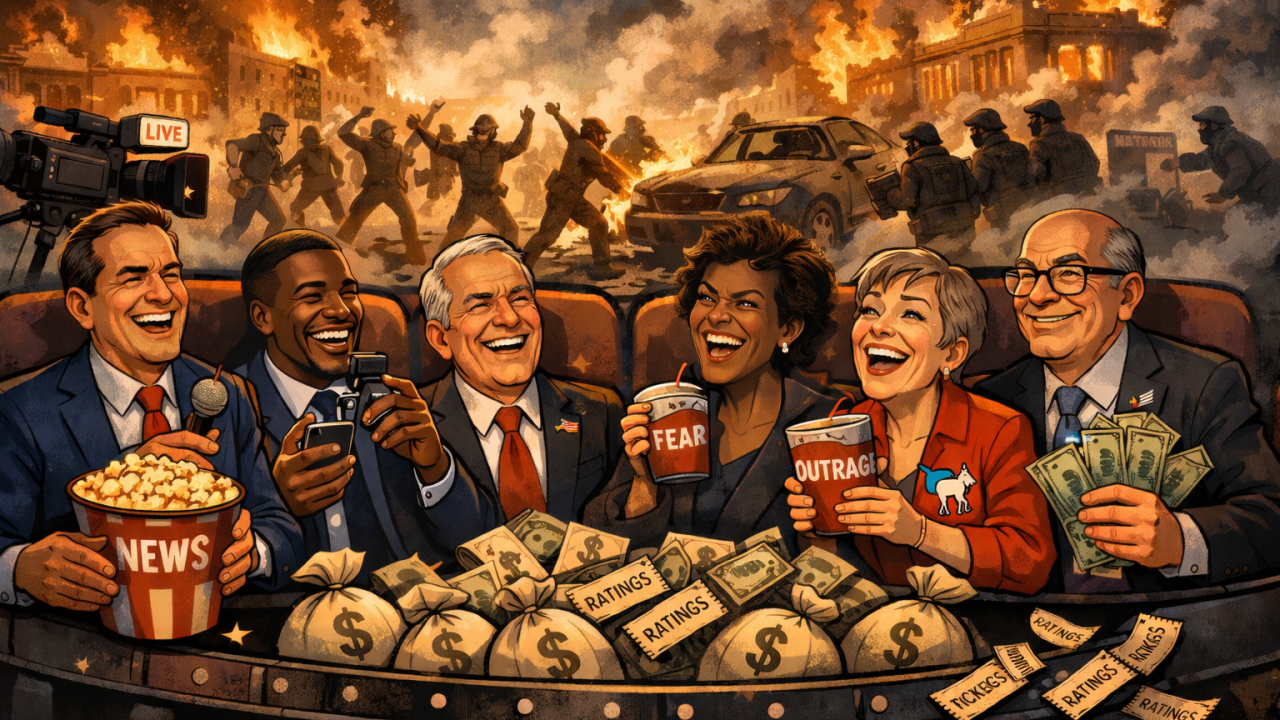
There was a time when riots were a civic catastrophe. Now they’re a content vertical.
That’s the first thing that makes this story more relevant today than it was even a few years ago. We no longer merely suffer unrest. We package it, clip it, brand it, stack sponsor reads around it, and feed it into an outrage machine so efficient it could turn a house fire into a subscription bundle. The old nightmare was social collapse. The new one is social collapse with studio lighting.
And no, the accelerants were not just foreign adversaries, fringe lunatics, or the usual collection of basement warlords cosplaying as philosophers. A grotesque amount of the gasoline came from inside the building. It came from our own legacy media, our own digital media, and our own opposing factions in government, all of them acting like the nation’s emergency room was really just a venue for audience growth, partisan point-scoring, and ratings necromancy. That’s not a conspiracy theory. It’s an incentives story, which is worse, because incentives don’t need villains with capes. They just need ambitious people with weak character and a quarterly target.
Let’s start with the legacy press, those solemn guardians of democracy who spent years informing us that the republic was hanging by a thread and then proceeded to sell scissors at the gift shop. Too much of national media did what national media does when the country is cracking in half. It zoomed in on the loudest lunatics, the hottest footage, the most combustible angle, and the most emotionally unstable square inch of the map, because nothing says public service like treating civic trauma as a cross between the Kentucky Derby and a shark attack. Researchers at Syracuse’s Institute for Democracy, Journalism and Citizenship put it politely, noting that media patterns still exacerbate divisions and that outlets face strong economic incentives to push the extreme and outrageous because clicks rule the kingdom. Polite academia always sounds like it is trying to describe a meth lab as an “energetic chemistry initiative.”

And now, in 2026, the ecosystem is even more deranged. Reuters Institute reported in its 2025 Digital News Report that engagement with traditional media continues to fall while dependence on social media, video platforms, and online aggregators grows, with the United States showing a sharp rise in social media news use and no compensating “Trump bump” for traditional sources. So the old gatekeepers lost their gates, then decided the best response was to scream louder through the chain-link fence. Legacy media no longer merely reports the fire. It competes with influencers, podcasters, and partisan carnival barkers by setting its hair on fire first and calling that urgency.
Trust didn’t just circle the drain. It cannonballed into the sewer and took the last shred of credibility with it. Gallup’s latest update says trust in U.S. mass media fell to a new low of 28 percent in 2025. Twenty-eight percent. That’s not a credibility problem. That’s a public mugging in a nice font. When the public increasingly believes the people narrating the chaos are also merchandising it, every riot becomes a Rorschach test splashed across a billboard.
Then there is the delicious ugliness of the political class, which saw unrest and thought not “How do we calm this down” but “How do we make this useful.” Opposing factions inside our own government didn’t have to engineer anything. They merely had to do what modern American factions do best, which is to weaponize every public wound before the bleeding stops. One side points at flames and screams that civilization is ending unless you hand them more power. The other side points at the response and screams that fascism has already arrived unless you hand them more power. Somewhere in the middle, an actual citizen loses a business, a neighborhood loses trust, and the body politic gets turned into campaign mulch.

This isn’t some swooning fairy tale of perfect symmetry. The factions aren’t interchangeable, the grievances aren’t imaginary, but the racket is real. Political elites get the most media attention precisely because they are more extreme, and the public then assumes ordinary people on the other side are just as deranged. That’s one reason polarization deepens. It is elite behavior, amplified by media incentives, then recycled as public reality until everybody thinks the whole country has been replaced by comment-section reptiles.
The incentives get uglier still online. A 2024 Science study found that misinformation exploiting moral outrage spreads especially well, in part because outrage is highly engaging and gets amplified. Another 2025 study on U.S. state legislators found that harmful or low-credibility content can increase political visibility during periods of high tension. In other words, the machine is not broken. The machine is paying bonuses. Outrage is not a side effect. It is the product.
So when unrest erupts now, it lands in a country already marinated in mutual delegitimization. Pew reported that 62 percent of Americans were dissatisfied with the way democracy was working in spring 2025. PRRI found that blame for political violence is itself bitterly polarized, with Democrats overwhelmingly blaming right-wing groups and Republicans overwhelmingly blaming left-wing groups. That is the perfect market for every cynical broadcaster and every feral faction in government. They do not need to persuade you of everything. They just need to make sure you despise the other side enough to rent them your nervous system for another election cycle.
That’s how the situation got worse and stays worse. Not because one magical villain pulled all the strings, but because too many institutions discovered that a nation on edge is profitable. The riots became a bonanza for hostile powers abroad, for nihilists at home, for opportunists in office, and for legacy outlets that still pretend they’re referees while selling front-row tickets to the brawl.
The country didn’t just suffer the flames. It developed a whole managerial class of people who fan them professionally, then appear on television in tasteful makeup to ask who could have done such a thing.
_____________________________
Tammy Pondsmith is a part-time curmudgeon, full-time enemy of performative sanctimony, and the only woman ever escorted from a media summit for suggesting that three cable executives and a Senate aide be locked in an Escape Room labeled “National Healing” with no Wi-Fi and one stale biscotti.
As the Voice of the Veteran Community, The Havok Journal seeks to publish a variety of perspectives on a number of sensitive subjects. Unless specifically noted otherwise, nothing we publish is an official point of view of The Havok Journal or any part of the U.S. government.
Buy Me A Coffee
The Havok Journal seeks to serve as a voice of the Veteran and First Responder communities through a focus on current affairs and articles of interest to the public in general, and the veteran community in particular. We strive to offer timely, current, and informative content, with the occasional piece focused on entertainment. We are continually expanding and striving to improve the readers’ experience.
© 2026 The Havok Journal
The Havok Journal welcomes re-posting of our original content as long as it is done in compliance with our Terms of Use.


