The Changing Character of War
The character of war has always evolved alongside technology, but its underlying logic has remained remarkably consistent: when the costs and risks of using force decline, the frequency of its use tends to rise. Today, advances in long-range strike capabilities, cyber operations, and artificial intelligence are reshaping the cost-benefit calculus of conflict in ways that make the initiation and conduct of violence easier, more deniable, and more politically palatable. The result is not necessarily more large-scale wars between great powers, but rather a proliferation of conflict across the spectrum—from gray-zone competition to limited strikes and proxy engagements.
International relations theory provides a useful framework for understanding this shift. Offense-defense theory, most prominently articulated by Robert Jervis (1978) and later expanded by scholars such as Stephen Van Evera (1998), posits that the likelihood of conflict is shaped by the relative ease of offensive versus defensive operations. When offense is perceived to have the advantage—when it is easier to strike than to defend—states are more likely to initiate conflict, whether preemptively or opportunistically. Conversely, when defense dominates, deterrence is strengthened and war becomes less likely.
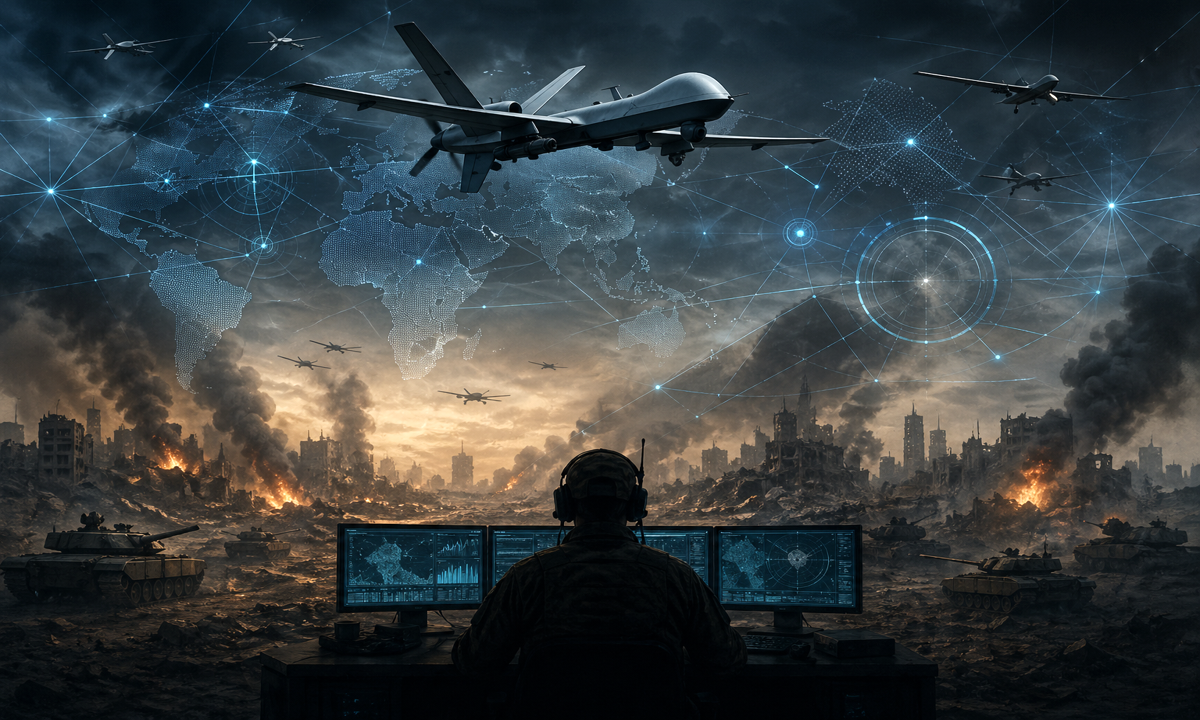
Emerging technologies are steadily tilting this balance toward the offense, at least in specific domains. Unmanned aerial systems (UAS), or drones, have dramatically reduced the cost and risk associated with projecting force. States no longer need to risk pilots or deploy large formations to achieve tactical or even strategic effects. A relatively inexpensive drone swarm can threaten critical infrastructure, military installations, or civilian targets at distances once reserved for advanced air forces. This lowers the threshold for action, particularly for weaker states or non-state actors that previously lacked such capabilities.
Cyber operations further erode traditional barriers to conflict. Offensive cyber capabilities allow actors to disrupt financial systems, degrade military readiness, and undermine political stability without crossing the conventional threshold of armed attack. Thomas Rid (2013) has argued that cyber war, strictly defined, has not yet occurred, but cyber operations clearly enable persistent competition below the level of kinetic war. From the perspective of offense-defense theory, cyber capabilities favor the attacker: vulnerabilities are widespread, attribution is difficult, and defensive measures are often reactive rather than preventative. The result is a strategic environment in which low-cost, high-impact actions can be undertaken with limited risk of retaliation.
Artificial intelligence amplifies these dynamics. AI enhances targeting, accelerates decision-making, and enables autonomous or semi-autonomous systems to operate at scale. In doing so, it reduces both the cognitive and logistical burdens of warfare. As Erik Lin-Greenberg (2020) notes, the use of unmanned and AI-enabled systems can decrease domestic political constraints on the use of force by minimizing casualties, thereby lowering the perceived cost of military action. This aligns with broader findings in democratic peace theory, where public sensitivity to casualties has historically acted as a restraint on conflict initiation. Remove or reduce that constraint, and the political calculus shifts.
Cause, and Effect
The cumulative effect of these technologies is not merely to make war more efficient, but to make it more accessible. Just as industrialization once enabled mass mobilization and total war, the digital and autonomous revolution is enabling persistent, low-level conflict across multiple domains. States can now engage in “war-like” activities—coercion, disruption, signaling—without formally declaring war or triggering traditional responses. This aligns with what scholars describe as the “gray zone,” a space between peace and war characterized by ambiguity, deniability, and incremental escalation.
Importantly, the ease of engaging in such activities does not eliminate risk; rather, it redistributes and obscures it. The lowered threshold for action increases the number of interactions in which misperception, miscalculation, or unintended escalation can occur. Jervis’s earlier work on the security dilemma remains relevant here: when offensive capabilities are difficult to distinguish from defensive ones, and when intentions are uncertain, states may interpret even limited actions as threatening, leading to spirals of escalation.
The key point is straightforward: when something becomes easier to do, it tends to be done more often. This principle applies as much to interstate conflict as it does to any other human activity. Lower costs, reduced risks, and increased deniability create incentives for more frequent use of force, even if that force is applied in limited or indirect ways. While major wars between great powers may still be deterred by nuclear weapons and economic interdependence, the space below that threshold is becoming increasingly crowded.
The Policymakers’ Paradox
In this emerging environment, policymakers face a paradox. The same technologies that promise precision, efficiency, and reduced casualties also enable a more continuous state of competition and conflict. Managing this reality will require not only technological adaptation, but also conceptual clarity. If war is no longer a discrete event but a persistent condition, then traditional frameworks for deterrence, escalation, and conflict termination may prove insufficient.
War has not disappeared, nor has it fundamentally changed its nature as a contest of wills. What has changed is the ease with which that contest can be initiated and sustained. And if history and theory are any guide, that means we should expect to see more of it.
_____________________________
Charles is the owner of The Havok Journal. He served more than 27 years in the U.S. Army, including seven combat tours in Iraq and Afghanistan with various Special Operations Forces units, two assignments as an instructor at the United States Military Academy at West Point, and operational tours in Egypt, the Philippines, and the Republic of Korea. He holds a doctorate in business administration from Temple University and a master’s degree in international relations from Yale University. For The Havok Journal, he writes largely on leadership, military and veteran issues, and current affairs.
As the Voice of the Veteran Community, The Havok Journal seeks to publish a variety of perspectives on a number of sensitive subjects. Unless specifically noted otherwise, nothing we publish is an official point of view of The Havok Journal or any part of the U.S. government.
Buy Me A Coffee
The Havok Journal seeks to serve as a voice of the Veteran and First Responder communities through a focus on current affairs and articles of interest to the public in general, and the veteran community in particular. We strive to offer timely, current, and informative content, with the occasional piece focused on entertainment. We are continually expanding and striving to improve the readers’ experience.
© 2026 The Havok Journal
The Havok Journal welcomes re-posting of our original content as long as it is done in compliance with our Terms of Use.


