Some regimes project power.
Others perform it.
And right now, Iran is doing theater.
Not the kind meant to entertain—but the kind meant to distract, distort, and disguise a reality the regime can no longer fully control.
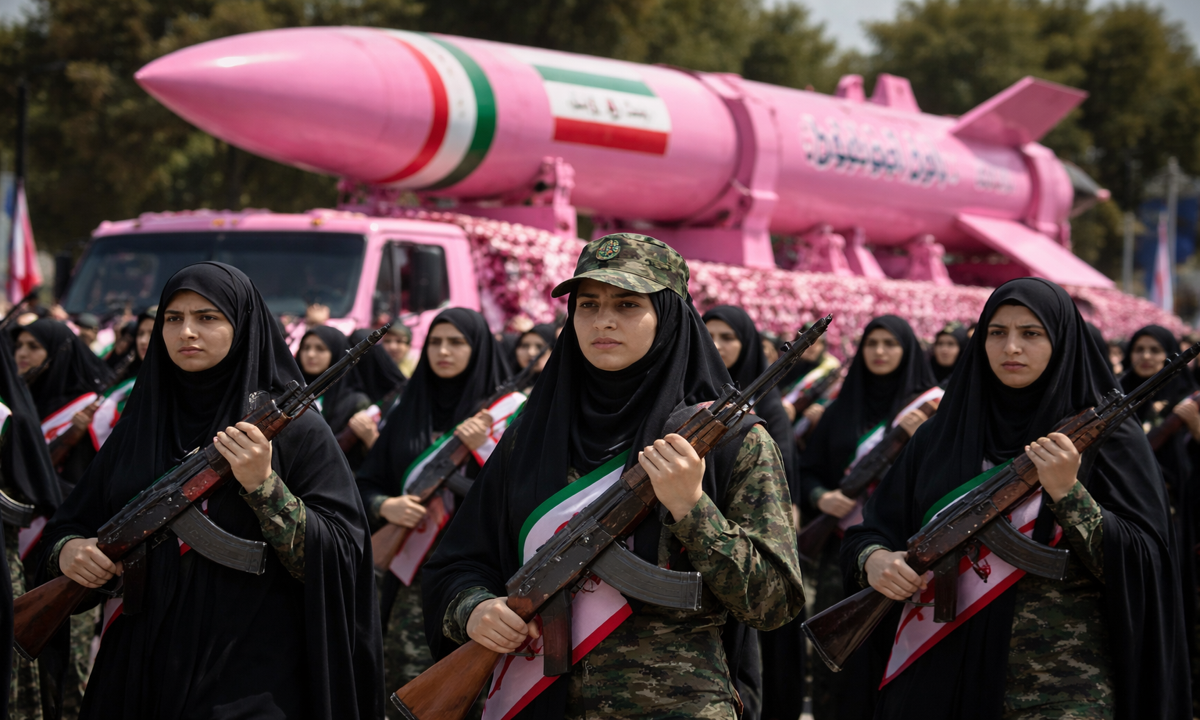
Because when you get to the point where you’re painting missiles pink to satisfy a child’s request, you’re not signaling strength.
You’re signaling something else entirely.
War, Rebranded in Pastel
In April 2026, images circulated of a pink-painted missile tied to a viral video of a young Iranian girl asking for exactly that—a pink missile strike against Israel. The regime didn’t just acknowledge it. They leaned into it, turning the weapon into a piece of emotionally packaged propaganda designed for domestic consumption.
That alone would be strange enough, but it gets worse.
The messaging around the missile emphasized its symbolic nature as much as its operational role, framing it as a response to a child’s request rather than a calculated act of war.
Think about that for a second.
A ballistic missile, one of the most destructive tools in modern warfare, rebranded as something closer to a social media trend.
Not deterrence.
Not capability.
Content.
When the Message Matters More Than the Weapon
Iran has a large missile arsenal. Thousands, by most estimates. But capability isn’t the issue, credibility is. That’s because if you actually intend to use force decisively, you don’t wrap it in pastel colors and children’s narratives. You don’t turn it into something that looks like it belongs on a poster instead of a battlefield.
You certainly don’t risk making your own military power look unserious, unless the goal isn’t warfighting. Or unless the goal is perception management.
The Parallel Theater: Women With Weapons
At the same time, Tehran staged highly visible parades featuring women and girls in military-style formations—some riding in pink vehicles mounted with weapons.
There’s just one problem.
These displays are entirely symbolic.
Women in Iran are not permitted to serve in combat roles.
So what you’re seeing isn’t empowerment.
It’s casting.
They’re handing rifles to people they will never trust to use them. Putting them in formations they will never command. Giving them a role they will never actually hold.
It’s not a military evolution.
It’s a photo op.
The Regime’s Contradiction
This is where the problem becomes impossible to ignore.
The same regime that violently suppresses protests—including those led by women—is now showcasing women as part of its military image.
The same system that limits women’s rights is now putting them on parade in uniform.
The same leadership that restricts autonomy is now pretending to promote participation.
That’s not progress.
That’s branding.
And branding only works if people believe it.
Desperation in Disguise
Here’s the uncomfortable truth:
Strong regimes don’t need props.
They don’t need to dress up weapons to make them appealing. They don’t need to stage participation from groups they systematically exclude. They don’t need to blur the line between war and spectacle.
They act.
When a government starts relying on symbolism this heavily, it’s often because reality isn’t cooperating.
Because internally, there are cracks.
Economic pressure. Public unrest. Generational frustration.
And when you can’t fix those problems, you distract from them.
The Risk of Your Own Narrative
There’s another danger here—one that cuts deeper than international perception.
When you turn war into theater, you start believing your own script.
You convince yourself that symbolism equals strength. That visibility equals capability. That viral moments equal strategic success.
And that’s how bad decisions get made.
Because eventually, the difference between a real missile and a pink one stops being about paint—and starts being about intent.
What This Actually Signals
None of this means Iran isn’t dangerous.
It is.
Missiles still kill. Conflicts are still real. And the region remains volatile.
But what this does signal is a regime increasingly concerned with how it looks, not just what it does.
A regime that understands it’s being watched—by its own people, by its adversaries, and by the world—and is trying to control the narrative in ways that feel less like strategy and more like performance.
What this actually signals is that Iran doesn’t have a missile problem, it has a credibility problem.
Because when your show of force looks like a social media campaign, when your fighters are actors, and when your weapons double as props, you’re not projecting power.
You’re auditioning for it.
And the world is watching closely enough to tell the difference.
_____________________________
Charles served over 27 years in the US Army, which included seven combat tours in Iraq and Afghanistan with various Special Operations Forces units and two stints as an instructor at the United States Military Academy at West Point. He also completed operational tours in Egypt, the Philippines, and the Republic of Korea and earned a Doctor of Business Administration from Temple University as well as a Master of Arts in International Relations from Yale University. He is the owner of The Havok Journal, and the views expressed herein are his own and do not reflect those of the US Government or any other person or entity.
As the Voice of the Veteran Community, The Havok Journal seeks to publish a variety of perspectives on a number of sensitive subjects. Unless specifically noted otherwise, nothing we publish is an official point of view of The Havok Journal or any part of the U.S. government.
Buy Me A Coffee
The Havok Journal seeks to serve as a voice of the Veteran and First Responder communities through a focus on current affairs and articles of interest to the public in general, and the veteran community in particular. We strive to offer timely, current, and informative content, with the occasional piece focused on entertainment. We are continually expanding and striving to improve the readers’ experience.
© 2026 The Havok Journal
The Havok Journal welcomes re-posting of our original content as long as it is done in compliance with our Terms of Use.


