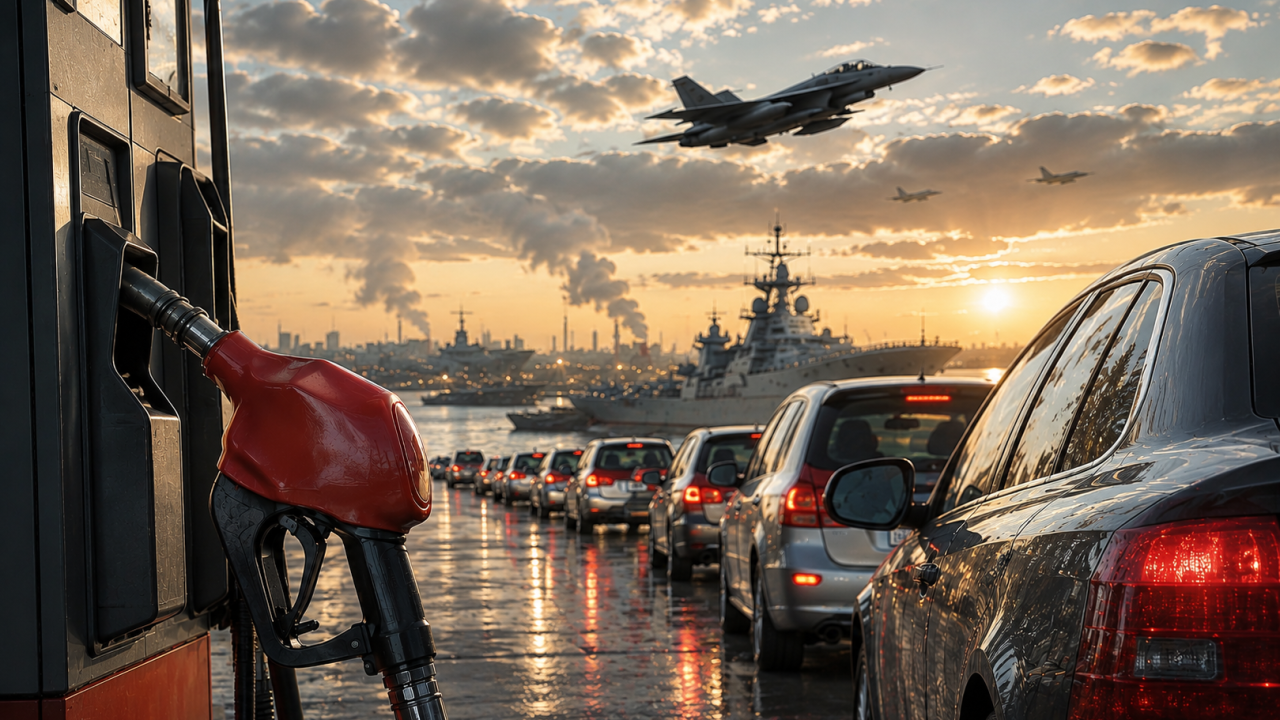
Americans hate high gas prices. Politicians know it, economists study it, and every election cycle seems to include promises to bring them down. Rising fuel costs affect nearly every aspect of daily life, from commuting to work to purchasing groceries, and they are among the most visible economic indicators that ordinary citizens encounter. It is therefore understandable that increases at the pump generate frustration. What is less understandable is how surprised Americans often seem when those increases occur in direct response to international instability, military conflict, or disruptions to global energy markets.
To be clear, I don’t like to pay more at the pump personally (I remember the days of $1 a gallon unleaded), and I know that higher energy costs have a knock-on affect that increases the prices of many of the goods and services we rely on. But in some respects, high gas prices perform a valuable civic function. For example, they remind Americans that the world still exists beyond their immediate experience and that military conflict has consequences that cannot be entirely hidden behind government spending, professional armed forces, and twenty-four-hour entertainment. At a time when the United States remains involved in multiple security commitments around the globe and continues to confront an increasingly unstable international environment, perhaps the most important thing rising fuel prices accomplish is forcing citizens to acknowledge a reality that many would otherwise ignore: there is a war on.
Several years ago, (under the Havok Journal’s collective pseudonym, because I was on active duty at the time), I wrote an article called Back to Basics #2: Returning the Poor Game to Modern U.S. Warfare. In that piece, I explained the historical concept of the “Poor Game,” the idea that war should impose costs on the population conducting it. Otherwise, you’ll get the “forever wars” we saw in Afghanistan and Iraq. In short, throughout most of human history, societies at war experienced direct and unavoidable consequences. Men were conscripted into service, resources were diverted to military production, taxes increased, shortages emerged, and entire communities reorganized themselves around national survival. War was not something that happened elsewhere, it was something that happened to society itself.
The United States has largely abandoned that model. Since the transition to an all-volunteer force following Vietnam, the burden of military service has fallen upon a relatively small percentage of the population. Simultaneously, the government has increasingly financed military operations through borrowing rather than direct taxation. The result is a strategic environment in which the nation can engage in military action for decades without requiring meaningful sacrifice from most citizens. Americans can support military interventions, oppose military interventions, or remain completely indifferent to military interventions while experiencing little direct impact on their daily lives.
This separation between the military and the society it serves has profound implications. If war carries no visible cost, it becomes easier for political leaders to initiate military action and easier for citizens to ignore it. Public scrutiny declines because public involvement declines. Strategic decisions that would once have required broad societal commitment can now be made by a relatively small group of policymakers while the overwhelming majority of Americans continue their normal routines. The nation may be at war, but the people are not.
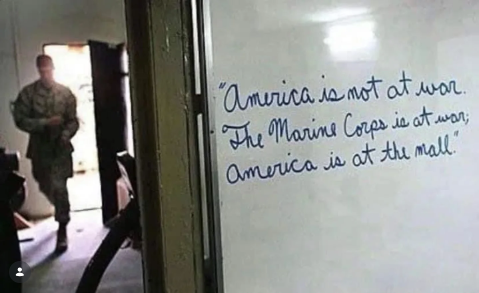
Historically, democratic societies maintained a stronger connection between military action and public accountability because citizens were required to bear some portion of the burden. During World War II, rationing, war bonds, industrial mobilization, and military service ensured that nearly every American household understood the stakes of the conflict. Even during the Cold War, Americans recognized that national security involved costs and obligations. Today, however, it is entirely possible for a citizen to support a twenty-year military campaign without knowing where US forces are deployed, what objectives they are pursuing, or what resources are being consumed in the process. To paraphrase a popular meme from the War on Terror, “America is not at war. The US military is at war. America is at the mall.”
This is where energy prices become significant. Fuel occupies a unique position in modern life because it serves as a direct link between global events and personal experience. Most Americans do not track maritime security operations in the Persian Gulf. They do not monitor disruptions in global shipping lanes. They rarely follow developments in oil-producing regions or study the strategic implications of conflicts involving major energy exporters. Yet when those events affect fuel prices, the consequences become impossible to ignore.
A sudden increase in the cost of gasoline creates something that modern warfare often lacks: visibility. Citizens who previously paid little attention to international affairs begin asking questions about events overseas. They become interested in conflicts, alliances, and geopolitical tensions because those factors are now influencing their household budgets. While few people enjoy paying more for fuel, the resulting awareness is arguably healthier for a democratic republic than the alternative condition of strategic indifference.
The broader problem is not that Americans are paying more for gasoline. The broader problem is that Americans have spent decades operating under the assumption that military power can be maintained indefinitely without corresponding costs. The United States maintains hundreds of overseas installations, protects international trade routes, supports allies across multiple continents, sustains the world’s most capable military force, and increasingly finds itself engaged in strategic competition with peer adversaries. None of this is free. Whether the costs appear through inflation, debt, taxation, supply disruptions, or energy prices, they ultimately reach the public in one form or another.
What makes high gas prices politically unpopular is precisely what makes them strategically useful. They disrupt the illusion that national security exists independently from everyday life. They remind citizens that the international system requires maintenance, that military power requires resources, and that geopolitical instability inevitably carries domestic consequences. Most importantly, they remind Americans that decisions made in Washington, Brussels, Moscow, Beijing, Tehran, or Riyadh do not remain confined to those capitals. They ripple outward until they affect ordinary people.
My argument regarding the return of the Poor Game was not fundamentally about making people suffer. It was about restoring the connection between the costs of war and the citizens on whose behalf wars are fought. A republic functions best when its people understand both the benefits and the burdens of the policies conducted in their name. When military action becomes entirely disconnected from public sacrifice, accountability weakens and strategic thinking deteriorates.
No one should celebrate economic hardship for its own sake. Families operating on tight budgets feel fuel price increases immediately, and those burdens are real. Yet there is also value in a society being reminded that security is neither automatic nor free. The price displayed on a gas station sign may be one of the few remaining indicators that connects Americans to the geopolitical realities shaping their world.
In that sense, high gas prices serve an important purpose. They remind people that there is a war on, that national security has costs, and that the privileges enjoyed by a global superpower are sustained by resources that must ultimately come from somewhere. Whether Americans like that reminder is beside the point. The fact that they need it is the real issue.
_____________________________
Charles served over 27 years in the US Army, which included seven combat tours in Iraq and Afghanistan with various Special Operations Forces units and two stints as an instructor at the United States Military Academy at West Point. He also completed operational tours in Egypt, the Philippines, and the Republic of Korea and earned a Doctor of Business Administration from Temple University as well as a Master of Arts in International Relations from Yale University. He is the owner of The Havok Journal, and the views expressed herein are his own and do not reflect those of the US Government or any other person or entity.
As the Voice of the Veteran Community, The Havok Journal seeks to publish a variety of perspectives on a number of sensitive subjects. Unless specifically noted otherwise, nothing we publish is an official point of view of The Havok Journal or any part of the U.S. government.
Buy Me A Coffee
The Havok Journal seeks to serve as a voice of the Veteran and First Responder communities through a focus on current affairs and articles of interest to the public in general, and the veteran community in particular. We strive to offer timely, current, and informative content, with the occasional piece focused on entertainment. We are continually expanding and striving to improve the readers’ experience.
© 2026 The Havok Journal
The Havok Journal welcomes re-posting of our original content as long as it is done in compliance with our Terms of Use.


