To most Americans, Iran’s foreign policy often looks less like grand strategy and more like a drunken bar fight.
Missiles at Israel. Proxy attacks on U.S. bases. Harassing Saudi Arabia. Backing the Houthis. Threatening the Strait of Hormuz. Launching drones at commercial shipping. Attacking merchant vessels from… <checks notes> …South Korea? Wow. OK. That’s pretty random. And occasionally deciding that random tankers apparently need to experience turbulence, or at least some additional ventilation.
From the outside, it feels chaotic, almost suicidal. But here’s the uncomfortable reality: From Tehran’s perspective, this strategy may actually make perfect sense.
Not morally. Not ethically. No, it’s much more important than that. It makes sense strategically.
And if you want to understand why Iran behaves the way it does, you have to stop looking at the Middle East through an American lens and start viewing it through the eyes of a regime that believes it is permanently under siege.
Iran Understands Something About Power Most Nations Forget
Weak states that behave politely tend to die. This is especially true in dangerous neighborhoods.
Iran is surrounded by hostile rivals, American military bases, nuclear powers, Sunni monarchies, insurgent groups, and one of the most technologically advanced militaries on Earth in Israel, which Iran has decided is its blood enemy. The Iranian regime has spent decades under sanctions, covert sabotage, cyberwarfare, assassinations, and constant threats of regime change.
In that environment, Tehran has reached a simple conclusion: If everyone already hates you, being unpredictable becomes a survival mechanism. That’s why Iran’s strategy often appears deliberately abrasive. It creates uncertainty. And uncertainty is deterrence.
I mean, it works for North Korea.
The regime understands it cannot defeat the United States conventionally. It cannot outspend Saudi Arabia. It cannot out-tech Israel. So instead, Iran has built an asymmetric warfare doctrine designed around making conflict unbearably expensive for everyone involved.
And honestly?
It works.
Well, kind of. Until now.
The Strait of Hormuz Is Iran’s Loaded Gun on the Table
Roughly 20% of the world’s oil supply moves through the Strait of Hormuz. Iran sits directly on that chokepoint. That geographic reality gives Tehran enormous leverage disproportionate to its actual military strength. Analysts increasingly describe the Strait as Iran’s single most powerful deterrent tool.
Recent clashes involving Iranian threats, drone attacks, and interference with shipping have demonstrated just how much chaos Tehran can create with relatively limited resources. From a Western perspective, targeting shipping lanes looks reckless. But from Iran’s perspective, it sends a very clear message:
“If we suffer, the global economy suffers too.”
That dramatically alters the strategic calculus of countries considering military action against Iran. The regime does not need to win a war outright. It only needs to make war costly enough that enemies hesitate.
Iran Learned the Lesson Saddam Hussein Didn’t
Saddam Hussein’s Iraq tried confronting the United States conventionally in 1991 and again in 2003. The result was catastrophic.
Iran watched closely.
Tehran concluded that traditional military parity with America is impossible. So instead of tanks and fighter jets, Iran invested in proxy militias, ballistic missiles, drone warfare, cyber capabilities, and maritime disruption.
In modern military theory, this is called “asymmetric warfare.” But in plain English, it means weaponizing annoyance.
Iran doesn’t try to overpower stronger enemies directly. It bleeds them gradually through constant pressure, regional instability, and psychological exhaustion. That’s why Iranian-backed groups operate across Lebanon, Iraq, Syria, Yemen, and beyond. The strategy creates what military planners call “distributed deterrence.” Attack Iran directly, and suddenly problems erupt everywhere simultaneously.
American troops come under fire. Oil prices spike. Shipping lanes close. Regional militias activate.
Missiles start flying. Insurance markets panic. Governments feel domestic pressure. The U.S. feels the effect of that pressure.
The objective is not battlefield dominance, iIt’s strategic friction.
The “Madman Theory” Isn’t Always Irrational
Richard Nixon famously attempted to convince adversaries he was unstable enough to do almost anything. The idea was simple:
If opponents believe you are unpredictable, they become more cautious.
Iran employs a similar logic.
By maintaining an image of volatility and ideological fanaticism, Tehran forces adversaries to constantly ask:
“How far are they willing to go?”
That uncertainty itself becomes a deterrent.
And there’s evidence it works.
Even major military powers remain cautious about direct full-scale confrontation with Iran because nobody wants to trigger regional escalation capable of destabilizing global energy markets. Recent tensions surrounding the Strait of Hormuz demonstrate how rapidly Iranian actions can create international economic anxiety.
In strategic terms, Iran has successfully made itself dangerous enough to avoid easy destruction.
That’s not accidental.
Proxy Warfare Gives Iran Plausible Deniability
One of Tehran’s most effective tools is ambiguity. Iran rarely attacks openly unless cornered. Instead, it operates through partner militias and aligned groups. That provides multiple advantages:
First, it complicates retaliation. Governments hesitate when attribution remains murky.
Second, it stretches enemy resources across multiple theaters simultaneously.
Third, it allows Iran to escalate or de-escalate without committing fully to direct war.
This is frustrating for Western powers because conventional militaries prefer clear battlefields and identifiable opponents. Iran deliberately avoids giving them that clarity.
To American observers, this feels dishonest or cowardly.
To Iran, it feels efficient.
Why Internal Politics Reward Aggression
Iran’s leadership also faces domestic incentives to appear defiant.
Authoritarian governments often maintain legitimacy by presenting themselves as defenders against foreign enemies. External pressure can actually strengthen hardliners internally because confrontation reinforces revolutionary narratives.
Sanctions, threats, covert actions, and military posturing frequently validate the regime’s claim that Iran is under permanent attack by outside powers.
That makes compromise politically dangerous.
Aggression becomes both foreign policy and internal propaganda.
And historically, siege mentalities tend to radicalize governments rather than moderate them.
Here’s the Part Americans Usually Miss
Iran doesn’t believe time favors the United States.
Tehran sees America as politically divided, war-weary, economically strained, and increasingly reluctant to commit to endless Middle Eastern conflicts.
From Iran’s perspective, the U.S. has already demonstrated strategic exhaustion after Iraq and Afghanistan. That means survival itself becomes victory.
If the regime remains standing while frustrating stronger enemies decade after decade, Tehran views the strategy as successful.
And objectively speaking, the Islamic Republic has survived enormous pressure for more than forty years.
That’s difficult to dismiss.
None of This Means Iran Is “Good”
Understanding a strategy is not endorsing it.
Iran’s actions have destabilized entire regions, fueled proxy wars, empowered extremists, and contributed to enormous human suffering.
But serious geopolitical analysis requires understanding adversaries as rational actors operating according to their own incentives — not cartoon villains acting randomly.
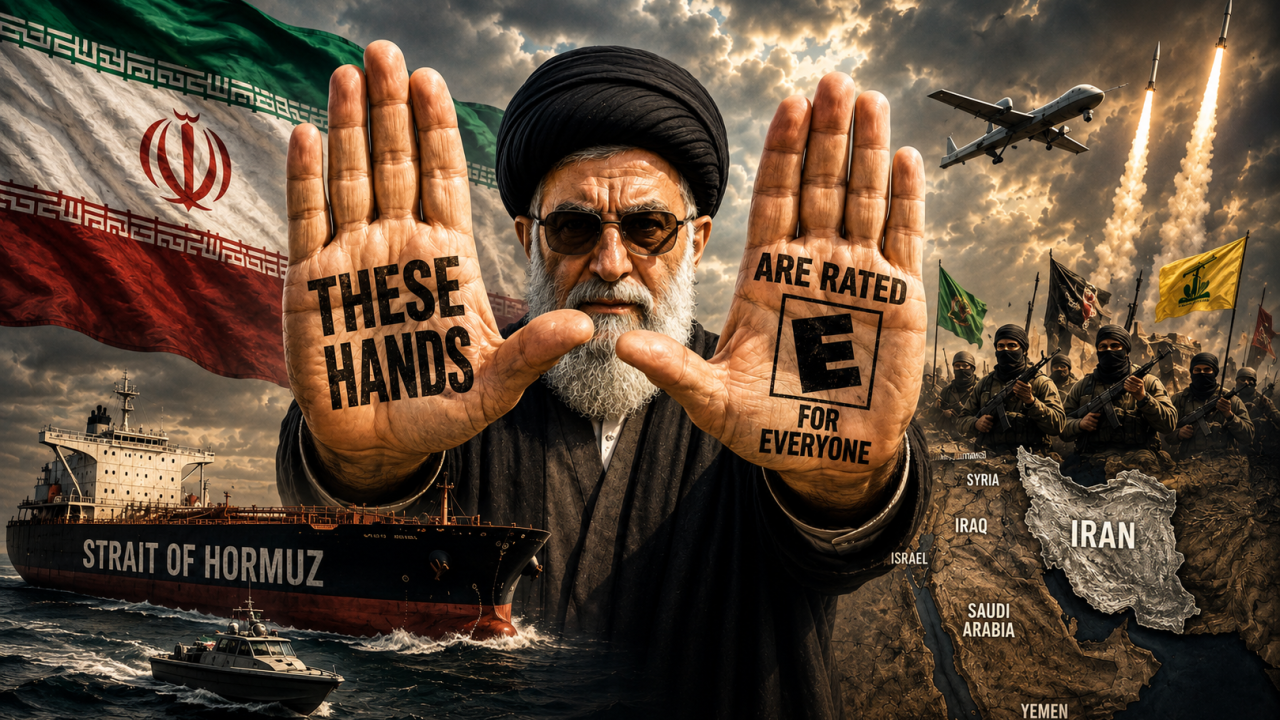
And when viewed coldly through the lens of deterrence, asymmetric warfare, and regime survival, Iran’s “these hands are rated E for everyone” foreign policy starts looking a lot less irrational.
The regime understands a brutal truth about geopolitics:
Weak countries survive not by being loved, but by being dangerous enough that stronger countries decide killing them would cost too much.
And for decades now, Iran has been very, very good at making itself expensive to fight.
_____________________________
Charles is the owner of The Havok Journal. He served more than 27 years in the U.S. Army, including seven combat tours in Iraq and Afghanistan with various Special Operations Forces units, two assignments as an instructor at the United States Military Academy at West Point, and operational tours in Egypt, the Philippines, and the Republic of Korea. He holds a doctorate in business administration from Temple University and a master’s degree in international relations from Yale University. For The Havok Journal, he writes largely on leadership, military and veteran issues, and current affairs.
As the Voice of the Veteran Community, The Havok Journal seeks to publish a variety of perspectives on a number of sensitive subjects. Unless specifically noted otherwise, nothing we publish is an official point of view of The Havok Journal or any part of the U.S. government.
Buy Me A Coffee
The Havok Journal seeks to serve as a voice of the Veteran and First Responder communities through a focus on current affairs and articles of interest to the public in general, and the veteran community in particular. We strive to offer timely, current, and informative content, with the occasional piece focused on entertainment. We are continually expanding and striving to improve the readers’ experience.
© 2026 The Havok Journal
The Havok Journal welcomes re-posting of our original content as long as it is done in compliance with our Terms of Use.