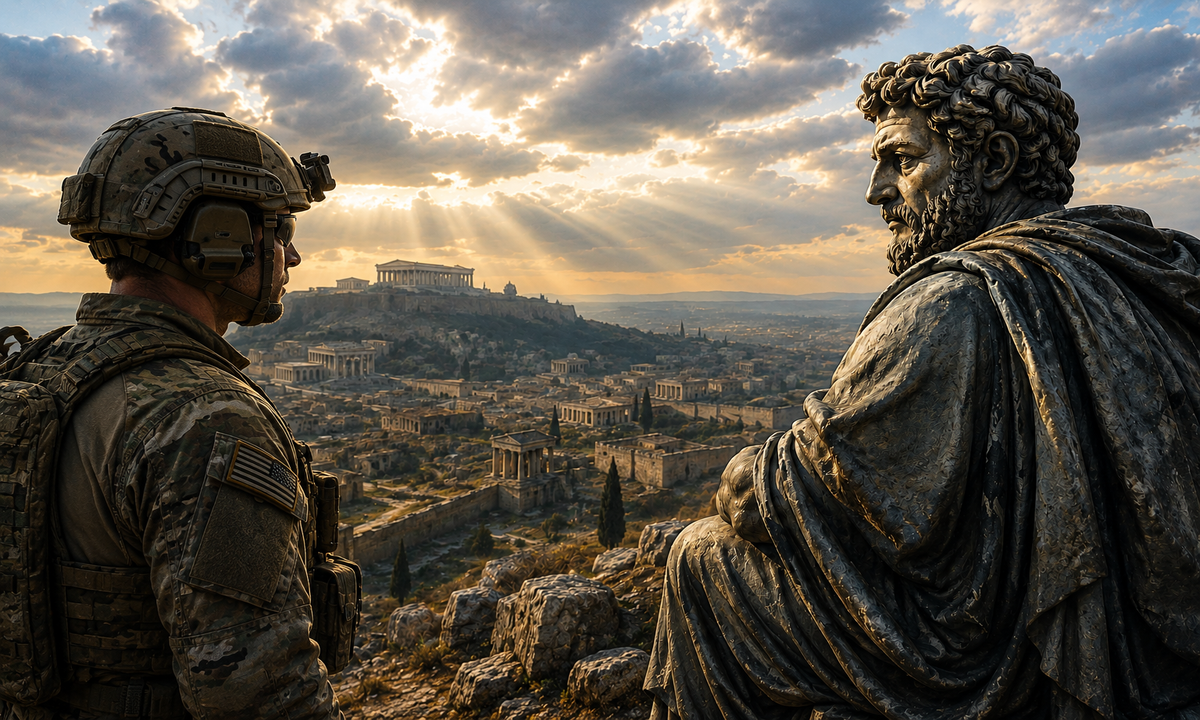
“Waste no more time arguing about what a good man should be. Be one.” — Marcus Aurelius
There’s a certain kind of man everyone in the military has met before.
He can quote every leadership book ever written. He talks endlessly about discipline, standards, warrior ethos, sacrifice, accountability, and integrity. He has opinions on everything—from combat readiness to masculinity to patriotism. Around the smoke pit, the gym, or over cheap beer after work, he’ll lecture anyone willing to listen about what’s wrong with the country, the military, the younger generation, or society itself.
But when it’s time to actually do something—to lead from the front, to mentor the young private, to take responsibility for failure, to protect the weak, or to stand firm under pressure—he’s nowhere to be found.
Marcus Aurelius had no patience for men like that.
Nearly two thousand years ago, the Roman emperor wrote a simple line that still cuts through modern noise like a combat knife:
“Waste no more time arguing about what a good man should be. Be one.”
That wasn’t philosophy for a classroom. It was battlefield wisdom from a man who spent much of his reign at war, buried in mud, plague, politics, betrayal, and death. Aurelius wasn’t theorizing from comfort. He was writing reminders to himself while carrying the weight of an empire on his shoulders.
And his point was brutally simple:
Character is not debate.
It is action.
Today we live in an age obsessed with performance instead of substance. Social media rewards outrage over integrity. People signal values rather than practice them. Everyone has a podcast opinion, a political rant, or a motivational quote ready to fire off into the void. But fewer people seem willing to quietly do the hard things that actually define character.
Because virtue is rarely loud.
A good man shows up when nobody’s watching.
He keeps his word when it costs him something.
He controls his emotions instead of letting them control him.
He treats people with dignity without demanding recognition for it.
He remains dependable long after motivation fades.
In the military community, this lesson matters more than ever.
We love talking about leadership. Entire industries have been built around it. Seminars, books, challenge coins, LinkedIn posts, “leadership influencers”—all of it selling the image of leadership. But real leadership isn’t found in slogans or mission statements hanging on a wall.
It’s found at 0200 when everyone is exhausted and somebody still chooses to carry more weight.
It’s found in the NCO who takes time to mentor a struggling soldier instead of humiliating him.
It’s found in the officer who accepts blame publicly and gives credit privately.
It’s found in the veteran who leaves the uniform behind but continues serving his family, community, and country without applause.
The Stoics understood something modern culture often forgets: excellence is built through repeated action, not endless discussion.
Aurelius wasn’t asking men to appear virtuous. He was demanding discipline over ego.
That distinction matters.
Talking about values is easy because it creates the illusion of progress. Living them is harder because it requires sacrifice. Anyone can post a motivational quote online. Far fewer can remain patient with their spouse during hardship, stay sober when life falls apart, or maintain integrity when cutting corners would be easier.
Real virtue is usually inconvenient.
And that’s why so many people avoid it.
The modern world encourages constant commentary. Everyone is expected to have an opinion on every issue at every moment. But constant commentary often becomes a substitute for meaningful action. We mistake emotional reactions for moral courage.
Marcus Aurelius would likely look at our culture and shake his head.
Less talking.
More doing.
Be honorable.
Be disciplined.
Be reliable.
Be courageous.
Be useful.
The ancient Stoics believed a man’s character was revealed not during comfort, but during adversity. Anybody can appear composed when life is easy. Anybody can sound wise when there’s no cost attached. The real test comes when exhaustion, anger, fear, humiliation, or grief enter the equation.
That’s where virtue either becomes real—or collapses entirely.
Veterans understand this instinctively. Military service strips away pretension fast. Under stress, people eventually reveal exactly who they are. Combat, hardship, deployments, and suffering expose character in ways ordinary life often cannot.
And yet the same principle follows us after service.
Being a good man after the uniform comes off may actually be harder.
There’s no rank structure enforcing standards anymore. No inspections. No chain of command. No morning formation. Nobody forcing discipline into your life.
At that point, character becomes entirely voluntary.
That’s where Aurelius still speaks directly to us across centuries.
Stop debating morality like it’s an abstract theory.
Stop waiting for perfect conditions.
Stop performing wisdom instead of practicing it.
Just be the kind of man you claim to admire.
Quietly.
Consistently.
Without needing recognition.
Because in the end, nobody remembers who won arguments online.
Nobody cares who sounded the smartest in the room.
What matters is who carried the burden.
Who stayed loyal.
Who remained calm under pressure.
Who protected others.
Who acted with honor when dishonor would have been easier.
That’s the difference between talking about virtue and actually possessing it.
Marcus Aurelius understood that better than most modern men ever will.
The challenge is whether we’re willing to live it.
_____________________________
Charles served over 27 years in the US Army, which included seven combat tours in Iraq and Afghanistan with various Special Operations Forces units and two stints as an instructor at the United States Military Academy at West Point. He also completed operational tours in Egypt, the Philippines, and the Republic of Korea and earned a Doctor of Business Administration from Temple University as well as a Master of Arts in International Relations from Yale University. He is the owner of The Havok Journal, and the views expressed herein are his own and do not reflect those of the US Government or any other person or entity.
As the Voice of the Veteran Community, The Havok Journal seeks to publish a variety of perspectives on a number of sensitive subjects. Unless specifically noted otherwise, nothing we publish is an official point of view of The Havok Journal or any part of the U.S. government.
Buy Me A Coffee
The Havok Journal seeks to serve as a voice of the Veteran and First Responder communities through a focus on current affairs and articles of interest to the public in general, and the veteran community in particular. We strive to offer timely, current, and informative content, with the occasional piece focused on entertainment. We are continually expanding and striving to improve the readers’ experience.
© 2026 The Havok Journal
The Havok Journal welcomes re-posting of our original content as long as it is done in compliance with our Terms of Use.