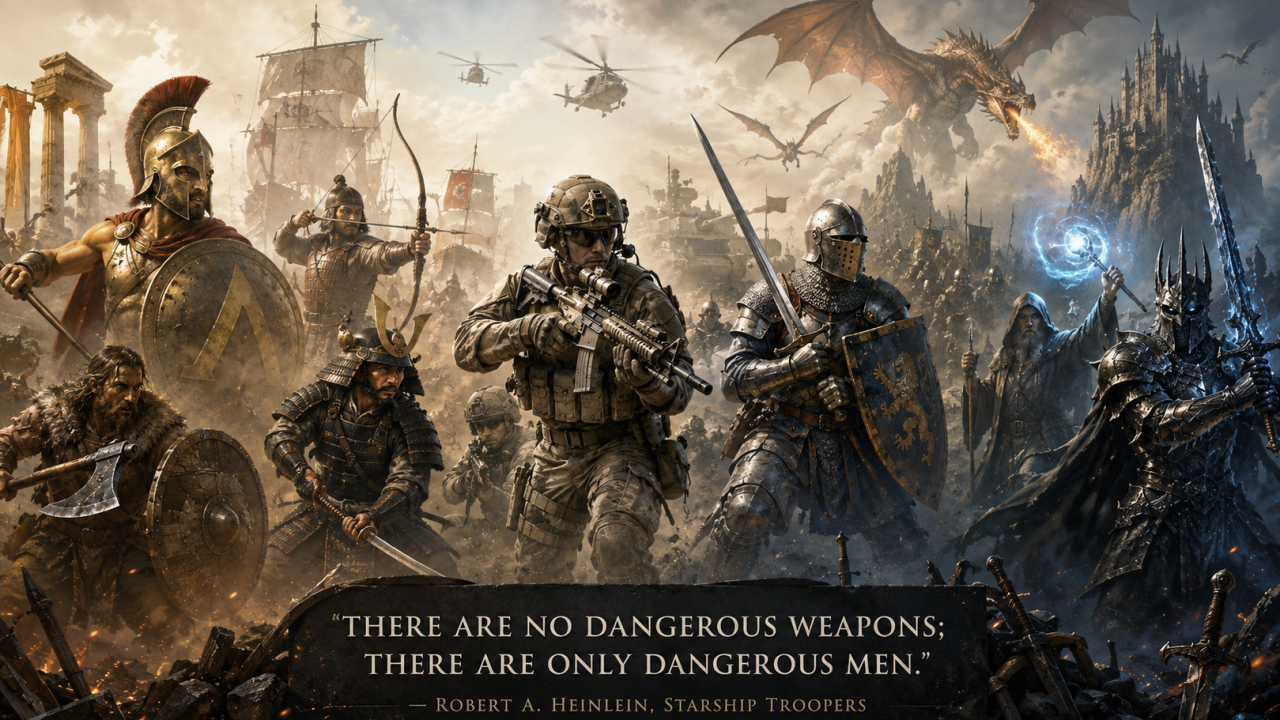
“There are no dangerous weapons; there are only dangerous men.”
— Robert A. Heinlein, Starship Troopers (1959)
Spend enough time around soldiers, police officers, hunters, or responsible gun owners and you will eventually hear some version of that quote. Spend enough time in the aftermath of a tragedy and you will hear the opposite: that the weapon itself is to blame.
The truth is more complicated than either slogan allows.
Robert A. Heinlein’s observation has endured for more than sixty years because it shifts the conversation from the object to the person holding it. Weapons are tools. Dangerous people are the ones who decide how those tools will be used. Whether the instrument is a rifle, a knife, a drone, a keyboard, or artificial intelligence, every weapon ultimately reflects the intentions of the human being behind it.
That distinction matters.
Every military in history has understood that possessing weapons is only half the equation. The harder task is developing the character, discipline, judgment, and restraint of the people entrusted to carry them. The United States Army does not simply hand a young private an M4 rifle and wish him luck. It spends months—and often years—teaching him when to use force, when not to use force, and how to exercise violence ethically under the law of armed conflict.
That is because the military has never believed that hardware wins wars.
People do.
History repeatedly demonstrates this lesson. Throughout the twentieth century, technologically superior armies were defeated by opponents with inferior equipment but greater resolve, adaptability, or strategic vision. Better weapons improve capability, but they cannot compensate for poor leadership, weak discipline, or flawed decision-making. A sophisticated rifle in reckless hands is less effective than an older weapon wielded by a disciplined professional.
The same principle extends well beyond combat.
We often talk about “dangerous technology” as though technology possesses independent moral agency. It does not. Nuclear weapons do not decide when to launch themselves. Artificial intelligence does not independently choose to deceive, manipulate, or wage war. Social media platforms do not invent hatred on their own.
Human beings do those things. Technology simply amplifies human intent.
That reality explains why every major technological innovation has produced both extraordinary progress and extraordinary destruction. Fire cooks food and burns cities. Chemistry produces life-saving medicines and chemical weapons. The internet democratizes knowledge while simultaneously spreading propaganda and fraud. AI can accelerate scientific discovery or generate convincing disinformation.
The technology changes. Human nature, and therefore “war” itself, does not. Clausewitz knew this. And this is where Heinlein’s quote becomes especially relevant today. We live in an era where public debate often focuses on controlling objects while paying comparatively little attention to cultivating character. We regulate hardware, software, and algorithms. Those conversations are important. But they cannot substitute for developing ethical, responsible people capable of exercising sound judgment.
After all, every system eventually depends on someone’s decision.
The military understands this perhaps better than any other profession. Soldiers are deliberately trained to become dangerous. That statement may make some civilians uncomfortable, but it is nevertheless true. Society asks military professionals to possess the capability to employ overwhelming violence when necessary. The objective is not to eliminate danger from the individual. It is to place that danger under disciplined control.
An Army made up of harmless people would not deter anyone. It would invite aggression. The same logic applies to police officers. We expect them to possess both the authority and the capability to use force. What distinguishes a professional officer from a criminal is not access to weapons but adherence to law, ethics, accountability, and restraint. The badge does not make someone trustworthy. Character does.
This is equally true in civilian life.
A successful executive controls enormous economic power. A journalist shapes public opinion. A politician influences national policy. A software engineer may write code used by millions. None of these people carries a rifle as part of their profession, yet each possesses the ability to profoundly help—or harm—others. Power takes many forms. Weapons are simply one of them.
There is another subtle lesson hidden inside Heinlein’s observation. It reminds us that responsibility cannot be outsourced. It is tempting to blame the tool because tools cannot defend themselves. They cannot answer criticism or stand trial. People can. Holding individuals accountable is more difficult than condemning an object, but it is also more just.
None of this means that weapons should be unregulated or that society should ignore reasonable safety measures. Dangerous tools deserve careful stewardship. The military maintains strict accountability for every weapon in its inventory for good reason. Responsible gun owners secure their firearms. Pilots follow checklists. Nuclear powers establish elaborate command-and-control procedures.
Those safeguards matter. But safeguards are only effective because trustworthy people operate them. Ultimately, civilization has never depended on making tools perfectly safe. It has depended on producing people capable of using dangerous tools wisely. That is why families teach values, schools teach ethics, militaries teach discipline, and societies establish laws. None of those institutions exists because weapons are dangerous. They exist because human beings can be.
Heinlein’s quote endures because it forces us to confront an uncomfortable truth: violence is golden.
The greatest threat has never been the weapon. It has always been the person who chooses how to use it.
_____________________________
Charles served over 27 years in the US Army, which included seven combat tours in Iraq and Afghanistan with various Special Operations Forces units and two stints as an instructor at the United States Military Academy at West Point. He also completed operational tours in Egypt, the Philippines, and the Republic of Korea and earned a Doctor of Business Administration from Temple University as well as a Master of Arts in International Relations from Yale University. He is the owner of The Havok Journal, and the views expressed herein are his own and do not reflect those of the US Government or any other person or entity.
As the Voice of the Veteran Community, The Havok Journal seeks to publish a variety of perspectives on a number of sensitive subjects. Unless specifically noted otherwise, nothing we publish is an official point of view of The Havok Journal or any part of the U.S. government.
Buy Me A Coffee
The Havok Journal seeks to serve as a voice of the Veteran and First Responder communities through a focus on current affairs and articles of interest to the public in general, and the veteran community in particular. We strive to offer timely, current, and informative content, with the occasional piece focused on entertainment. We are continually expanding and striving to improve the readers’ experience.
© 2026 The Havok Journal
The Havok Journal welcomes re-posting of our original content as long as it is done in compliance with our Terms of Use.