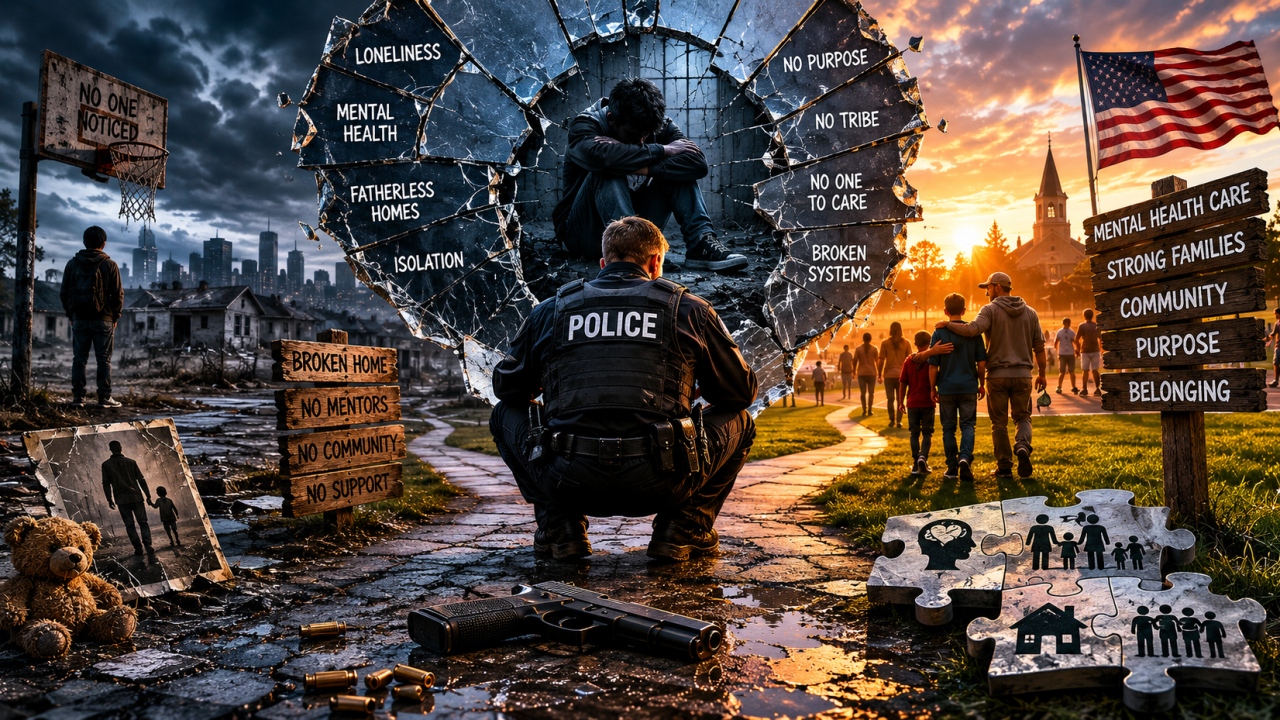
I have responded to enough crime scenes in my career to know what violence looks like up close. I have seen what a bullet does to a human body. I have knocked on doors in the middle of the night to deliver news that destroys families. I have sat with grieving mothers, stunned fathers, and children who will never be the same.
I have also carried a weapon every day for over two decades, in the streets of Iraq and the streets of Massachusetts. I know what a firearm is capable of. And I can tell you with absolute certainty: the gun is not the problem.
The gun is the last chapter of a story that started much earlier, in a broken home, an untreated mind, a community that stopped caring, and a society that stopped paying attention. If we keep arguing about the last chapter, we will never understand the book.
The Debate That Goes Nowhere
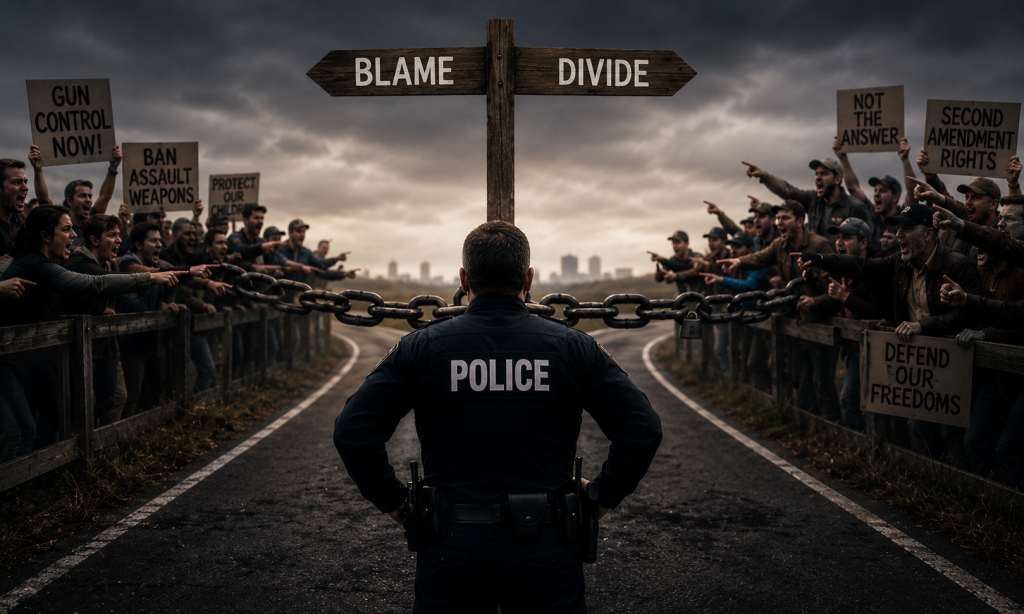
Every time a mass shooting tears through our news cycle, we have the same argument. One side demands gun bans. The other defends the Second Amendment. Both sides perform outrage for their base. Nobody fixes anything. And then it happens again.
I am not here to argue gun policy. Reasonable people can debate background checks, red flag laws, and safe storage. Those conversations have their place.
But they are not enough. Not even close. Because the conversation we are not having, the one that is harder and slower and doesn’t fit on a campaign ad, is the one about what is actually producing violent people in the first place.
In 2023, 27,300 people died by firearm suicide in the United States. The highest number ever recorded. Nearly six out of every 10 gun deaths were self-inflicted. Think about that. The majority of this crisis is not mass shooters in schools. It is people, alone, in despair, with no one left to reach them and no system that reached them in time.
That is not a gun problem. That is a human problem.
We Have Abandoned Mental Health
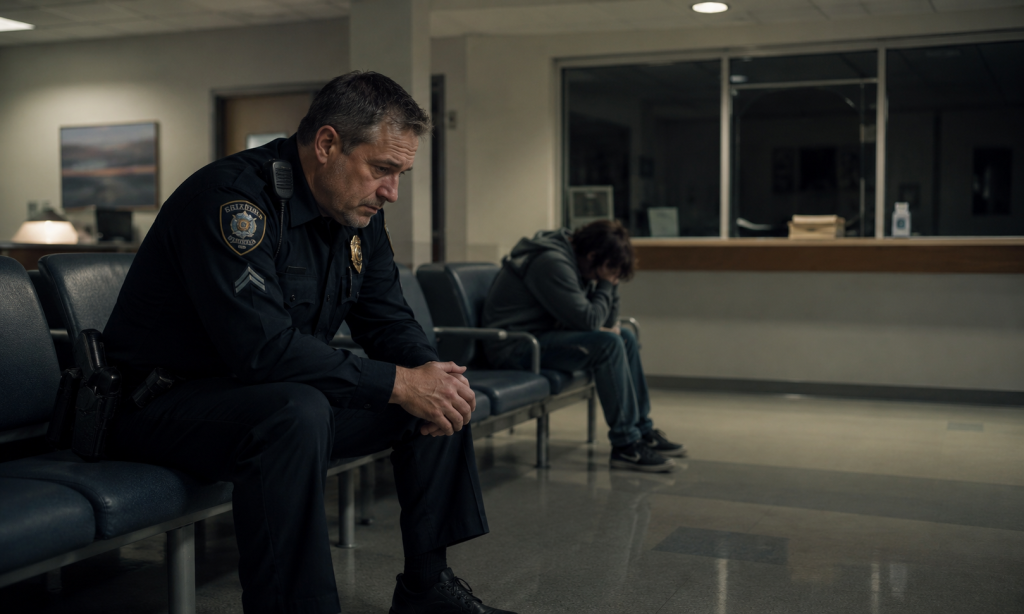
I have watched law enforcement become the de facto mental health system in this country. We are the ones who show up when someone is in crisis. We are the ones making split-second decisions about people who are suffering, dangerous, and completely untreated. That is not what we were trained to do. And it is not working.
The numbers are damning. As of 2024, more than 122 million Americans, over one-third of the entire country, live in areas officially designated as Mental Health Professional Shortage Areas. Seventy percent of U.S. counties have zero child and adolescent psychiatrists. Not a shortage. Zero.
More than 57 million Americans reported having some form of mental illness in recent years. Yet only 52% of adults with a mental illness received any treatment in the past year. Only 26.4% of mental health care needs across the country are actually being met.
We do not have a gun problem. We have a health care abandonment problem.
I have sat across from people who were one bad week away from a catastrophic decision. Many of them tried to get help and were turned away, or put on a waiting list, or couldn’t afford it, or lived somewhere that simply had nothing to offer them. We wait until the crisis explodes, until there is a body, or an arrest, or a headline, and then we argue about the weapon.
That is backwards. That is negligence dressed up as policy debate.
The Loneliness Is Killing People

In May 2023, U.S. Surgeon General Dr. Vivek Murthy declared loneliness and social isolation a public health epidemic. His advisory found that approximately half of American adults were experiencing measurable loneliness. The health impact of that isolation is equivalent to smoking 15 cigarettes a day. It increases the risk of premature death by 29%.
I believe it. I have seen it in the field. I have seen men who had nothing, no family, no friends, no community, no purpose, and watched them spiral. Some ended up in handcuffs. Some ended up in the morgue. Some ended up in both.
For most of human history, people were embedded in something. A family. A church. A neighborhood. A unit. Those structures were not just social comfort. They were early warning systems. When someone started to unravel, people noticed. People intervened. People cared enough to say something.
That scaffolding is gone for too many Americans. Civic organizations have hollowed out. Religious communities have shrunk. Social media creates noise but not connection. Robert Putnam documented this collapse in Bowling Alone more than 20 years ago. The trends have accelerated since.
What fills the void? Rage. Ideology. Nihilism. Online communities built around grievance. We have created a generation of people, particularly young men, who have no tribe, no mission, and no one who would notice if they disappeared. That is a powder keg. The gun is just the spark.
The Family Has Collapsed, and Nobody Wants to Say It
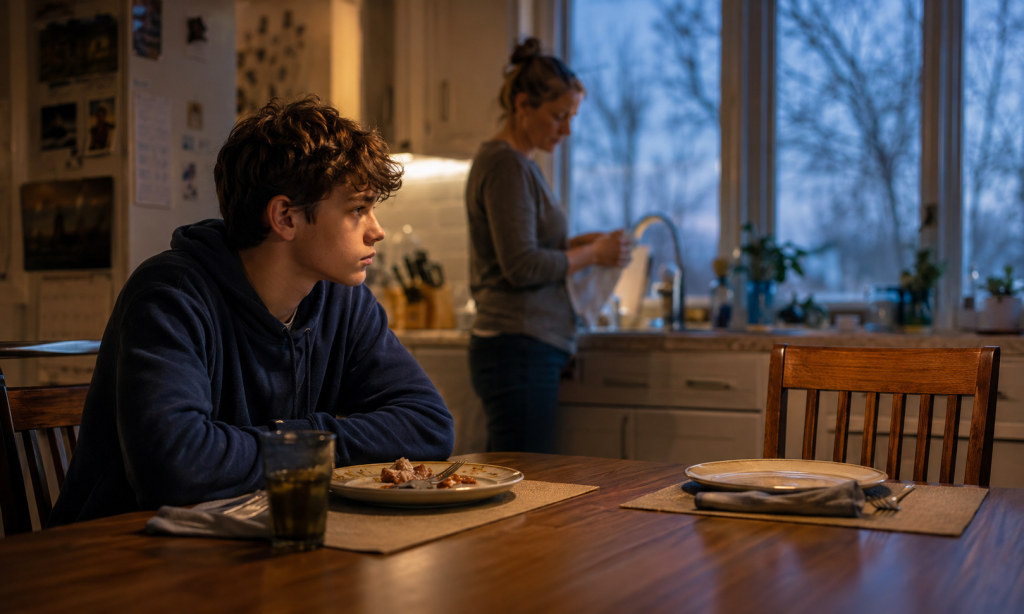
According to the U.S. Census Bureau, approximately 18.3 million children, roughly one in four, live without a father in the home. The United States has the highest rate of single-parent households of any nation on earth. More than three times the global average.
The data that follows is not comfortable, but it is real. Sixty-three percent of youth suicides come from fatherless homes. Seventy-one percent of high school dropouts. A 2023 analysis by the Institute for Family Studies found that cities with high levels of single parenthood had violent crime rates 118% higher and homicide rates 255% higher than cities with intact family structures. In a study of 56 school shootings, only 18% of the perpetrators were raised in a stable two-parent home.
I am not pointing fingers at single mothers. I have seen single mothers do extraordinary things under impossible circumstances. But I have also seen what the absence of a father does to a boy who is trying to understand what it means to be a man. I have seen the void it leaves. I have seen what moves in to fill it.
Harvard sociologist Robert Sampson concluded that family structure is one of the strongest predictors of violent crime variation across American cities. This is not ideology. This is data. And we refuse to talk about it honestly because it has become politically radioactive.
So instead, we argue about the gun.
The Institutions That Used to Catch People Are Failing
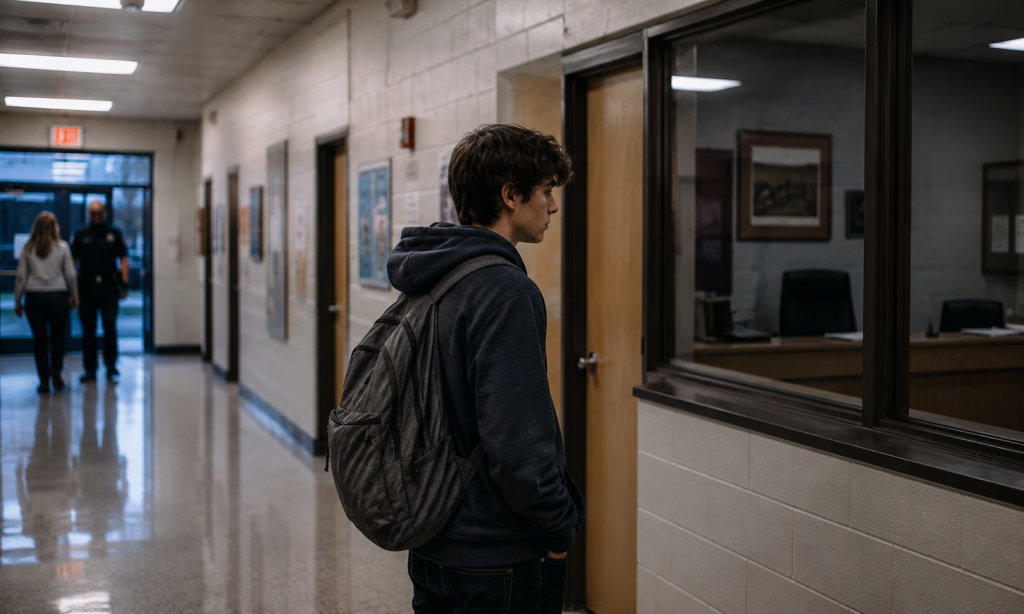
When I was in Iraq, the Army gave me structure, discipline, mission, and brotherhood. It did not fix everything. But it gave me something to belong to, something to fight for, and people who would notice if I was struggling.
Here is what should alarm every American: a 2020 Pentagon study found that 77% of young Americans between the ages of 17 and 24 cannot qualify for military service without a waiver. Not because they don’t want to serve, but because their bodies and minds are already broken. Obesity. Drug and alcohol abuse. Mental health disqualifications. That number was 71% in 2017. It is trending the wrong direction, and it is accelerating.
Think about what that means. Nearly eight out of 10 young Americans cannot pass the basic threshold to serve their country. The military is not turning them away because there is no room. The branches have actually met or exceeded their recruiting goals in 2024 and 2025. The problem is not opportunity. The problem is that we are producing a generation that cannot meet even a baseline standard of physical and mental fitness.
That is not a recruiting crisis. That is a societal health crisis wearing a uniform.
Schools in under-resourced communities have become overwhelmed triage centers. Teachers are asked to be counselors, surrogate parents, social workers, and educators simultaneously, with resources that rarely match the mandate. Seventy-one percent of teachers and 90% of law enforcement officials report that lack of parental supervision at home is a primary driver of school violence.
There are times at work when a parent calls 911 because their teenage child doesn’t want to get out of bed for school. I remember, during a command staff meeting, the chief mentioned that and made a statement that should make everyone think. He said, “People keep asking for less governmental intrusion into homes, yet they call us to help get their kids out of bed.”
Just think about it. A parent calls the government because their child refuses to get out of bed for school. Now you may think, well, why do the cops go to those? By law, police officers are required to respond to any 911 emergency call.
The systems that used to catch people before they fell are either gone, underfunded, or crushed under the weight of problems they were never designed to solve.
What the Police See That Nobody Else Does
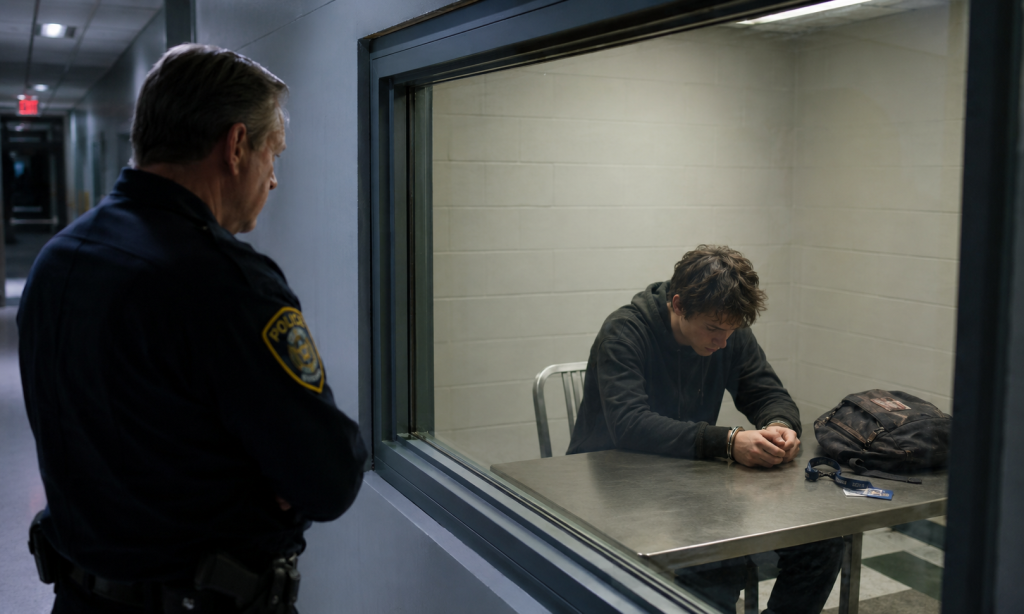
I have worked in plainclothes units, narcotics, detectives, a DEA task force, and street interdiction. I have arrested people who, if you traced their life back, failed at every checkpoint.
Broken home. No mental health intervention. No mentors. No community. No purpose. By the time they were in front of me in handcuffs, a dozen systems had already failed them, years or decades before I ever met them.
We get the last look. By the time law enforcement shows up, the failure is complete. The violence has already happened or is about to. We are not the solution to this problem. We are the final line of a very long chain of neglect.
A firearm is what made the violence irreversible and final. But everything that brought a person to that point happened long before they picked it up.
If we want to reduce gun violence, we have to work backwards from the trigger. Not to the gun. To the person. To the family. To the community. To the mental health system. To the culture. That is where the answers are.
Every time we have this argument, guns vs. rights, control vs. freedom, we fail the people who died. We fail them because we are performing a debate instead of solving a problem.
Treating mental health care as infrastructure, the way we treat roads and hospitals, is not a radical idea. It is a basic investment in the stability of the society we claim to care about. Rebuilding community institutions, being honest about family structure, and asking what we owe to young men who are failing and adrift before they reach the breaking point are not political positions. They are responsibilities.
The countries that have actually reduced violence have not done it by addressing guns alone. They have done it by creating societies where fewer people reach the point of no return. By investing in belonging. In treatment. In purpose.
We keep choosing the argument we can have loudly over the work that would actually help.
I have been in the arena long enough, on the battlefield and on the streets, to know that you do not win a fight by staring at the weapon pointed at you. You win by understanding where the threat is coming from, what is driving it, and how to neutralize it at the source.
The gun is the weapon. The threat is everything that created the person holding it.
Nearly six in 10 gun deaths in this country are suicides. That is not a weapons crisis. That is a hopelessness crisis. That is what happens when a society stops investing in its people, stops building community, stops catching the ones who are falling, and then acts surprised when they hit the ground.
We owe it to the dead, and to the living who are still on that edge, to do better than this. Stop staring at the muzzle flash. Follow the fuse. All the way back to where it was lit. That is where the real work begins.

Sources:
- Firearm Violence in the United States: 2023-2024, by Johns Hopkins Center for Gun Violence Solutions (Johns Hopkins Bloomberg School of Public Health)
- Our Epidemic of Loneliness and Isolation, by U.S. Surgeon General Dr. Vivek H. Murthy (U.S. Department of Health and Human Services)
- Behavioral Health Workforce Brief, by Health Resources and Services Administration (U.S. Department of Health and Human Services)
- Mental Health Care Access Analysis, by Kaiser Family Foundation (Kaiser Family Foundation)
- Stronger Families, Safer Streets, by Institute for Family Studies (Institute for Family Studies)
- Workforce Policy Statement, by American Academy of Child and Adolescent Psychiatry (American Academy of Child and Adolescent Psychiatry)
- America’s Families and Living Arrangements: 2022, by U.S. Census Bureau (U.S. Census Bureau)
- School Shooting Study, by Peter Langman (Peter Langman)
- Bowling Alone, by Robert D. Putnam (Simon & Schuster)
_____________________________
Ayman Kafel is a patrol sergeant, combat veteran, and founder of Project Sapient, with more than 20 years of operational experience. He served in Iraq as a U.S. Army soldier and translator and has worked in law enforcement roles including SWAT, DEA task force work, and plainclothes interdiction; he also holds a master’s degree in counterterrorism. For The Havok Journal, he writes from that background on law enforcement, service, training, stress, resilience, and national security, often focusing on the physical and psychological demands of high-stress work. Follow Project Sapient on Instagram, YouTube, and all podcast platforms for engaging content. He can be reached at ayman@projectsapient.com.
As the Voice of the Veteran Community, The Havok Journal seeks to publish a variety of perspectives on a number of sensitive subjects. Unless specifically noted otherwise, nothing we publish is an official point of view of The Havok Journal or any part of the U.S. government.
Buy Me A Coffee
The Havok Journal seeks to serve as a voice of the Veteran and First Responder communities through a focus on current affairs and articles of interest to the public in general, and the veteran community in particular. We strive to offer timely, current, and informative content, with the occasional piece focused on entertainment. We are continually expanding and striving to improve the readers’ experience.
© 2026 The Havok Journal
The Havok Journal welcomes re-posting of our original content as long as it is done in compliance with our Terms of Use.


