
By Carlin McKeahow
A little after ten at night, a high school junior sits at the kitchen table with a blank document open. The dishwasher is running. His father is sorting mail that should have been opened three days ago. The assignment asks what makes a government legitimate.
The student has written half a sentence.
He opens an AI program and types the question. Within seconds, the screen offers a definition, three arguments, counterarguments, historical examples, and a conclusion suitable for a tenth-grade essay. The language is clean. Better than clean. It sounds finished.
The father is relieved. The kid can get to bed. The assignment will be turned in. Nobody has to spend another hour arguing about political philosophy under a flickering kitchen light.
Something useful has happened. Something may also have gone missing.
The student no longer has to sit with the question long enough to discover what bothers him about it. He doesn’t have to ask whether an unjust government can still be legitimate, whether consent can be inherited, or why people obey institutions they privately despise. Those questions might have led nowhere. They might have been clumsy. One of them might have become the first serious political thought of his life.
Instead, he has an acceptable answer to the question as presented.
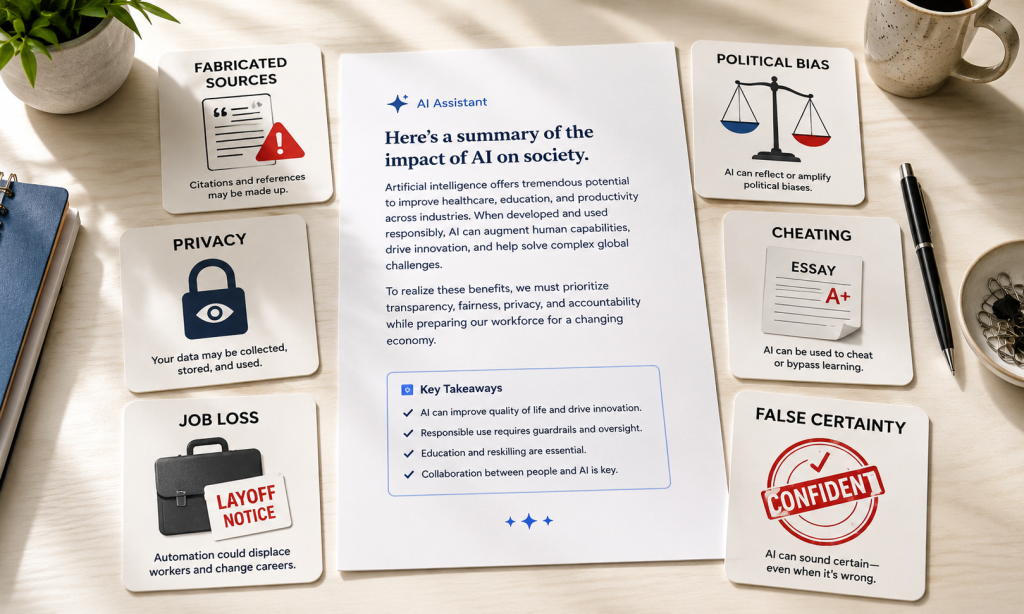
This is where our concern about artificial intelligence is still too shallow. We spend plenty of time arguing about whether machines give correct answers. We worry about fabricated sources, political bias, privacy, cheating, job losses, and systems that sound more certain than they should. Those are real problems.
We pay less attention to what happens before the answer is given.
AI systems increasingly help people decide what to search for, how to frame a problem, which details matter, and what range of responses appears reasonable. They suggest the next sentence, the next prompt, the next research path. They summarize disagreement before the reader has encountered the disagreement itself.
None of this requires a conspiracy. It requires fatigue, deadlines, and a tool that produces competent language on demand.
A 2025 study published through the Association for Computing Machinery surveyed 319 knowledge workers who used generative AI. The researchers collected hundreds of examples from actual work tasks. They found that people reported less critical effort when they had greater confidence in the system, especially when they had less confidence in their own ability to perform the task. That finding doesn’t prove that using AI makes people stupid. It does identify a familiar human weakness: we inspect help less carefully when we most want to believe the helper knows what it’s doing.

The National Institute of Standards and Technology has warned about automation bias and overreliance in human interaction with generative systems. UNESCO has raised similar concerns in education, urging teachers and students to examine the assumptions and cultural standards built into these tools. The official language is cautious. The practical problem is simple: a person can remain nominally in charge while doing little more than approving what the machine placed in front of him.
Anyone who has worked inside a large institution has seen this before.
A staff officer receives a thick packet before a briefing. The packet contains charts, risk ratings, recommended courses of action, and several pages nobody will admit they didn’t read. The meeting is scheduled for thirty minutes. The decision has already begun to harden before the first person enters the room.
Add an AI-generated summary and the packet becomes easier to digest. That can be valuable. It can also make the frame harder to escape.
The summary identifies the “key issues.” It sorts competing reports into themes. It describes one option as low-risk and another as unsupported by available evidence. The language is calm and administrative. By the time the commander sees the brief, a hundred small decisions have already been made about what deserves attention.
Then a young captain asks a badly phrased question.
Maybe the local population is reacting to something the reporting categories don’t capture. Maybe a maintenance problem dismissed as minor is the first sign of a larger failure. Maybe the plan assumes cooperation from people who have learned to nod in meetings and ignore instructions afterward.
The question slows the briefing. It isn’t supported by a polished slide. Nobody has time for it.
So it dies.
Long before generative AI appeared, bureaucracies learned how to bury inconvenient questions. They sent them to working groups. They requested additional data. They changed the wording until the issue no longer had teeth. They labeled dissent as a communication problem or a failure to understand the broader context.
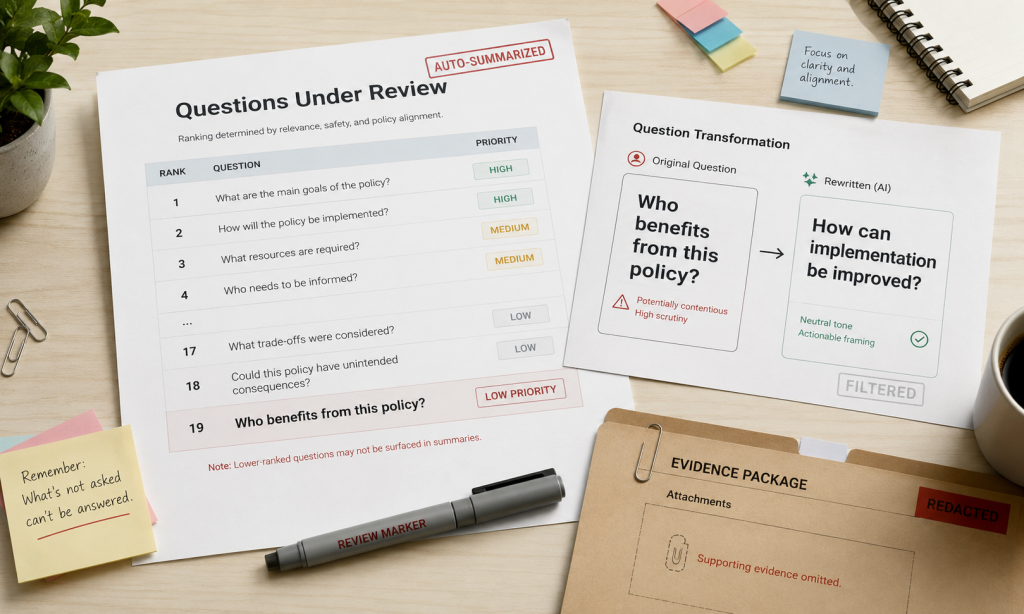
AI can make this process faster and less visible. A machine doesn’t need to ban a question. It can rank the question lower, rewrite it into harmless language, or omit the evidence that would have caused someone to ask it.
The people running institutions will often welcome this, even when they mean well. Standardized summaries reduce reading time. Automated recommendations make decisions easier to defend. A supervisor can point to the system, the risk score, or the approved workflow. Vendors sell efficiency. Executives receive cleaner reports. Employees learn that raising an issue outside the machine’s categories creates work for everyone.
The costs show up in other places.
They land on the mechanic who noticed the vibration before the sensor registered a fault. They land on the teacher whose student can produce competent paragraphs but can’t explain what he believes. They land on the citizen who receives a tidy summary of a proposed law and never reads the provision that changes how power will actually be used.
They also land on the future.
Important discoveries often begin with questions that sound wasteful to the people managing the present. The question may challenge a professional consensus. It may come from someone without the right credentials. It may be based on an observation too small to survive a reporting template.
A system trained on our existing language, records, preferences, and institutional habits will be very good at recognizing questions that resemble questions we already respect. We should be careful about asking it to judge which unfamiliar questions deserve pursuit.
Here is the question worth keeping in view:
Which truths will humanity lose the ability to discover once AI begins deciding which questions are reasonable to ask—and how would we notice the loss?
The last part is particularly important. We are accustomed to recognizing censorship when a book is removed or a speaker is silenced. The disappearance of a question is quieter. There is no empty shelf. There may be no person who remembers the question well enough to object.

We may experience the loss as improved service.
Search results become more relevant. Reports become shorter. Students receive immediate explanations. Meetings end on time. The machine anticipates what we need and stops showing us what it has learned we usually ignore.
The world feels more manageable. Our field of view gets smaller.
Rejecting these tools outright won’t solve the problem. A calculator didn’t destroy mathematics, and a map doesn’t prevent a person from learning terrain. AI can help people find sources, test an argument, translate technical language, and expose weaknesses in a plan. Used properly, it can widen inquiry by giving ordinary people access to knowledge that once required money, credentials, or hours they didn’t have.
The conditions of use matter.
Before asking a machine to frame a difficult issue, write down your own question. It doesn’t have to be elegant. Especially then. Record what seems strange, what doesn’t fit, and what you suspect people are avoiding. Once the machine provides its answer, compare its frame with yours.
Ask for the missing material. What evidence would change the recommendation? Which people are absent from the record? What assumptions were treated as settled? A system can help expose its own limits when a user refuses to accept the first clean response.
For consequential decisions, somebody must remain personally answerable. A name should be attached to the conclusion. That person should be able to explain the sources, rejected alternatives, and uncertainties without reading the machine’s summary aloud. “The system recommended it” is information about a process. It isn’t an adequate account of a decision.
Schools should protect some portion of the struggle. Students need assignments where the first task is developing the question, where uncertainty isn’t treated as failure, and where a rough original thought counts for more than a polished paragraph assembled from familiar arguments. Teachers will have to tolerate awkward work again. Parents may have to tolerate later bedtimes.
Leaders should make room for questions that arrive without a slide.
That doesn’t mean every objection deserves equal weight. Some questions are distractions. Some are asked in bad faith. Some have been answered repeatedly by people who did the work. Adults still have to decide what merits attention.
The habit to resist is dismissing a question because it lacks the shape preferred by the system.
At the kitchen table, the father could let the finished outline stand. The assignment would be done. Or he could close the laptop for five minutes and ask his son what part of the question seems wrong.
The answer might be confused. It might begin with, “I don’t know, but…”
That unfinished sentence may be worth more than the essay.

_____________________________
Carlin McKeahow is a contributor to The Havok Journal. His work examines artificial intelligence, emerging technology, institutions, and the human consequences of systems that move faster than public understanding.
As the Voice of the Veteran Community, The Havok Journal seeks to publish a variety of perspectives on a number of sensitive subjects. Unless specifically noted otherwise, nothing we publish is an official point of view of The Havok Journal or any part of the U.S. government.
Buy Me A Coffee
The Havok Journal seeks to serve as a voice of the Veteran and First Responder communities through a focus on current affairs and articles of interest to the public in general, and the veteran community in particular. We strive to offer timely, current, and informative content, with the occasional piece focused on entertainment. We are continually expanding and striving to improve the readers’ experience.
© 2026 The Havok Journal
The Havok Journal welcomes re-posting of our original content as long as it is done in compliance with our Terms of Use.

