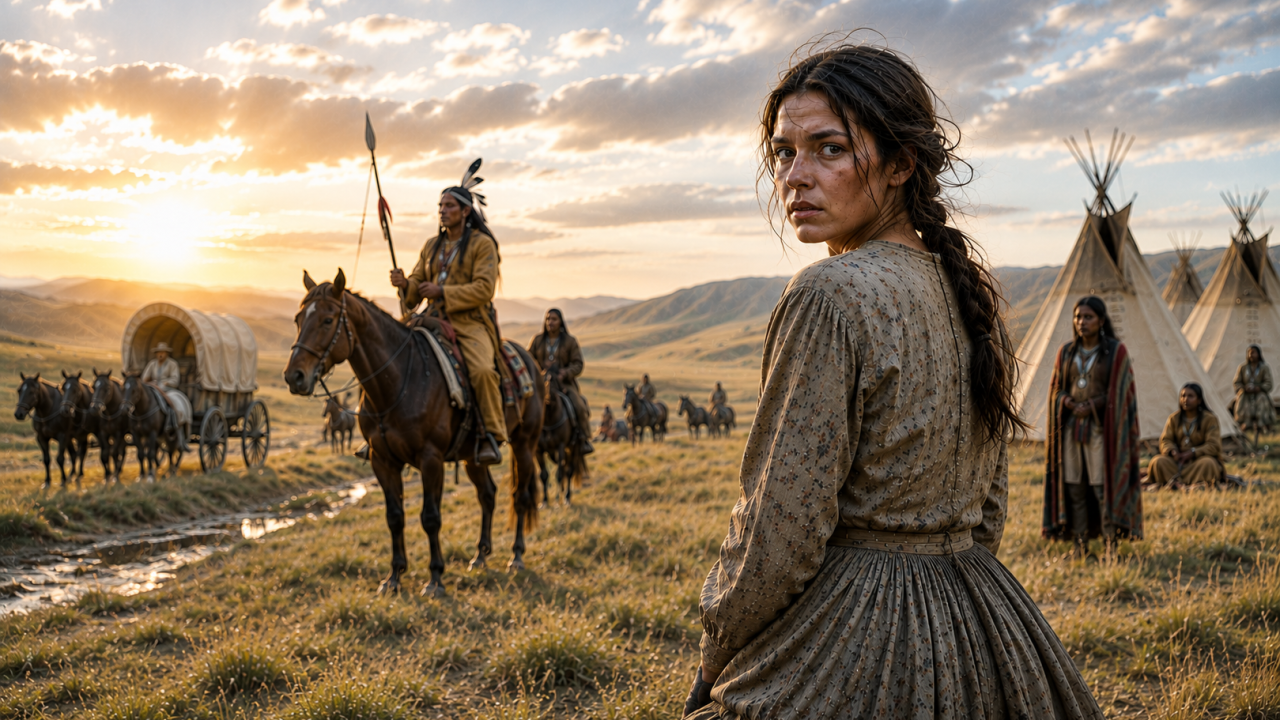
History remembers spectacular battles. It remembers famous generals, decisive campaigns, and treaties that redrew maps. Far less often does it remember the ordinary people who happened to find themselves caught between those events. Their stories rarely shape strategy or alter the course of nations, yet they often reveal more about the human cost of conflict than any official report ever could. One of those people was Fanny Kelly.
Although her name has largely faded from public memory, her story remains one of the most remarkable personal accounts to emerge from the American frontier. It is a story of survival, endurance, trauma, and resilience. It is also a reminder that war does not begin or end on battlefields. It engulfs families, travelers, and civilians who often have little understanding of the forces pulling them into history.
In May 1864, Fanny Kelly and her husband, Josiah, joined an emigrant wagon train bound for the Idaho Territory. Like thousands of Americans moving west before, during, and after the Civil War, they hoped to build a better future beyond the settled frontier. The timing, however, could hardly have been worse.
The Great Plains were in turmoil. Only two years earlier, the Dakota War of 1862 had erupted in Minnesota, leaving hundreds of settlers and Native Americans dead. In response, the U.S. Army launched punitive expeditions against various Dakota and Lakota bands, driving many farther west. The result was not peace but displacement. As military pressure increased, violence spilled onto the emigrant trails leading toward Montana and Idaho. What many pioneers viewed as an opportunity for a new beginning was, in reality, a route through an active conflict zone.
On July 12, 1864, Kelly’s small wagon company was attacked near present-day northeastern Wyoming by Oglala Lakota warriors. Several members of the party were killed almost immediately. Others escaped. Fanny Kelly did not. She and a young girl traveling with the wagon train, Mary Hurley, were taken captive.
For the next five months, Kelly marched hundreds of miles across what are now Wyoming, Montana, North Dakota, and South Dakota. She experienced hunger, exhaustion, repeated threats of execution, and constant uncertainty about whether she would survive another day. She attempted escape more than once. Each failure increased the danger. Several times she believed death was imminent.
Yet her captivity narrative is striking for another reason. That’s because it is not simply a story of brutality, but also a story of complexity. Kelly described acts of violence committed by some of her captors, but she also wrote about individuals who protected her, shared food, intervened to save her life, or treated her with unexpected kindness. Chiefs such as Jumping Bear appear repeatedly in her account as men whose decisions often determined whether she lived or died. Even amid extraordinary hardship, Kelly resisted reducing every Native American she encountered to a single stereotype.
That nuance deserves attention today.
Modern discussions of the American frontier often gravitate toward absolutes. One side portrays westward expansion as heroic civilization. The other views it exclusively through the lens of conquest and dispossession. Reality was considerably messier.
Fanny Kelly found herself caught between two societies already at war. Neither side experienced the conflict in simple moral terms. The Army was attempting to secure transportation routes and settlements for a rapidly expanding nation. Many Plains tribes were fighting against what they viewed as an existential threat to their lands, cultures, and survival. Civilians like Kelly occupied the dangerous space between those competing objectives.
Military professionals should recognize this dynamic immediately. Modern warfare increasingly places civilians inside contested environments. Whether in Iraq, Afghanistan, Ukraine, Gaza, or countless other conflicts, ordinary people often become unwilling participants in struggles driven by political and military objectives beyond their control.
Fanny Kelly’s experience reminds us that this is hardly a modern phenomenon. The frontier was not merely a place. It was also an active operational environment. Her story also highlights another enduring military lesson: resilience is rarely dramatic.
Popular culture often portrays survival as a sequence of heroic moments. In reality, endurance usually consists of small decisions repeated over and over again. Keep walking. Endure another day. Preserve hope. Adapt to changing circumstances. Refuse to surrender psychologically even when physical freedom has disappeared.
Kelly’s greatest strength was not physical. More precisely, it was not just physical. It was mental. Again and again, she resisted despair despite having almost every reason to abandon it. Eventually, negotiations involving traders, Native intermediaries, and Army officers secured her release near Fort Sully in present-day South Dakota in December 1864. She was reunited with her husband shortly thereafter. The emotional reunion became one of the defining moments of her memoir. Tragically, the young girl Mary Hurley did not survive captivity, a loss that haunted Kelly for the remainder of her life.
Seven years later, Kelly published Narrative of My Captivity Among the Sioux Indians. Like many nineteenth-century captivity narratives, the book reflected both personal trauma and the cultural attitudes of its era. Historians have debated portions of her account, questioning specific details while generally accepting the broad outline of her experience. Today, the memoir remains an important primary source, not because it provides a complete history of the Plains Wars, but because it offers one woman’s firsthand perspective on a violent and transformative period in American history.
Military readers should approach Kelly’s story the same way they would any eyewitness account from a battlefield. Personal narratives are invaluable, but they are also often incomplete. Every participant observes only a fragment of the larger conflict. Strategic context often emerges only when many individual accounts are examined together. Kelly’s memoir tells us what captivity felt like. It does not explain every motivation of her captors any more than a soldier’s combat memoir fully explains the enemy’s strategy.
That limitation does not diminish its value. It defines it.
Perhaps that is why Fanny Kelly deserves to be remembered. Not because she was a general. Not because she won a battle. But because she reminds us that history is experienced one person at a time. Wars are ultimately measured not only in victories and defeats, but in lives interrupted, families separated, and individuals forced to discover reserves of courage they never imagined they possessed.
Fanny Kelly was one of those people. The frontier changed her forever. Fortunately for us, she lived long enough to tell us what it felt like.
_____________________________
Charles served over 27 years in the U.S. Army, which included seven combat tours in Iraq and Afghanistan with various Special Operations Forces units and two stints as an instructor at the United States Military Academy at West Point. He also completed operational tours in Egypt, the Philippines, and the Republic of Korea and earned a Doctor of Business Administration from Temple University as well as a Master of Arts in International Relations from Yale University. He is the owner of The Havok Journal, and the views expressed herein are his own and do not reflect those of the US Government or any other person or entity.
As the Voice of the Veteran Community, The Havok Journal seeks to publish a variety of perspectives on a number of sensitive subjects. Unless specifically noted otherwise, nothing we publish is an official point of view of The Havok Journal or any part of the U.S. government.
Buy Me A Coffee
The Havok Journal seeks to serve as a voice of the Veteran and First Responder communities through a focus on current affairs and articles of interest to the public in general, and the veteran community in particular. We strive to offer timely, current, and informative content, with the occasional piece focused on entertainment. We are continually expanding and striving to improve the readers’ experience.
© 2026 The Havok Journal
The Havok Journal welcomes re-posting of our original content as long as it is done in compliance with our Terms of Use.