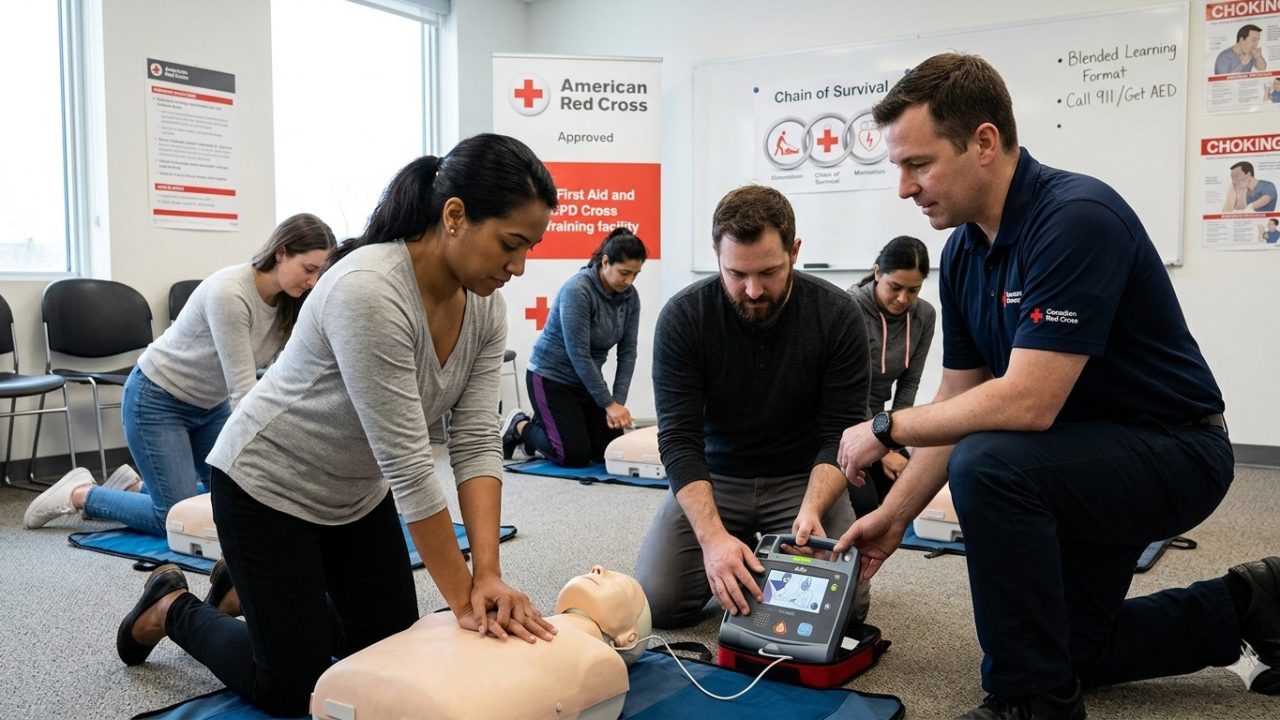
Veterans and first responders often experience a culture shock when transitioning to civilian life, specifically regarding how everyday people react to physical emergencies. This article explores the bystander effect, the reality of emergency response times, and the critical need for civilians to take ownership of their safety through accessible, blended First Aid and CPR certification.
You spend years in uniform training for the worst-case scenario. Muscle memory takes over when things go sideways. But when you transition to the civilian world, you quickly realize something unsettling. Most people simply do not know what to do in a medical emergency.
Whether you are in a crowded mall or a quiet neighborhood, the default civilian reaction to a crisis is usually panic. It is a dangerous gap in community readiness. Bridging that gap means taking personal responsibility. That is why veterans and everyday citizens alike are seeking out First Aid CPR Training to ensure they are never the bystander just waiting and hoping for an ambulance to arrive.
Let’s talk about why waiting is not a strategy, and what we can actually do about it.
Why do good people freeze under pressure?
We have all seen the videos. A car accident happens, or someone collapses on the sidewalk. Instead of jumping in to help, a dozen people pull out their phones to record. Or worse, they just stand there looking at each other.
It is called the bystander effect. It isn’t because people are malicious or cruel. It is because they lack the training to confidently take charge. When you don’t know the right steps, your brain assumes someone else in the crowd is more qualified.
But what if nobody else is qualified? What if you are the only one standing next to a person who is choking on a piece of steak at a restaurant? You cannot rely on the hope that an off-duty nurse happens to be sitting at the next table over. You have to be an asset.
What is the true cost of waiting for 911?
We have incredible emergency medical services in this country. Dispatchers are amazing at talking you through a crisis. But physics and traffic dictate reality.
If someone suffers sudden cardiac arrest, the clock starts instantly. Brain tissue begins to die after just four to six minutes without oxygen. In major cities, an ambulance might take eight, ten, or twelve minutes to navigate through gridlock to reach your location.
If nobody in the room knows how to do chest compressions, the odds of that person waking up drop by about 10% for every minute that passes. Those first few minutes belong to the bystanders. Knowing how to keep blood pumping to the brain until the paramedics wheel the stretcher through the door is literally the difference between life and death.
How does modern safety training actually work?
A major excuse people use for not getting certified is time. Nobody wants to burn an entire weekend sitting in a sterile classroom listening to someone read from a textbook. The good news is that the training industry finally modernized.
The standard approach now is Blended Learning. It works incredibly well for busy professionals and parents.
Here is the breakdown of how it works:
- Online Theory: You do the reading and the quizzes online. You can knock this out on your laptop from your couch.
- In-Class Skills: You go to a facility for a single day to practice the physical skills. You do the chest compressions on a mannequin. You practice using a real AED trainer.
- Full Certification: You walk away with American / Canadian Red Cross and WSIB/OHS approved credentials.
For those living or working around the nation’s capital, it is easy to find a schedule that fits. You can check out the options at https://www.c2cfirstaidaquatics.com/ to find a class near you. It is highly efficient and gets straight to the point.
What can we do to change the culture?
It starts with leading by example. If you are a parent, get trained so you know what to do if your kid takes a bad fall. If you run a business, get your team certified so your job site is actually safe.
We cannot control when a medical emergency will happen. We can only control how we react to it. Stop assuming someone else will step up. Take the class, learn the skills, and be ready to act when it counts.
FAQ: Practical First Aid Readiness
Q: Do I need a medical background to learn CPR? A: Not at all. Standard First Aid and CPR Level C courses are designed from the ground up for absolute beginners. They teach simple, repeatable steps.
Q: Is there legal protection for civilians who try to help? A: Yes. In Canada, Good Samaritan laws exist specifically to protect individuals who voluntarily step in to offer emergency medical assistance, provided they act reasonably and within the scope of their training.
Q: Does my certificate cover how to use a defibrillator (AED)? A: Yes. Modern Canadian Red Cross training integrates AED usage directly into the CPR curriculum. AEDs are designed to be foolproof, and the training removes the fear of using them.
Buy Me A Coffee
The Havok Journal seeks to serve as a voice of the Veteran and First Responder communities through a focus on current affairs and articles of interest to the public in general, and the veteran community in particular. We strive to offer timely, current, and informative content, with the occasional piece focused on entertainment. We are continually expanding and striving to improve the readers’ experience.
© 2026 The Havok Journal
The Havok Journal welcomes re-posting of our original content as long as it is done in compliance with our Terms of Use.


