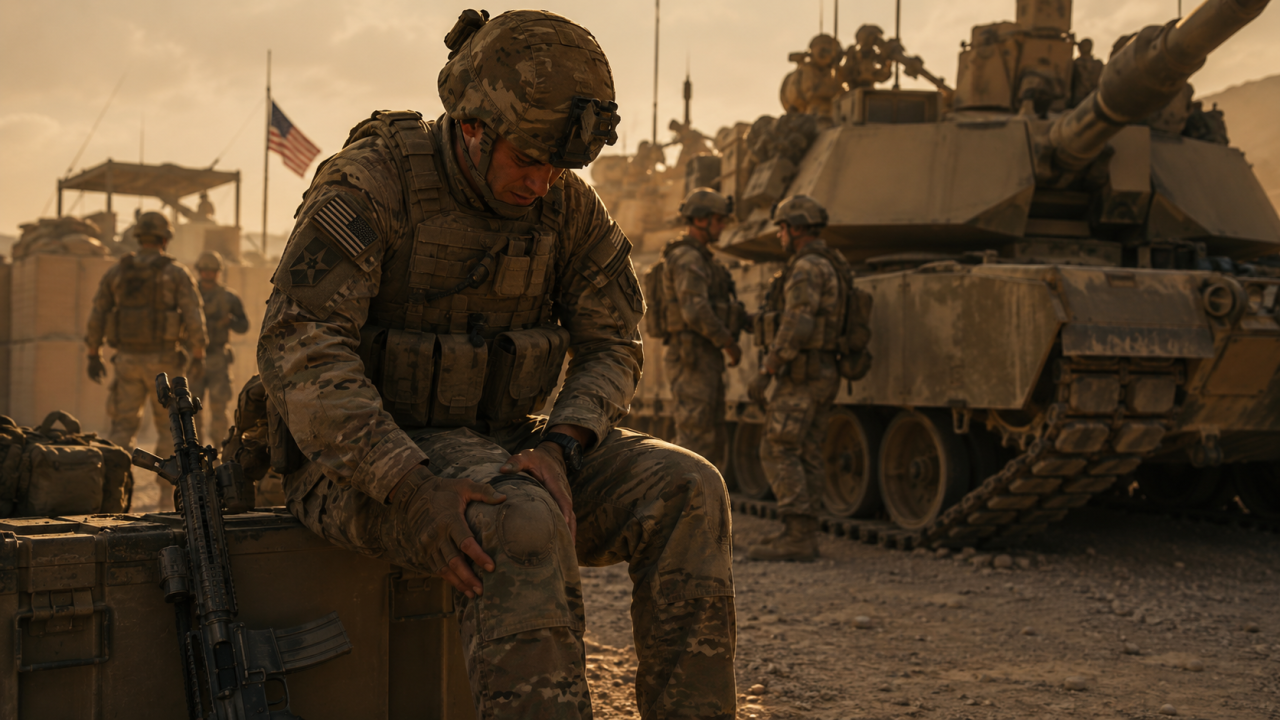
I joined the Army as an underdog. Strong on paper, useless in practice. Two kilometers into a run, I would gray out and throw up, only to end up doing it again the next morning.
That fight lasted about five months. Then my body stopped negotiating. By the time basic was behind me, we were logging more than 20 kilometers a day, and I served three years after that.
I made it through. But I didn’t walk out clean. My right knee never went back to the way it was.
And here is the part that puzzled me for years. The knee didn’t punish me for the hard stuff; it fired up during the most basic of tasks. A 30-minute drive in traffic became more than enough for my knee to bill me for the rest of the night.
Yes, I Got My Knee Checked
I went to appointments, and I did it a lot. The problem was that I didn’t have any dramatic blow or injury. So no doctor could diagnose something specific, and I didn’t blame them. It was simply an overuse injury that lasted for years.
Still, “live with it” was a polite phrase in place of “there’s no solution.” And it just didn’t register with me that I was just 32 and unable to drive for an hour without regretting it all night.
In short, conventional medicine didn’t work, so I approached chiropractors, herbalists, and even acupuncture therapy, all of which do work in the scientific sense. But for some reason, they just didn’t work for me.
At the end of the line, I came across a lesser-known concept: recovery garments.
What Are Recovery Garments?
On paper, recovery garments (or recovery wear) are pieces of clothing or sleeves designed to help your body recover. The concept is simple: put them on, and you’ll feel better.
Needless to say, I called out BS. Wear this and feel less pain? That doesn’t make any sense. I mean, it can’t be true, right?
But my pain had me desperate at this point. I’d already paid good money trying to get rid of the pain; what’s a bit more?
Still, despite my frustration, I decided to do some research first. I needed to know how such garments work and whether that’s based on any scientific evidence. Accordingly, this next part is information-heavy. Grab a cup of tea.
What Do Recovery Garments Do?
Recovery wear introduces nothing into the body. It redirects heat you’re already producing. Resting metabolism generates a continuous thermal output, most of which dissipates into the surrounding air and does nothing useful.
Recovery fabrics are engineered to intercept that output and return it to the tissue.
The mechanism sits in the fabric itself. Manufacturers embed semiconductor particles into the fibers during production. Skin contact raises those particles to their activation threshold, and they re-emit the absorbed energy as infrared radiation directed back into the underlying tissue.
Infrared here means the far end of the spectrum, wavelengths well below visible light, carrying no ultraviolet component and no burn risk. Unlike surface heat from a topical rub or a hot pack, these wavelengths penetrate past the epidermis and deposit energy in the tissue beneath.
Why Does Any of This Matter to You?
That penetration is what matters for a chronically overused joint. Degenerative and overuse conditions share a common feature: compromised local circulation.
Cartilage has no direct blood supply and depends on movement and surrounding perfusion for nutrient exchange. Reduced blood flow means slower delivery of oxygen and nutrients, and slower clearance of inflammatory byproducts.
Heat is the oldest and most consistently effective countermeasure, which is why every clinician reaching for a stiff joint reaches for warmth rather than ice.
The limitation has always been duration. A hot pack delivers 20 minutes of therapy and requires you to stay seated for it, which is the same static position that provokes the stiffness.
A garment, however, removes that constraint. It maintains the thermal input continuously, through a workday, a long drive, or a full night of sleep, which are precisely the intervals where a joint like mine deteriorates.
What’s the Science Behind Recovery Garments?
The concept made sense to me. Whether anyone had actually tested it was another question.
The functional component is the semiconductor material, typically germanium or carbon, sometimes both. Semiconductors occupy a middle ground in electrical conductivity, and the relevant property here is their behavior under mild thermal load.
Above roughly 32°C, which is normal skin surface temperature, electron activity in these materials increases enough to produce measurable infrared emission and negative ion release. The energy source is the wearer. No external power is involved.
What Happens Next?
The downstream effect is vasodilation (a fancy word for widening of the blood vessels). Infrared energy absorbed by tissue raises local temperature marginally, which triggers the blood vessels in that region to widen.
Wider vessels carry more volume, which increases oxygen and nutrient delivery and accelerates removal of inflammatory metabolites. For a joint operating with a circulatory deficit, that’s a direct correction of the underlying problem rather than a mask over the symptom.
This Is Actually Grounded in Science
The clinical work is recent but consistent. A 2025 controlled trial published on PubMed by J. Funct Morphol Kinesiol put active adults through a resistance protocol and assigned them either a far-infrared garment or a visually identical placebo.
At 24 and 48 hours, the infrared group showed significantly better neuromuscular recovery, measured through force production and jump performance, alongside faster subjective readiness to resume training.
The authors attributed the difference to improved peripheral blood flow, enhanced tissue oxygenation, and accelerated metabolic clearance.
In short, the early evidence pointed the right way, and with nothing chemical involved, the downside looked limited. So I decided to give it a try. And to my surprise, there are major brands advertising such a concept.
I’ll spare you the back and forth; I ended up getting a knee sleeve from a brand called Thermo Recovery Wear.
My Experience With Thermo Recovery Wear
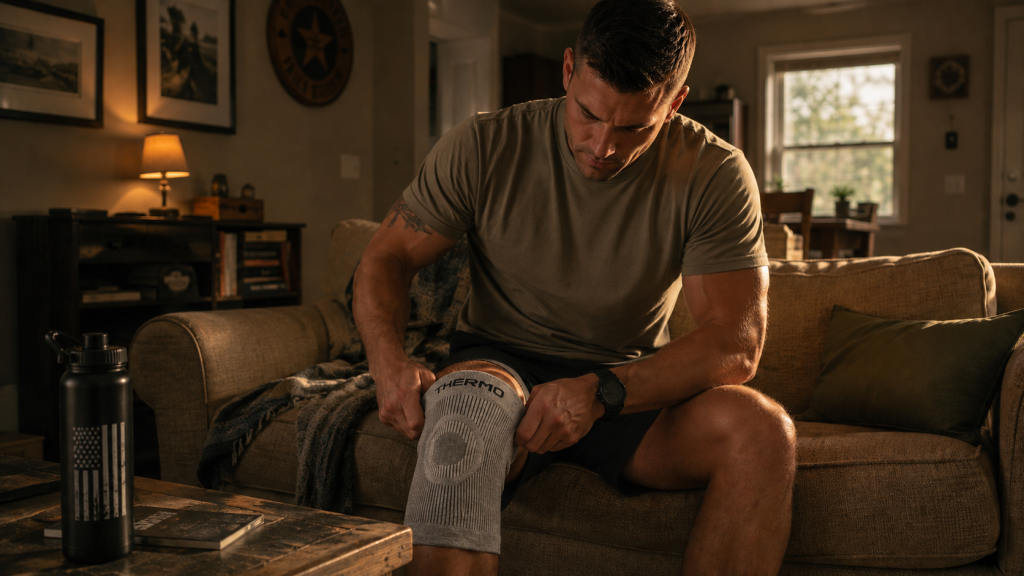
I found some positive reviews of this brand, and their prices seemed a lot more manageable compared to others. They had three knee sleeve options: comfort, classic, and support, with the latter having a few stays to support you while running.
Each one had five different sizing options and even a handy sizing guide that made my first purchase, the comfort circulation knee sleeve, a good fit.
Upon receiving the sleeve, I wasted no time putting it on. My first impressions were as follows: The sleeve is surprisingly comfortable and forgettable. You can wear it under your pants and go on with your day, and your brain won’t even sense it anymore.
Later that night, I still went to bed with the usual knee pain, and it took its usual 90 minutes off of my sleep before I could fall asleep. However, I read somewhere that these sleeves work best overnight, and since I felt no blood restriction throughout the day, I indeed kept it on while sleeping.
The Next Day Was a Strange One
I still woke up with the usual pain, and I braced myself for the pain spike as I stood up, but for the first time in as long as I can remember, it was not there.
The dull aching pain itself was there, but the pain in the first few steps away from bed was almost non-existent.
It could be a fluke; it could be a mental placebo; I didn’t know. I just started my day, kept it on, and went to work.
That night, the end-of-day pain was there, but noticeably less.
My 3-Month Progress
Since then, I kept the sleeve on. Unless I needed to shower or wash it, it was always on my knee. I didn’t base this on any instructions; I just wanted to get the most I could out of this.
After 3 months, I can say that at least 70% of my pain was gone. Some of it still lingered, but it was a lot more manageable than it was. I could drive longer, sleep better, and walk around with a lot more confidence. That was more than enough for me.
Do I Recommend Thermo Recovery Wear?
The short answer is yes. As long as you’re managing your expectations properly, using the sleeves as instructed, and not expecting a (snap-on, pain-gone) situation. Thermo Recovery Garments actually work.
They’ve expanded their storefront to include every major joint in the body, like the shoulders, elbows, ankles, and hips. They even have sleeves for your wrists and fingers, all of which utilize their trademark Germanium Carbon Bioactive Infrared Fabric™ Technology.
Additionally, the owner of the brand says he reads every email personally and responds when he can. Haven’t tried that myself, but I still appreciate this kind of personal touch.
I decided to write this out of good intentions to help others. The point is, if it worked for me, maybe it can work for you too. If you have lingering pain from an old service injury, maybe it’s time to give yourself a little break from it. It could be just what you need.
Buy Me A Coffee
The Havok Journal seeks to serve as a voice of the Veteran and First Responder communities through a focus on current affairs and articles of interest to the public in general, and the veteran community in particular. We strive to offer timely, current, and informative content, with the occasional piece focused on entertainment. We are continually expanding and striving to improve the readers’ experience.
© 2026 The Havok Journal
The Havok Journal welcomes re-posting of our original content as long as it is done in compliance with our Terms of Use.

