by Duncan Rhinehart
[Editor’s Note: “A Peculiar Drug” is more than a reflection on emergency medicine—it’s a meditation on purpose, pain, and the strange beauty found in chaos. More than a year after its original publication (May 22, 2024), this isn’t a timely reprint, but in my opinion, it’s both a worthy and necessary one.]
It started with a TV show.
I was at the house of a high school friend, enjoying sweet tea and home cooking after an afternoon of lawn work. Her father was watching the late 90s medical drama “ER,” starring Anthony Edwards (of Top Gun fame) along with Noah Wyle, George Clooney, and Julianna Margulies. I can’t remember the episode or even all of the circumstances, but I clearly remember being spellbound by a team shouting and working a bloody, traumatic resuscitation.
At the time, I was planning on a totally different vocation as a Christian minister, and I didn’t quite know what an EMT did—that they worked on ambulances and “knew things” (one could have convinced me they knew almost anything at the time) seemed to be my only vague impression. All I did know after that episode was that I wanted a piece of the action, and I wanted to be accorded their knowledge. I quickly convinced myself that some medical training would be appropriate and useful in a remote mission’s work (which really is true but wasn’t the main point) and in the relative calm of a 2021 post-COVID semester break from school, I enrolled in an eight-week accelerated-format EMT course.
As the course started, I made decent grades, got along with my fellow students, and learned quite a bit of interesting facts and skills. We laughed during scenarios and seriously interacted with our experienced and professional instructor, a down-to-earth retired Coast Guardsman. I learned the difference between an EMT and a paramedic—that a paramedic gets to do the majority of the “cool stuff,” and the EMT usually just helps out and is mostly a transportation and monitoring specialist (however, we still get cool uniforms and a bit of social respect too, so that assuaged whatever disappointment there was in the lack of ability to start IVs or perform intubations.)

But I was unknowingly sleepwalking into a job with little idea of the American healthcare structure, the socio-economic environment I’d be working in and, even more importantly, of the kind of work I’d actually be doing most of the time. I was on a path to potential disillusionment and burnout, ending in poor care, resentment, and even bad physical, mental, and spiritual health.
Until I saw a book on my instructor’s desk with an eye-catching title. A Thousand Naked Strangers. What the heck? I thought. The tagline below read “A Paramedic’s Wild Ride to the Edge and Back,” which served to dispel some of the shock but only added to my interest. When I got home that night I bought it on kindle. As I read, ten-year Atlanta paramedic Kevin Hazzard cued me into the mystery-turned-reality that is prehospital emergency care. I was shown the contrast between depressing, apathetic bureaucracy, but also the amazing capabilities and coordination possible in public service; I read about the tragic events, and other times good outcomes; the wild patients, and the sweet ones; the good providers, and the bad ones; the whacky calls, and the mundane runs. I was shown real EMS in all of its glory (or infamy.)
And I also learned my true role as an EMT. Sure, I was to transport, give a couple medications, write certain numbers down, and ask certain questions. But it entailed more than that. I came to learn that I also would be a person to show up on the worst day of some people’s lives. I would be a stand-in child or grandchild, by necessity an amateur social worker and counselor, and for some, a witness and an usher into death or, more rarely, life—right this way, please, sir or madam. It’s not an exaggeration to say that book single-handedly gave me the expectations and mindset regarding prehospital emergency medicine that I carry to this day, and by the time I graduated EMT school, I was mentally prepared for the job at hand.
Since finishing training, I have worked in many environments and experienced many things, younger EMT though I am. I’ve worked on ALS ambulances (Advanced Life Support, requiring a paramedic) and BLS units (Basic Life Support—just EMTs.) I’ve worked in ERs and psychiatric units. I’ve worked in mid-sized busy hospitals and small sleepy ones, urban cities and empty rural counties. I’ve sampled most of what medicine has to offer at the EMT level, and I’ve loved it. I’ve also gained a few things in these few years of intermittent EMS.
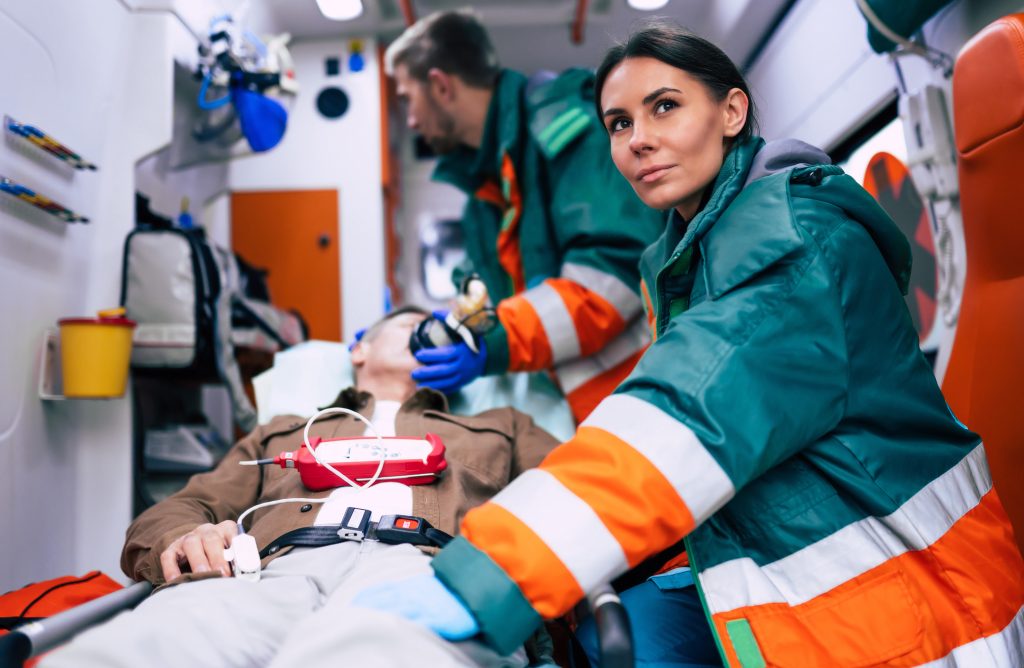
I have so many stories. The happy and humorous ones run by my mind’s eye with a wave and a smile. Like the first-time drunk teen who required myself, a medic, a sheriff’s deputy, and two firefighters to wrestle and tie him into an ambulance gurney; or the antics of my partner Tom, who’d been riding on ambulances since the Cold War and was a god-like figure to a brand-new EMT, always crashing model planes at our ambulance base. Or the psychiatric patient who believed he was the President and threatened to use the nuclear codes on me. The stark terror and then blessed relief of a baby who nearly was delivered dead in the hospital parking lot, but was delivered screaming (and very much alive) ten minutes later in the back of the birthing center (an episode after which I definitely had to change into loaner scrubs.)
The tragic stories take longer to pass by, patting me on the shoulder, squeezing my hand, their mark on my heart deeper and more profound. Like the screaming veteran amputee being carried out by hospital security because he is belligerent and untreatable. The little girl barely clinging to life after a hit-and-run as we struggle to stabilize and transfer her. The eleven-year-old I sat with for a whole night to make sure she didn’t try to harm herself again. The man in his prime, who had a girl who loved him, yet used his temple as a clearing barrel and survived all night before we found him, just in time for him to die. The baby girl tortured to death by her own mother.
I have collected a few ghosts in my memory too, as these stories often include the dead. A few, the dearest, are very young. Most are very old and were ready to pass. A handful are in between. They all lie in the cold lockers of my mind, ready to be drawn out, the tags read, the end of their lives pondered. Their smells, their feel to touch, their sounds come to clear recollection when bidden. Their stories always bring up a sad smile, sometimes elicit tears, and occasionally make me shake my head. No matter the story or person, whether humorous or sad, including a ghost or not, all of them are worth remembering and even honoring.

Lessons and skills I have learned as well, some technical and some more abstract, some learned through the easy mediums of class and advice from fellow healthcare workers, some hard learned through mistakes or the pain of others. I learned how to (usually) calm down a belligerent patient or family member. I learned how to “duck and weave” when a psychiatric patient wants out and takes a swing at me. I have learned that I can perform very high-quality CPR. I learned to splint bones, and examine, clean, and dress wounds. I learned how to ask a trail of questions to gain important information, much of which impacts the care a hospital team will give. I picked up snippets of knowledge about anatomy, pharmacology, and healthcare policy. I learned that I had better know the oxygen distribution system of my ambulance if I’m going on a critical care transfer. I learned how to safely load patients into helicopters and how to best assist individual paramedics, nurses, and doctors based on their preferences and treatment styles.
I’ve seen the good we can do, the dignity we can show to someone in life and death, and the truly remarkable instances when we can turn someone’s condition around and haul them back from the edge of death’s doorstep, but I have also come to accept and recognize the limits of emergency services and of medicine generally. We cannot save every patient every time, try as we might. Very rarely can we heal them even if we can restart their heart. A Band-Aid, a bus pass, and a turkey sandwich cannot re-home the homeless, Naloxone cannot solve opioid addiction, and no amount of advice or medicine can heal the underlying social, emotional, spiritual, or even physical causes of most of society’s ailments.
Above all, I learned a lot about myself. I know what frustrates me and what scares me to death. I know what genuinely grosses me out and what I can ignore with chuckle (believe me, blood is not the worst thing.) I know how I will react in life and death circumstances. I know how I will respond when confronted by the worst of humanity. I learned that my faith in God is resilient, and He gives me the strength to face the corruption and pain and terror of the world, and yet, continue believing in Him, and growing in that belief every day. Through learning these things about myself, I gained humility, and at the same time, confidence. I have learned this the hard way in the back of ambulances and the trauma rooms of hospitals, but I have come to know and accept myself and my responses and my limitations—and with that there is a confidence and a peace to act in that self-knowledge.

In sum, my journey into EMS been extraordinarily worthwhile, every moment of it, whether happy or sad, hard or easy, interesting or boring, and I thank God for the opportunity and the strength to fulfill a very small role in caring for others. I don’t believe my time in emergency medicine is ending; I think that, even if I take a professional detour for a few years, I will spend the majority of my adulthood working in acute healthcare. But even if I was winding down my time in EMS, these few years would still be some of the most worthwhile I have ever spent. The work compels me, drags me in, lets me see things the average person can’t, won’t, wouldn’t, and gives me a sense of accomplishment and having done something worthwhile, not just for other people, but for my own soul. It’s a peculiar drug, one I’m addicted to.
I’ll close with a rather long quote from Kevin Hazzard:
From that very first night of EMT school, through every shift I ever ran, all the way to the end and as I think back on it now, the question has always been the same: Why am I here? It’s a complicated question with a simple answer, though it took quitting and walking away before I could see it…
Turns out in the real world, you don’t get to snake a breathing tube down a dying woman’s throat. When you have a regular job, no one gets shot dead in the clay or has back-to-back seizures in the county jail. No one hands you their limp child and places not only their trust but their entire world in your hands. Which is too bad. There’s a strange exhilaration not just in having done those things and done them well but in knowing that eventually you’ll be called on to do them again.
Still, that’s not what I miss. Frankly, I’m not sure that’s what anyone misses. Yes, the medicine is the draw, but it’s not the show. Everyone who sticks around and anyone who’s ever left and considered a comeback knows that there are better places—and better money—in almost any other aspect of the medical field.
So why stay? Because the modern world is orderly and practical. The sun goes up, the sun goes down, bills are due, the carpool line starts over there. But it’s not so for everyone, and once I realized that, it was hard to walk away.
Today, not far from where I’m sitting, the universe will slip a gear and all hell will break loose. Somewhere there’s an ambulance crew who knows it. And they’re waiting.

So yes, the medicine is great, but you can keep it. I miss the madness. I miss being out at night, running through streets alive with the dead and dying, the drunk, the crazy, the angry, those in need, and those who only think they are… I miss the sense of duty, of honor, of humor, the sense of having lost myself somewhere, somehow, in a very strange world. I even miss the fear of mistakes. Whatever it was that brought us here, it’s everything else that kept us around.
People like to say it takes a certain type of person to do this job, a special person. They’re probably right, just not in the way they think. Medics don’t have to be heroic or tough or even good people. They simply have to enjoy the madness.
The normal reaction to gunshots or screaming or house fires or someone collapsing in a messy heap is to get away, to back off, not necessarily to ignore it, perhaps, but not to stumble in half-cocked. And really—aside from a driver’s license and a high school diploma—that’s what this job takes. A willingness to walk in unprotected when we clearly should walk away. A desire to take part but just as often to bear witness.
So why are medics here?
Because panic and death, near death, even your own, is a peculiar drug, and whether or not it’s what the injured and the sick and the desperate want to hear, the people who show up do so because they like it. Disasters, even the small ones, mean freedom. Freedom to bend the rules, break the rules, disregard the rules. Maybe I don’t even know the rules, just make them up as I go along. The people who stay are the ones who like those moments and all that comes with them, even the hard parts.
Someday it’ll be my turn. A call will be placed, an alarm will sound, an ambulance will shudder to life. Six minutes later, weather and distance permitting, two medics will walk through my door. Experience has taught me what they’ll find, how they’ll react, the things they’ll consider when deciding whether or not to save me. That much, at least, is preordained.
And this crew, the one who shows up for my death, will be there for the same reason I hoped to show up for yours.
Because it’s fun.
To those who may be intrigued, and who may want to join me in the back of an ambulance or at the side of a hospital bed—to partake of this intoxicant that is emergency medicine—reach out to me or someone you know in this field. Let us share our experiences with you.
And to those who already race down streets and halls to the rhythm and rhyme of lights and sirens, whose office is a dimly lit bench seat and gurney, who play tug-of-war with Death himself, who snooze in firehouses or hospital break rooms, and are there regardless of a person’s attitude, social status, or ability to pay you or return the favor—from one professional to another—Thank you. Godspeed.
I’ll see you on the streets.
Happy EMS Week.
____________________________

Timothy Rhinehart is an EMT, graduate of West Coast Baptist College, and aspiring Marine Corps Infantry Officer. His interests and hobbies include literature, theology, hiking, and running. He resides in Redding, California, and can often be spotted at one of the bookstores or coffee shops in the area, or on late night runs trying to cut down his 5k time. He intermittently writes personal essays, book reviews, and short fiction at his Substack, We Are The Times.
As the Voice of the Veteran Community, The Havok Journal seeks to publish a variety of perspectives on a number of sensitive subjects. Unless specifically noted otherwise, nothing we publish is an official point of view of The Havok Journal or any part of the U.S. government.
Buy Me A Coffee
The Havok Journal seeks to serve as a voice of the Veteran and First Responder communities through a focus on current affairs and articles of interest to the public in general, and the veteran community in particular. We strive to offer timely, current, and informative content, with the occasional piece focused on entertainment. We are continually expanding and striving to improve the readers’ experience.
© 2026 The Havok Journal
The Havok Journal welcomes re-posting of our original content as long as it is done in compliance with our Terms of Use.