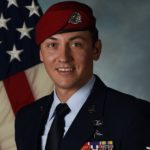
I saw her in the pre-op holding area one day, and her usual composure was gone.
“Are you OK?” I asked.
She didn’t answer. She stared past me.
I’d never seen Captain B like this. I asked again, this time letting concern edge my voice. She swallowed, pursing her lips before answering, a glint of tears welling.
“Mike, I’m tired,” she said. The words hung in the air, anger and frustration wavering in her voice like a gospel hymn.
She was my hero, our bulwark. Seeing the best of us stumble stabbed at my heart.
At the time, I didn’t understand what I felt. I just knew her cracking was a warning. If Captain B could break, so could the rest of us.
This was at Elmendorf Air Force Base (AFB) in Alaska, late in my tour there in 2004. I’d already submitted my separation paperwork.
Captain B was the senior captain among us. She was a regal, hard-working woman and an extremely capable OR nurse and leader. She frequently ran the operating room (OR) in our dusty, detached major’s absence. I always preferred her to be in charge because she was the “real deal.”
Captain B cared, not just about patients, but about people. It wasn’t a leadership principle or a tactic; it was who she was.
None of us wanted the responsibility of “running the board”: managing the seven-room OR suite, tracking patient flow, ensuring breaks and lunches for OR staff, and the inevitable urgent add-on cases. It was a hard job.
A few times, when both the major and Captain B were unavailable, I was put in charge. It was my first taste of running a busy OR suite and the realities of rank. I was a junior captain and others outranked me, but they weren’t put in charge.
They couldn’t afford to be. When patient care was at stake, rank didn’t matter.
Ability did.
In that role, I wasn’t just responsible for one patient at a time; I was responsible for all of them. Not just those in surgery, but those waiting their turn, as well as urgent and emergent patients. I felt the weight of responsibility not just to them, but also their families in the waiting room.
Captain B called me at home late one night to give her a break during a complex emergency orthopedic case she’d been working for several hours. She’d worked all day, was on call, and likely worked 16–18 hours by that point. I respected her work ethic, her clinical acumen, and the professional way she carried herself.
What made it harder was watching leaders stay insulated behind closed office doors while the rest of us pulled call and worked the rooms. Their detachment reminded me all too much of my personal life, which I didn’t want to accept.
Coffee became an artificial “go” switch because I dreaded going into work. The pager became a part of life. Whenever falling asleep, I’d worry about not hearing the pager.
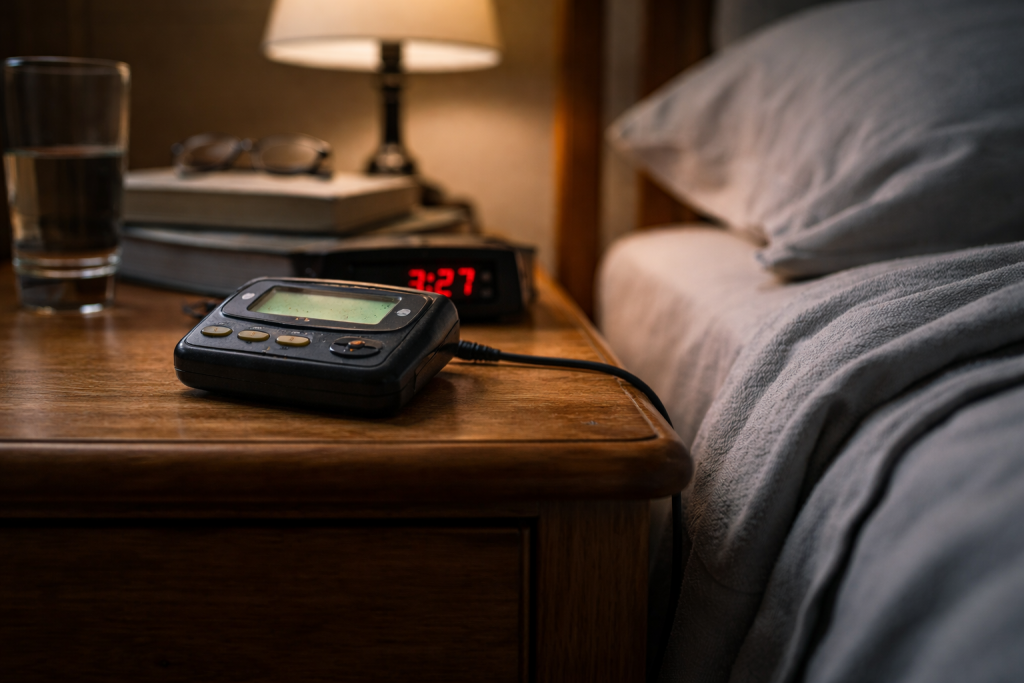
I lived life braced for the next interruption and desperate for relief wherever I could find it.
By the end of my tour, OR nurses were leaving and I understood why.
I’d submitted my military separation paperwork before volunteering for deployment. Going to Iraq was the only meaningful thing the Air Force could give me. I’d tried to go to Iraq in 2003 and ended up in Guam, but another opportunity came in 2004.
After deploying, I wanted out. I saw no future in staying in. No camaraderie or pride. No sense of belonging, which at the time I’d not consciously realized I was seeking. Serving in the Air Force hadn’t earned integration among my family. I had to get back to North Carolina.
I accrued almost 50 days of leave but was told I could take only one day of terminal leave. Leaving Alaska without a safety net meant uprooting my family in the middle of winter and moving thousands of miles with no paycheck on the horizon.
I recall the pained look on the major’s face as he told me: “We don’t have the staff to support you taking more than one day of terminal leave. I’m sorry.”
He implored me to reconsider and remain on active duty. As far as I was concerned, there were no leaders to emulate. Except one. And she’d been broken. To my mind, the Air Force offered two futures: keep your integrity and get broken, or sell out your subordinates to survive and make rank.
My assignment officer had one slot for a captain at Langley AFB in Virginia, and I told him I’d do one of two things: either let my separation paperwork go through, taking one day of terminal leave, or, if he could put me at Langley, I’d PCS (permanent change of station) there, do my time, and separate from the military there, where transitioning to NC would be much easier.
I asked who was in charge of the OR at Langley. If it was someone known to be subpar, I wouldn’t go there. To my surprise, the major in charge was someone I’d worked for at the latter part of my previous assignment at Barksdale AFB, Louisiana. We’ll call him Major A. He’d been a breath of fresh air back then: a natural mentor, approachable and unassuming, yet unmistakably in charge.
Major A invigorated the stagnant atmosphere of Barksdale’s OR. Major A worked hard, knew his craft, and above all, he invested time and energy into people. I looked up to him. I trusted him.
I pulled my separation paperwork and transferred to Langley AFB in early 2005. I couldn’t say no. I’d only owe one more year to the Air Force and be stationed next door to NC instead of half a world away.
I was burned out: with the uniform, the job, and myself. But even then, amidst the turmoil, I would follow Major A for as long as he was in charge. I wasn’t loyal to the Air Force; I was loyal to that man.
When I arrived, a young staff sergeant gave me a tour of Langley’s OR. She told me that Langley did more C-section cases than anyone else in the Air Force, except Wilford Hall, the USAF’s largest medical center. That sat like a pit in my stomach. I’d hoped to go to a place with a lower operational tempo.
Major A was the same affable leader I’d remembered.
During our initial counseling session, I laid out my path forward: I would complete my tour at Langley, then separate from the Air Force. I also told Major A that I would conduct myself as an officer and that no one would be able to tell that this was my intent.
I was surprised when he asked, “What happened to you in Alaska, Mike?” I still remember the concern in his voice. “Where is all this anger coming from?”
I recounted how overworked the staff was, the lack of camaraderie, and the lack of leadership.
Even though there were fewer OR suites at Langley, there were fewer staff and the operational tempo was much the same. We worked hard while pulling call (for emergency surgeries) once a week or over holidays and weekends. And yes, Langley lived up to what that staff sergeant had bragged about: an endless parade of urgent and emergency C-sections.
I was treading water all over again. But it was tolerable. I found respite in working for Major A.
Soon after arriving at Langley, Major A, who was projected to retire within a year, stepped down early as the operating room officer-in-charge (OIC) to make room for a new major. We’ll call him Major C.
I didn’t like him. First, he wasn’t Major A. Second, Major C never donned scrubs. He sequestered himself in the office, not even dressed to enter the OR, while staff worked around the clock and pulled call. And third, Major C constantly bragged about his son, who was a senior NCO in the Army, reminding us to appreciate the quality of life we had in the Air Force.
Along with this downgrade in leadership, one of the surgeons, also a field grade officer, would often use a phrase during surgery: “How white of you,” whenever he wanted to insult someone. The first time I heard it, I froze. No one said a thing. He said it like a slur, an ugly little power move.
When he kept repeating it, I thought about filing an Equal Opportunity complaint. But our new OIC was weak, and I didn’t trust anything constructive would come of it.
So I handled it myself. I waited for him to say something needlessly nasty during surgery. And when he did, I quipped: “How white of you.” I wanted him to hear how offensive it was and nobody else was checking him. OR staff were his captive audience, and he’d taken advantage of that. But for that moment, he was the captive audience.
You could have heard a pin drop in the OR. The surgeon visibly shuddered. To his credit, he recovered quickly. But he had to swallow it. He knew exactly what he’d been saying.
He never said it again, though remained abrasive in all his other usual ways. His conduct, along with Major C’s, only reinforced the arrogance and hypocrisy I’d come to associate with the Air Force.
Eventually, due to the OR’s staffing shortages, Major C was “shamed” into at least giving breaks for nurses in the OR. This didn’t last long. OR nursing is a perishable skill set, and he struggled in the rooms. Eventually, the surgeons complained and Major C ended up back in his office, in uniform, staring intently at his computer monitor.
Losing Major A, working long hours, and pulling call continued its toll. It was more of the same as I’d experienced in Alaska. I felt the familiar burn swell inside me. My fuse had been lit long ago; Major A had only briefly interrupted it.
One night, I’d worked a long day and then a late night/early morning emergency surgical case. The next day, I dragged myself in to drop off the pager, which had to be done no later than 2 p.m. for the next nurse on call.
I passed by the office and saw Major C in uniform, tapping away at his keyboard. I checked the board and we still had rooms running. Instead of going home after coming off call, I changed into scrubs.
I had only slept a few hours, worked all week and late into the night before, and would be back in the OR at 6 a.m. the next day. Next week would be the same. It always was.
Same board. Same pager. Same office door closed.
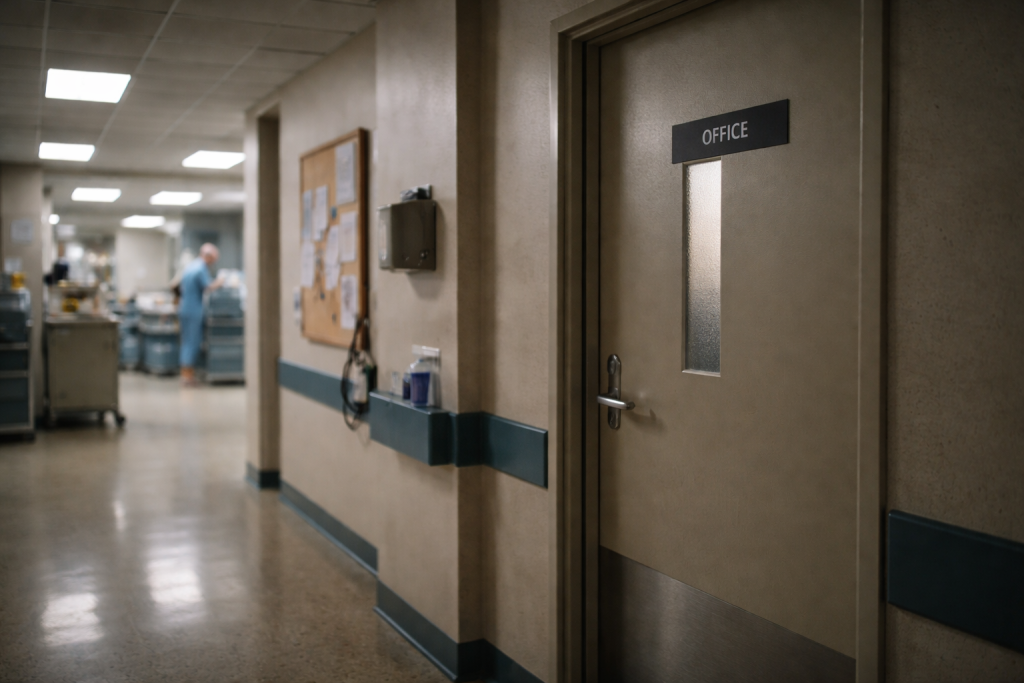
Captain B and Major A were exceptional. I could still hear Captain B in pre-op: “Mike, I’m tired.”
I went to the first OR and asked the circulating nurse if they’d gotten a break or lunch. Of course they hadn’t. So, I broke them out for a 30-minute lunch. Afterward, I went to the second OR, asked the same question and got the same answer. I broke them out for lunch. Then onto the third OR: rinse and repeat.
I seethed for those 90 minutes after working all day and night before, knowing Major C was nearby while his people kept grinding without relief.
I changed back into my uniform and walked into his office. He looked up as I loomed over him.
I was done.
“You sit in this office while we work ourselves to the bone!”
I pointed toward the ORs, shouting.
“None of the nurses got breaks or lunches. I worked all day yesterday, pulled an all-nighter on call, and just covered lunches while you sit here and do nothing!”
His mouth fell open but no sound came out.
“I’ll be back at 6 a.m. to do it all over again and you’ll still be sitting in this office.”
He stood up, dumbstruck.
“You’re always reminding us of how good we have it compared to your son in the Army.”
I nodded at his uniform. “Yeah, you’ve got it great! Sitting there not in scrubs while we pull call and work the rooms. You’re no leader.”
“You are nothing like Major A.”
The next morning, I told him I’d have my separation paperwork filled out. “All I need is your signature.”
That’s exactly what I did.
In six months, I was out of the Air Force.
It took years to see it, but what the Air Force couldn’t give me, it had left behind in the people.
When I think about what it took, I still see Captain B staring past me in pre-op. I see Major A stepping aside to let a lesser man take his place.
Only in hindsight do I see that Major C had at least tried to work the rooms. He was playing the game the Air Force imposes on everyone: move up or you’re out. Miss that twenty-year mark and there’s no brass ring. When Major A stepped aside to help him, a part of me felt abandoned and I took it out on him.
I didn’t know it then, but what I rebelled against in the Air Force was what I inherited at home.
I was caught in an impossible place. I wanted to choose family over the military, yet the only way I knew to earn my place was through military service.
There’s a difference between leaving something and being free of it.
If you leave a system but keep the yearning it trained into you, you’ll rebuild the same cage somewhere else.
Back then, I left the Air Force. What I didn’t leave was the need to earn my place.

_____________________________
Mike Warnock is the editor-in-chief of The Havok Journal, a retired U.S. Army Major and Air Force veteran with 20 years of active service across both branches.
During his military career, he led surgical teams as an Operating Room Officer-in-Charge at the hospital, medical center, and combat-support levels. He later served in senior clinical, administrative, and inspector general roles before retiring in 2019.
Over his 23-year civilian and military nursing career, he deployed to Guam and twice to Iraq, leading surgical and clinical teams in both peacetime and combat environments. He holds a B.S. in Nursing from the University of North Carolina at Charlotte and an M.A. in Military History from Norwich University.
As the Voice of the Veteran Community, The Havok Journal seeks to publish a variety of perspectives on a number of sensitive subjects. Unless specifically noted otherwise, nothing we publish is an official point of view of The Havok Journal or any part of the U.S. government.
Buy Me A Coffee
The Havok Journal seeks to serve as a voice of the Veteran and First Responder communities through a focus on current affairs and articles of interest to the public in general, and the veteran community in particular. We strive to offer timely, current, and informative content, with the occasional piece focused on entertainment. We are continually expanding and striving to improve the readers’ experience.
© 2026 The Havok Journal
The Havok Journal welcomes re-posting of our original content as long as it is done in compliance with our Terms of Use.