
Washington, D.C.
July 4, 2048
Professor Michael Reynolds stood near the entrance of the Memorial of the Lost Republic and watched another school group assemble in the morning sunlight. Teachers counted heads, adjusted backpacks and reminded excited students to stay with the group. Reynolds had witnessed the scene hundreds of times over the past 15 years. The faces changed. The questions did not.
That was what bothered him most. The innocence, coupled with the unintended accusation, always reopened the scars of his own role in the events that led to the war. He felt morally compelled to give these tours, partly as spiritual penance but mostly to try to stop it from happening again.
Sometime during the next two hours, one child would ask how many names were on the walls.
The answer was 12 million. Or at least 12 million they could account for.
The number always produced the same reaction. Eyes widened. Conversations stopped. A few children quietly repeated it, as though saying it aloud might make it comprehensible. Reynolds had long ago concluded that 12 million was too large for the human mind. Even 1,000 deaths carried emotional weight. Twelve million became something else entirely: a statistic, an abstraction, a number carved into stone.

His gaze drifted across the memorial grounds. Black granite walls stretched toward the horizon in neat rows, each covered with names. The polished surfaces reflected the morning sky, creating the illusion that the earth itself had fractured into dark mirrors. Visitors often called the memorial beautiful. Reynolds understood, but the word felt wrong. The place was too heavy with consequences.
The children were as quiet as previous groups. That usually meant they were beginning to grasp the weight of what stood before them. They had not yet asked their questions, but he could already hear them.
Did the soldiers start it? Why did it happen? Did people really hate each other that much? Why did they kill my mommy?
The same questions. Every year.
The same answers. At least the answers he gave the children.
The answers he gave himself were far less certain.
A breeze moved across the grounds, rustling the flags that lined the pathways. Reynolds shifted his weight against his cane and looked toward a distant section of wall. He could not read the names from where he stood, but he knew one by heart.
Thomas Whitaker.
History professor. Baseball fanatic. Lunch companion every Thursday for nearly two decades. Friend.
The word still felt strange.
For years after the war, Reynolds had referred to Whitaker as a former friend. The phrase allowed him to avoid uncomfortable truths. Only later did he realize friendship did not simply cease to exist because two people stopped speaking. The years they had spent together remained real whether he acknowledged them or not.
They had argued about politics during the final years before the collapse. At first, the disagreements seemed harmless: two educated men exchanging opinions over sandwiches and coffee. Then the conversations sharpened. Each arrived armed with articles, statistics and experts who supported his position. Each became convinced the other had fallen victim to misinformation.
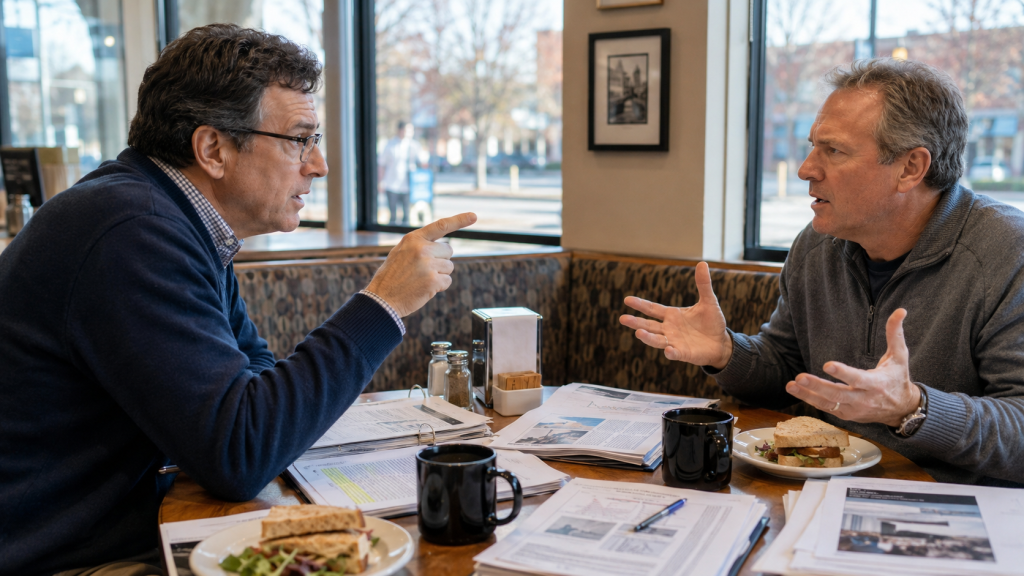
What neither man recognized was that they were making the same accusation for the same reason.
Both believed they were too intelligent to be manipulated.
Reynolds found that thought far more disturbing now than he had 20 years earlier. He had spent 40 years teaching persuasion, propaganda, media influence and public opinion. He had explained how narratives shape perception and emotion can overwhelm reason. And he had still fallen into the trap.
When journalists interviewed him after the war, they always wanted to discuss politicians, media organizations, technology companies and extremist groups. They wanted villains, identifiable causes and simple explanations that would fit neatly into documentaries and textbooks. Many still had not learned their own role in the cataclysm. Or admitted it.
The truth was less satisfying.
The country had not been destroyed by a handful of powerful people. It had been destroyed by millions of ordinary people making ordinary decisions from false or manipulated information.
That was what frightened him most.
Most Americans had never hated one another. They worked, raised families, attended church, coached Little League teams, worried about mortgages and helped neighbors after storms. They were imperfect, but most were decent.
Yet somehow those same people gradually became convinced that their fellow citizens posed an existential threat. Anger flared. They broadcast their fears and contempt online. Polarization began in earnest.
The process was so gradual that almost nobody recognized it while it was happening.
Fear arrived disguised as concern. Contempt arrived disguised as virtue. Tribal loyalty arrived disguised as principle. Nearly everyone, Reynolds included, believed they were acting responsibly.
The children would eventually ask why nobody stopped it. They always did. The question was simple enough to feel almost embarrassing. Why didn’t people check whether things were true?
The answer, Reynolds had concluded, was that checking required effort, while outrage required only emotion. Human beings gravitated toward information that confirmed what they already believed. Every generation imagined it was wiser than the ones before it, but the old instincts remained durable.

He had spent years consuming information from people who agreed with him. At the time, he called it staying informed. Looking back, he recognized something less admirable. He had been seeking reassurance. He wanted confirmation that his side was right, that his concerns were justified and that his opponents were as unreasonable as he suspected.
The most dangerous lies had not been outright fabrications. They had been partial truths: a story here, a statistic there, a carefully selected fact presented without context. Each piece was often partially or mostly accurate. The deception emerged from what was omitted. Millions of Americans spent years looking at different fragments of reality until they occupied different realities altogether.
By the time they realized what was happening, it was too late.
The children were beginning to form a line behind their teachers. Reynolds recognized the expressions on their faces: curiosity, confusion, unease. They sensed that the memorial represented something terrible, even if they did not yet understand what it was.
Most visitors assumed the memorial existed to remember the dead.
They were only partly correct.
The dead were the easiest losses to count.
The war had not merely taken lives. It had dismantled the routines that made civilization possible. Farms failed when fuel became scarce and transportation networks broke down. Grocery stores sat empty despite food existing elsewhere. Hospitals struggled to obtain medicine. Businesses closed. Entire neighborhoods vanished. Cities burned one building at a time until the destruction became too extensive to hide and too familiar to shock.
The statistics documenting those losses filled libraries. The reality of them lived in memory.
Reynolds often thought the memorial’s empty spaces were more important than the walls. The granite recorded who had died. The open ground represented everything else that had disappeared: businesses, churches, schools, communities, futures and countless ordinary plans interrupted by history.
Every war destroys lives, but most are fought between nations. This was American against American. The ultimate friendly fire event between neighbors. The wounds ran deeper when fellow countrymen became the enemy.
That, more than anything else, was what the memorial represented: a nation discovering that institutions could be rebuilt more easily than families and friendships, and that fires are easier to start than extinguish.
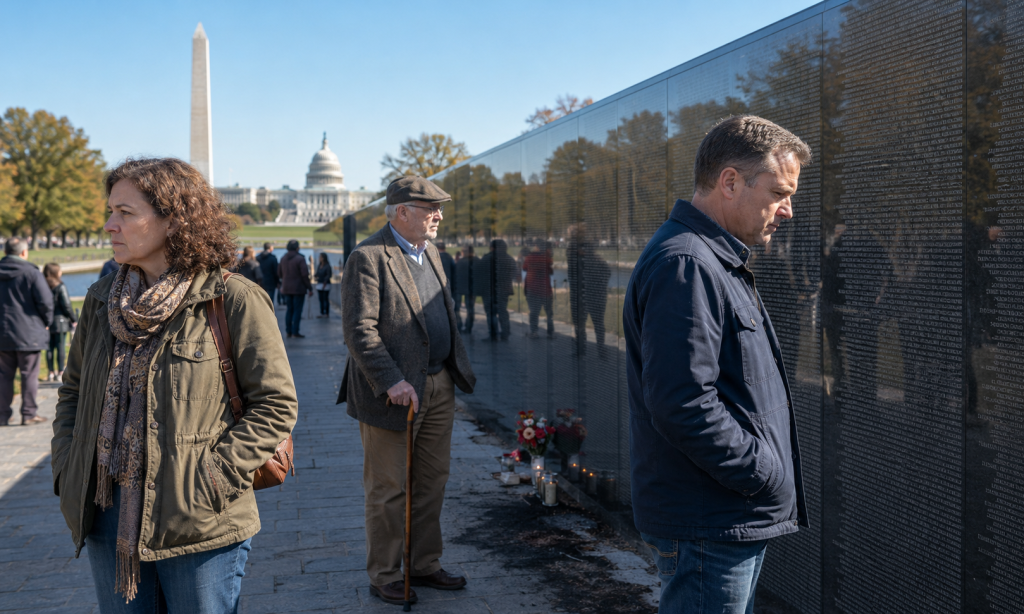
The lead teacher finally approached and offered the same polite greeting Reynolds had heard hundreds of times before. He smiled, returned it and adjusted his grip on the cane.
The children settled into place. Several were already staring at the nearest wall.
One little girl raised her hand before the tour had even begun.
Reynolds politely smiled while inside he wept.
He knew exactly what she was going to ask.
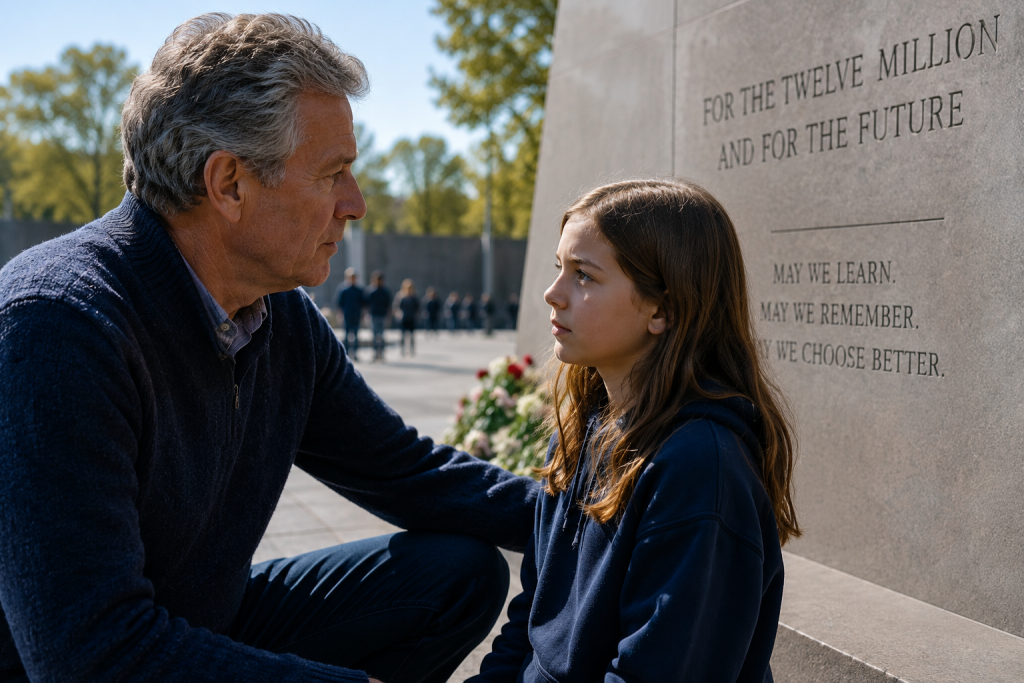
For a moment, he considered giving the children easy answers that would protect their innocence. But conscience would force him to tell the hard truth: the memorial existed because an entire generation had confused falsehood for truth. Intelligence was no protection against self-deception. Education could not substitute for humility. The collapse of the nation began long before the first brick was thrown.
He would also tell them of his personal culpability, of how he had failed to teach his students critical thinking and failed to demand that they model it in his classroom.
So he thinly smiled and invited the group to follow him, knowing he would challenge them to think for themselves and warn them about the merchants of anger and hatred.
He had learned how easily human beings fooled themselves, and he desperately wanted the youngest generations to avoid his terrible mistakes.
_____________________________
Dave Chamberlin runs a consulting and training company and brings more than 40 years of civilian and military aviation experience to his work. He retired as a Chief Master Sergeant after 38 years as an aircraft crew chief in the U.S. Air Force and Air National Guard, and has also worked in technical, instructor, consultant, and leadership roles. He holds an FAA Airframe and Powerplant license and a master’s degree in aeronautical science, and his writing often focuses on military issues, especially those affecting aircraft maintenance personnel.
As the Voice of the Veteran Community, The Havok Journal seeks to publish a variety of perspectives on a number of sensitive subjects. Unless specifically noted otherwise, nothing we publish is an official point of view of The Havok Journal or any part of the U.S. government.
Buy Me A Coffee
The Havok Journal seeks to serve as a voice of the Veteran and First Responder communities through a focus on current affairs and articles of interest to the public in general, and the veteran community in particular. We strive to offer timely, current, and informative content, with the occasional piece focused on entertainment. We are continually expanding and striving to improve the readers’ experience.
© 2026 The Havok Journal
The Havok Journal welcomes re-posting of our original content as long as it is done in compliance with our Terms of Use.


