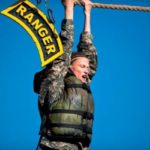
When my platoon formed up for Darby Phase, I felt out of place from the start. No one wears rank in Ranger School, but you can read the room. It was clear officers comprised the majority of my platoon: first and second lieutenants, a lot of them straight out of IBOLC, with a handful of privates from the 75th Ranger Regiment, about forty of us total.
I was a Private First Class, nineteen years old, National Guard, and just seven months into my enlistment. A few months earlier, I’d been at Basic, and after that, AIT. Then I immediately went to the Ranger Team Leader Initiative (RTLI) program with other soldiers who had followed the same path as me. On day one at Ranger School, I was the only RTLI soldier. I felt alone.
How would I keep up with these more experienced soldiers? I’d never planned a five-paragraph operations order. I’d never seen one. I’d never led anything outside a graded exercise.
When all was said and done, I made it through Ranger School. It wasn’t easy. I recycled Darby, came in fifth from the bottom on peer evaluations during that cycle, and picked up more spot reports than I’d care to admit. The Tab on my shoulder came after a complete change in how I carried myself: how I showed up for the soldiers around me, how I understood how others perceived me, how I held up under stress.
This is how I got there.
I enlisted in the National Guard at nineteen as an 11B and shipped to basic in June of 2024. I graduated Advanced Individual Training (AIT) that December. Around week sixteen, a recruiter from the Warrior Training Center at Fort Benning visited our company and asked who wanted a Ranger School slot straight out of training. Out of a few hundred soldiers, about twenty-five of us showed up to his brief.
He laid it out simply. The Ranger Team Leader Initiative program was a National Guard pipeline that took top performers from initial entry training and ran them through the Ranger Training Assessment Course (RTAC) before sending them on to Ranger School. The selection process consisted of two things. First, your state had to be willing to pay to send you, and second, your ACFT had to be over 550. That was it. (The program has since opened up to active-duty soldiers as well.)
My ACFT was a 598. My state was willing to foot the bill. I was on the list.
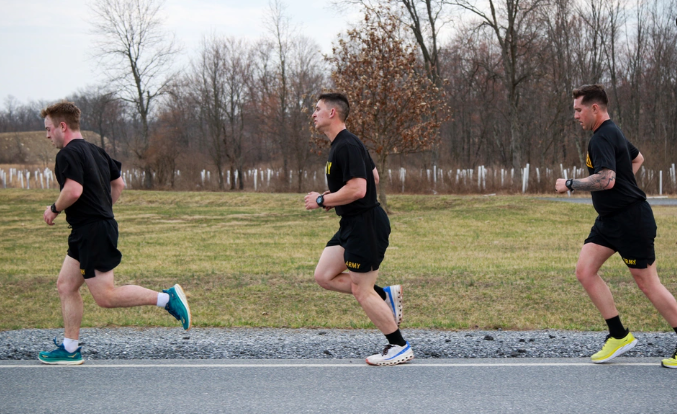
I had two reasons for taking it.
The first was my dad. He’d graduated Ranger School years before I was born and was the reason I knew what the Tab meant in the first place.
The second was that I planned to go to college while in the Guard, and I knew the Tab would open doors for me down the road. It already has. Underneath both of those reasons, though, were my expectations when joining the Army. Basic and AIT hadn’t tested me the way I’d hoped. I wanted training that would show me what I was made of. I found it.
The attrition through the pipeline was brutal. About 130 soldiers entered RTLI during my training window. Twenty-five of us were selected to attend RTAC. Six of us were selected to attend Ranger School. Four of us earned the Tab.
The Warrior Training Center’s job was to get us physically and mentally prepared for the workload of Ranger Assessment Phase (RAP) Week and the continued physical stress of the three phases of Ranger School. Every week we ran the Ranger PT test, and if you failed it twice, you went home. We rucked twice a week. We conducted countless land navigation exercises. We trained with the M249, the M240, and Claymores, partly so weapons stakes wouldn’t be where we picked up major minuses, and partly so we could pull weight in our platoons by carrying the heavy weapons and knowing how to use them.
Tactics weren’t really part of the curriculum. RTLI’s philosophy was that RTAC and the Ranger Course itself would teach us tactics. RTLI’s job was to make us mentally and physically tough enough to survive long enough to learn them.
RTAC was different. It actually taught patrolling. The five paragraphs of the operations order were drilled into us, as well as troop leading procedures and battle drills. When I arrived at RTAC, I could not have named the five paragraphs of an OPORD; by the time I left, I could write one. Not well, but just well enough.
The hardest part of the RTAC/RTLI pipeline wasn’t the physical training. It was the resulting social isolation once I got to Ranger School.
Every soldier in Ranger School comes from somewhere: a battalion, a post, a service academy class. They already have a clique. The Ranger Regiment guys had each other. The West Point lieutenants had each other. Even the NCOs from different infantry divisions quickly found each other. I was the only RTLI soldier in my Ranger School platoon. None of the cadre had come through RTLI either. I had no shared experiences with anyone in the formation other than basic and AIT. I couldn’t talk about a deployment because I hadn’t done one. I couldn’t talk about a combat training center rotation because I hadn’t done one of those either. I had basic, AIT, RTLI, and RTAC. That was my entire military résumé.
The advice every RTLI graduate gave me before I started Ranger School was the same word: confidence. You won’t match the experience around you. What you can do is sound certain when it’s your turn to lead. Soldiers tune out if they sense hesitation. They follow conviction, even when it’s wrong. Making the wrong call decisively is better than freezing and making no call at all.
I tried to bring confidence. I underestimated the cost of the isolation.
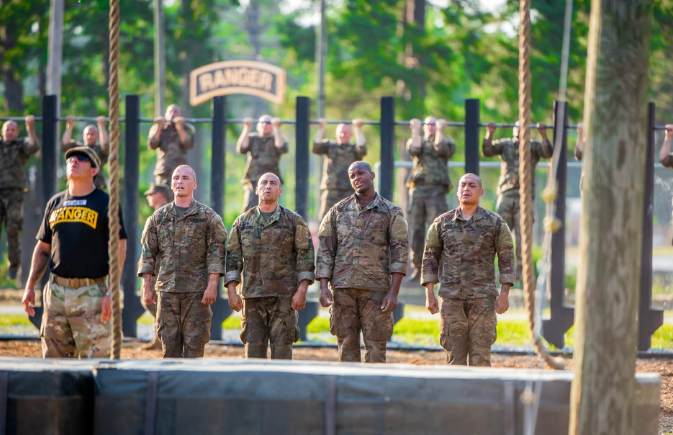
I passed RAP Week clean. Seven for seven on land navigation for a major plus. Twelve-mile ruck under time. Every obstacle they threw at us in RAP, I cleared.
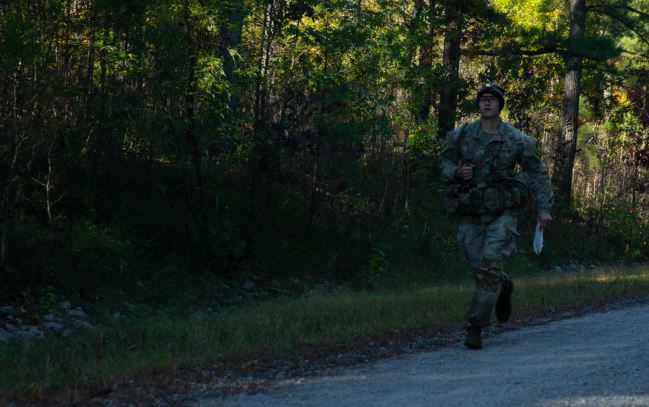
(U.S. Army Photo by Pfc. Richard Ortiz, 40th Public Affairs Detachment)
What I didn’t see coming was the dynamic that came with my class.
Mine was one of the first classes to run the new Ranger Physical Fitness Assessment, the continuous-evaluation event that replaced the old PT test. Fewer soldiers were getting cut on the test itself than the cadre expected, and the school still had a fixed number of patrol slots in Darby. That meant the cadre had to find their cuts somewhere else. They found them. An entire group got dropped during demolitions training because someone moved a step ahead of the instructor’s command. Several soldiers got dropped from the CWSA for releasing the zip line a half-second before the cadre’s command. I caught a major minus for getting caught using the wood line as a latrine: wrong place at the wrong time. Close calls over genuine attention-to-detail mistakes, and as an undisciplined private, that’s where my lack of maturity and experience almost caught me.
My strategy walking into Darby Phase was to fly under the radar. I figured that if I was a private in a platoon full of senior soldiers, the smartest move was to stay invisible until I got called on. Do my job when graded; don’t add friction; slide through.
I got my “go” as the weapons squad leader during my first graded patrol. My ambush worked. I set up the machine gun position with the right masking fires, locked in my safety angles and target reference points, and commanded talking guns at the right time. By the standard for that look, I performed. But my first Darby was far from over.
The major minuses I picked up over the rest of the phase were the kind that look small in isolation. Weapon not tied down in a patrol base. Fell asleep while pulling security. Talked with another soldier on security loud enough to bring a Ranger Instructor’s red light over.
And then there was the one I still think about.
I was pulling security when I got pulled into the middle of the patrol base to help with the terrain model. I had the M249 SAW at the time, so I swapped weapons with another soldier. I gave him the SAW to keep it on the line and took his M4 in trade. I sat down at the terrain model and set the M4 on the ground beside me to get to work. A Ranger Instructor came through and grabbed the rifle off the ground for a chamber check. There was no round chambered. My fourth major minus.
The recycle list came out at the end of the cycle. Four major minuses and one major plus. I had hit the recycle criteria.
The peers came out at the same time. I was ranked fifth from the bottom out of thirty-five soldiers in my platoon. The feedback was consistent. “He didn’t add much. He kept his head down. He doesn’t know tactics as well as the rest of us.”
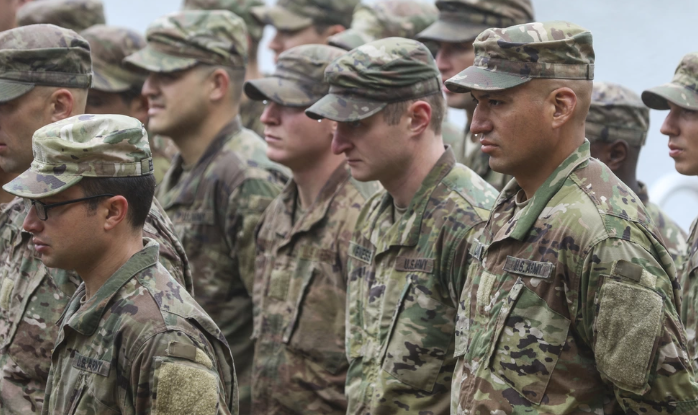
They weren’t wrong.
The first thing I caught myself doing when I heard my name on the recycle list was pitying myself.
That’s the trap. The soldiers who drop from Ranger School after a recycle aren’t usually the ones who can’t make the standards. They’re the ones who let the recycle convince them they don’t belong. The motivation goes. Then the drive to put out for the squad goes. Then the will to carry weight goes. Then they fail peers, fail patrols, and fold.
I caught it before it caught me. I had to. I’d come too far to let self-pity be the thing that took me out. RLTW!
The Darby Phase recycle process keeps you at Camp Darby. You stay in the barracks, you eat real food, you sleep, and you wait two or three weeks for the next class to finish RAP Week so you can join up with it.
What I needed to learn during that wait wasn’t tactics. It was how to be the kind of soldier other soldiers actually wanted around. So I started talking. I sat down with whoever was in the barracks, recycles like me, guys waiting for medical clearance, and I asked questions. Most of them came from a different Army than I had, the real Army: Ranger Regiment, infantry divisions, OCS, and more. On paper I had nothing in common with any of them. What I figured out was that I didn’t need a shared background. I needed to listen well and ask the right things, and most soldiers will take it from there.
The lesson was simple. Ranger School isn’t graded on whether you avoid mistakes. It’s graded on whether you contribute when you’re not being graded, and on whether you give your all for your teammates during their looks. When you do that, they do the same for you when it’s your turn.
That’s the leadership lesson the Army usually doesn’t teach a private at Basic; it’s learned the hard way in the real Army, from team leaders, squad leaders, and platoon sergeants. Ranger School compressed it for me into one peer evaluation and a recycle list.
I went back through Darby with a completely different posture. I carried the SAW every day I wasn’t being graded. I carried ammo “pork chops” for the M240 on every ruck. I built terrain models. I gave input on operations orders whether or not I was leading them. I stopped complaining out loud, because complaining is the cheapest thing a soldier can do, and it costs the platoon morale every time. I pulled extra shifts on security. In short, I was the type of soldier everyone wants in their squad, not the type of soldier I was before.
I made it through Darby. I moved on to Mountains.
Mountain Phase hurts different. The movement up and down the ridges in north Georgia works on your knees and ankles in a way flat ground doesn’t. I rolled my ankle twice. I taped it up and kept moving. I got my “go” on a security squad leader look during a movement to contact.

Florida was where the exhaustion, mental and physical, really caught up with me.
I got to the Fourth of July about halfway through the Florida Phase field exercise. Around 0100, I was leading a movement in a staggered column with the M249 across my chest and four pork chops on my kit. I had been awake for about twenty hours. I had slept maybe two to three hours total across the previous three days. My boots were soaked. My NVGs were barely working. I was fighting through spider webs in the pitch black, four miles into a long movement, and I could hear fireworks. Or I was hallucinating them. I genuinely don’t know.
I wanted to go home. I wanted to be done. I was thinking about my family, about every person I knew celebrating somewhere with hot food and dry feet, and the only thing between me and any of that was finishing this movement, then the next one, then passing this phase. I was carrying over a hundred pounds and every step felt like math: how much more weight can I carry, how much farther can I go, how much longer can I last? Flashes of doubt crept in. Was I doing enough? Had I gotten my “go”? Would I pass peers? From the moment I had recycled in Darby, I had told myself I would never let myself be complacent again, never stop pushing to be better. That promise was the only thing keeping me upright.
The moment I am proudest of came two weeks later, when the peer evaluations came at the end of the phase and I was the top-rated soldier in my platoon.
Same soldier. Different posture.
I graduated Ranger School at nineteen, less than a year after I enlisted. I came home, went through reception at my first unit in the Guard, and started fall semester at a university. I am an ROTC cadet now, on track to commission as an officer in 2028, hopefully Infantry.
The Tab changes things. It changed my own perception of myself, and it changed how other people perceive me. It opened up schools I would not have otherwise had access to. ROTC gave me a Sapper Leader Course slot largely because I had already shown I could do something hard and had what it took. The Tab on my shoulder showed that. People see the Tab and assume you have already made one of the hardest decisions an Infantry leader will ever make: to not quit when that is all you want to do. Maybe that is not always literally true. It is all up for debate, but regardless, the Tab certainly earns you a level of trust the cadet rank alone absolutely will not.
If you are a junior enlisted soldier thinking about Ranger School, here is what I would tell you. You will not out-tactic the officers around you. You will not out-lead the NCOs. What you can do is be the soldier they want next to them on a movement when no one is being graded and peer evaluations are far off. That is a mindset, not a skill set. You can choose it on day one. You must.
The one lesson from the school I keep coming back to is the simplest one. Train hard and train when it is hard. Motivation runs out. Discipline and character do not.
I am grateful for all of it. The opportunity. The hardship. The failure. I needed to hear my name on the recycle list. RLTW!
_____________________________
James B. is a National Guard infantryman and ROTC cadet who is projected to commission as an officer in 2028. He is a graduate of Ranger School and the Sapper Leader Course and earned his Ranger Tab as a private first class through the Ranger Team Leader Initiative. For The Havok Journal, he writes about Ranger School, junior enlisted service, leadership, and the National Guard and ROTC path to commissioning, drawing primarily from his experience as a young soldier and cadet. He also writes at warfighterforged.com.
As the Voice of the Veteran Community, The Havok Journal seeks to publish a variety of perspectives on a number of sensitive subjects. Unless specifically noted otherwise, nothing we publish is an official point of view of The Havok Journal or any part of the U.S. government.
Buy Me A Coffee
The Havok Journal seeks to serve as a voice of the Veteran and First Responder communities through a focus on current affairs and articles of interest to the public in general, and the veteran community in particular. We strive to offer timely, current, and informative content, with the occasional piece focused on entertainment. We are continually expanding and striving to improve the readers’ experience.
© 2026 The Havok Journal
The Havok Journal welcomes re-posting of our original content as long as it is done in compliance with our Terms of Use.