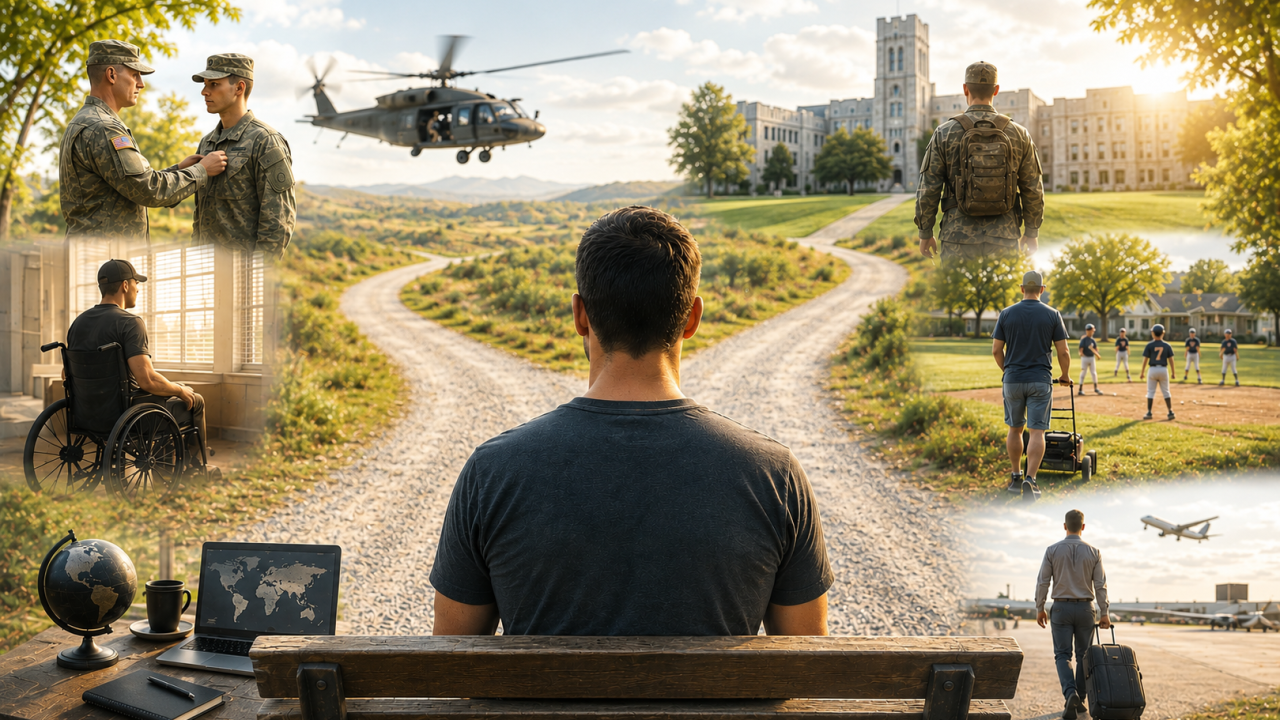
There is a concept that has been making the rounds online lately called the “Five-Year Stranger Theory.” It is not an established psychological theory, nor is it something you’ll find in an academic textbook. It is more of a modern observation about the way life works. The idea is simple: five years from now, most of the people you interact with every day will probably be strangers. Not because of betrayal. Not because anyone did anything wrong. Simply because life moves on. Careers change. Families grow. People relocate. Priorities evolve.
For most people, that’s an interesting thought experiment.
For military professionals, it’s practically a law of nature. And it usually happens shorter than five years.
Every PCS. Every deployment. Every promotion. Every retirement ceremony. Every unit inactivation. Every assignment to a new post. The military is a machine designed to constantly reshuffle human relationships. It takes people who have become family and scatters them across the globe, only to introduce another group of strangers who, given enough hardship and shared experience, will eventually become family themselves.
Then the cycle repeats.
When I retired after twenty-seven years in the Army, I realized something unsettling. There were people I had once spent every waking hour with. We had gone to war together. We had celebrated promotions together. We had mourned friends together. We had trusted each other with our lives. Yet years later, many of us hadn’t spoken in ages. There was no falling out. No disagreement. We had simply become strangers to each other’s daily lives.
That realization initially felt depressing.
Eventually, I realized it was something else.
Military culture often teaches us to think of relationships as permanent because the experiences are so intense. Civilian friendships may be built over coffee or weekend barbecues. Military friendships are built under stress, exhaustion, danger, and shared sacrifice. We assume those bonds will remain frozen in amber forever because the memories certainly do.
Life doesn’t work that way.
The Army that made you who you are keeps moving after you leave. The platoon sergeant becomes a first sergeant. The lieutenant becomes a battalion commander. Someone gets medically retired. Someone takes a contracting job overseas. The cadet you mentored are flying helicopters in combat, and returning to West Point as field grade officers. Someone else disappears into suburban life, coaching Little League and mowing the lawn every Saturday. The people stay the same in your memories, but they continue becoming different people in real life.
So do you.
That may be the most overlooked part of the Five-Year Stranger Theory. The future stranger isn’t just everyone else. It’s you.
Think back five years. Depending on where you are in your career, you were probably a different rank, in a different unit, worried about completely different problems. Your worldview has changed. Your priorities have changed. The things that kept you awake at night probably aren’t the things that keep you awake now.
If your current self met your five-years-ago self, you would probably agree on the important things. But you’d also probably surprise each other.
Military service accelerates that transformation because experience accumulates so quickly. One deployment can age a person emotionally more than five peaceful years ever could. One command can permanently reshape how someone thinks about leadership. One loss can fundamentally alter what success means.
That constant evolution is healthy. It is also why trying to preserve every relationship exactly as it existed is impossible.
Veterans sometimes struggle after leaving the service because they spend too much time trying to recreate a moment instead of building a future. They chase the feeling of a particular deployment, a particular team room, or a particular assignment. They convince themselves that the best years of their lives happened somewhere behind them.
But those people have changed.
And so have they.
The Five-Year Stranger Theory isn’t an argument against loyalty. Quite the opposite. It reminds us to invest deeply in the relationships we have today because we know they are temporary. Call your old platoon leader. Reach out to your former squad leader. Your favorite instructor. Your best boss. Your battle buddy. Keep in touch with the soldier you promised you’d stay connected with after PCS season… but didn’t.
Just don’t expect everyone to remain exactly where you left them.
More importantly, don’t let nostalgia prevent you from forming new relationships. Every assignment introduces people who feel temporary until one day you realize they became lifelong friends. Every new duty station contains someone you’ll still be talking to twenty years later. Every stranger is a future possibility.
The military teaches us that missions end, but the profession continues. Relationships work the same way.
Some people are with you for a firefight.
Some are with you for an assignment.
A precious few are with you for life.
The trick is learning to appreciate each one without demanding permanence.
Perhaps that is the real lesson behind the Five-Year Stranger Theory. It isn’t about loss. It is about perspective. It reminds us that time changes everyone, and that isn’t a tragedy. It is simply evidence that we are still growing.
Military service guarantees that your circle will change over time. Uniforms come off. Callsigns disappear. Unit patches get replaced. New names fill old rosters.
Five years from now, many of the people surrounding you today will indeed be strangers.
The question isn’t whether that will happen.
The question is whether the person you become over those five years will be someone worth knowing.
_____________________________
Charles served over 27 years in the US Army, which included seven combat tours in Iraq and Afghanistan with various Special Operations Forces units and two stints as an instructor at the United States Military Academy at West Point. He also completed operational tours in Egypt, the Philippines, and the Republic of Korea and earned a Doctor of Business Administration from Temple University as well as a Master of Arts in International Relations from Yale University. He is the owner of The Havok Journal, and the views expressed herein are his own and do not reflect those of the US Government or any other person or entity.
As the Voice of the Veteran Community, The Havok Journal seeks to publish a variety of perspectives on a number of sensitive subjects. Unless specifically noted otherwise, nothing we publish is an official point of view of The Havok Journal or any part of the U.S. government.
Buy Me A Coffee
The Havok Journal seeks to serve as a voice of the Veteran and First Responder communities through a focus on current affairs and articles of interest to the public in general, and the veteran community in particular. We strive to offer timely, current, and informative content, with the occasional piece focused on entertainment. We are continually expanding and striving to improve the readers’ experience.
© 2026 The Havok Journal
The Havok Journal welcomes re-posting of our original content as long as it is done in compliance with our Terms of Use.


