By Bruce D. Kowal, AUXOP, USCG Auxiliary
In June 2025, the United States Coast Guard released its Force Design 2028 Execution Plan, an ambitious strategic blueprint that includes a commitment to grow the uniformed workforce by 15,000 members by the end of 2028. The plan calls for investment in recruiting incentives, marketing outreach, and personnel support, and specifically pledges to “establish a national strategic communications campaign that better promotes the Coast Guard brand.”
Those are the right words. But to deliver on that promise, the Coast Guard needs to do something it has never really done before: tell a compelling story about who it produces, not just what it does.
I come to this subject with some skin in the game. I served in the U.S. Navy from 1966 to 1970 as a Quartermaster Second Class, completing four WESTPAC cruises homeported at Pearl Harbor aboard the USS Tanner and USS Bolster. I subsequently served in the Naval Reserve as QM1 aboard the USS Estocin. Today I serve as an AUXOP with USCG Auxiliary, District 1SR, Division 14. In the summer of 2025, I spent time at Coast Guard Station New York, in uniform, photographing a photo essay and absorbing the culture of the active-duty Coast Guard up close. What I observed reinforced a conviction I had been developing for some time: the Coast Guard has a powerful, authentic identity that it has simply never learned to communicate.
The Marine Corps Problem and What It Teaches Us
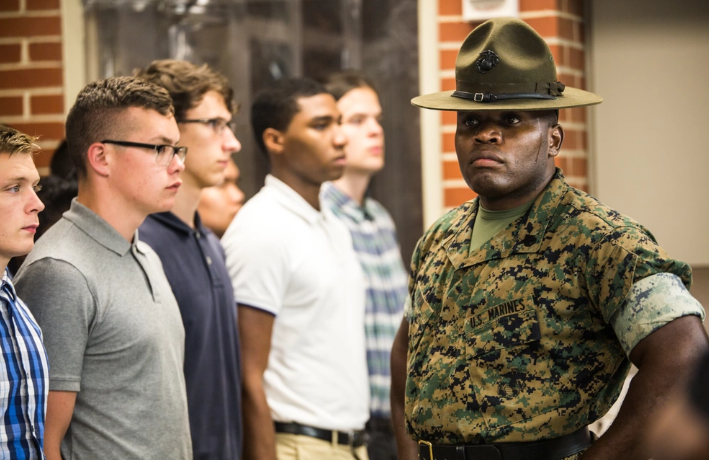
In early 2024, after most of the armed forces had reported serious recruiting shortfalls, Sergeant Major of the Marine Corps Carlos Ruiz testified before the House Armed Services Committee that, although the Corps faced many of the same recruiting challenges as the other services, the Marines had met their FY2023 recruiting mission.
Why?
The answer is almost embarrassingly simple: enough young Americans want to be United States Marines. Not because of a particular job assignment, not because of a signing bonus, and certainly not because they are dreaming of embassy duty in Khartoum. They want to earn the title. The identity itself is the product, and the product sells itself.
Now consider the Coast Guard, and ask a slightly different question: who enlists in the Coast Guard because they want to be an Electrician’s Mate? The honest answer is almost no one. Recruits may be drawn in by a specific A School assignment, by monetary incentives, or by the singular aspiration of becoming an Aviation Survival Technician, a helicopter rescue swimmer. Those are all legitimate motivations. But unlike the Marine Corps, the Coast Guard has never cultivated the kind of aspirational brand identity that makes someone want to belong to the organization simply for the honor of belonging. That is the core problem, and it is solvable.
A Dual Focus: Two Unique Selling Propositions
The conventional approach to military recruiting has been to optimize the toolkit: sharpen the incentives, refine the bonus structures, target the right demographics, and outcompete the other branches for the same pool of recruits. That approach has its place. But the Coast Guard is now competing directly with the Navy, Army, and Air Force, all of whom are running variations of the same playbook. An algorithmic arms race is not a winning strategy for a branch that currently lacks the brand recognition to compete on those terms.
There is another way, and it rests on two genuine, underutilized strengths that are unique to the Coast Guard.
The first is what I would call Marine Corps Lite. This is not a dismissive term. Not everyone wants to carry 50 pounds of gear into a combat zone or aspire to join SEAL Team Six. But a great many young Americans do want the intensity, the camaraderie, the small-unit cohesion, and that distinctive enlisted culture that the Marine Corps has always projected. The Coast Guard, as it happens, offers precisely that experience: small teams, law enforcement roles, serious operational gear, and a demanding professional culture, without the near certainty of ground combat deployment. That is not a lesser version of the Marines; it is a genuinely different and attractive proposition. The similarity should be implied through imagery and storytelling, not explicitly stated. But it should be unmistakable.
The second, and in some ways more powerful proposition, is the finished product: the Coast Guard veteran. This is where I believe the Coast Guard has an almost entirely untapped competitive advantage. Ask yourself what a Coast Guard veteran looks like. The answer, if the service has done its job, is someone who is handy, dependable, self-reliant, and highly employable: cheerful, good-natured, and quietly capable. Someone who can walk into almost any situation and figure it out. Think of the MacGyver archetype: the person in the room who, when something breaks, gets up and fixes it while everyone else is still talking about it.
Nobody aspires to be a Marine Corps veteran in quite the same way. The Marines own the identity of the warrior, the fighter. But there is a deep and underserved market for the identity of the competent, capable, self-made American: the person who served, learned, and came home better for it. The Coast Guard can own that identity. It just has to claim it.
Showing the Story: Three Campaign Concepts
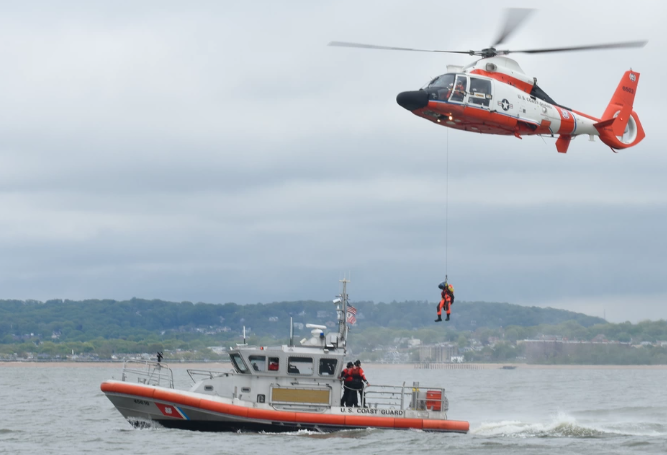
Abstract branding arguments are useful only if they translate into concrete imagery. Here are three visual concepts that illustrate how these two propositions could come to life on screen.
Concept One: Rescued by CG Vets. The setting is a tailgate party outside a football stadium, an all-American scene, families setting up grills, the full mise-en-scène of a fall Saturday. Something goes mechanically wrong. A portable generator fails, or someone has a flat tire. Three men nearby notice the problem and walk over without being asked. Working quickly and quietly as a team, they solve it, exchange a few words, and head back to their own truck. As they walk away, an onlooker asks in amazement: “Who were those guys? We’ve got three MacGyvers here.” Someone who knows them replies: “They’re ex-CG. The one on the right is Buzz, a Boatswain’s Mate. In the middle is Carl, an Electrician’s Mate. And that’s Dave, a Yeoman.” The departing vets return to attractive, clearly devoted partners. Their trucks suggest they own their own businesses, a mechanical contractor, a systems firm. The message is layered but clear: Coast Guard service produces capable, successful, grounded people. People worth becoming. That scenario, incidentally, can be varied almost infinitely across different settings and different trades.
Concept Two: The Small Team on Patrol. The camera opens in tight close-up on the crew of a 45-foot Response Boat making ready to get underway. No establishing shots, no landmarks, just the sailors: hands on lines, faces focused, voices low. The boat gets underway, and the camera settles on the bow from atop the pilothouse. The M240B machine gun is plainly visible. The bow cuts through the water. There is radio chatter on Channel 16, minimal conversation between the coxswain and crew. At least one female voice. The horizon is deliberately not shown. Then the camera angle rises in a slow, wide pull, and suddenly the Brooklyn Bridge fills the frame. The East River skyline opens up around the boat. It is a breathtaking reveal: this is the Coast Guard, operating in one of the most iconic waterways in the world, right now, today. The instinctive reaction from a target recruit should be: That is unbelievably cool. I want to be part of that. The format repeats across harbors: Tampa Bay, San Francisco’s Golden Gate, the Straits of Mackinac. The same concept applies to a Maritime Safety and Security Team boarding a container ship, with close-ups giving way to the reveal of a vast commercial port.
Concept Three: The Rescue Swimmer. A helicopter moves fast and low, filmed in black and white. Close-ups of the crew, pilot, flight mechanic, rescue swimmer, at least one woman, all in helmets and flight gear. Just the sound of the rotor blades and clipped radio traffic. You understand you are over water, but it is not the point of the shot. Then the side hatch opens, and suddenly you are watching GoPro footage as the rescue swimmer drops into a heaving sea. You don’t need to be told what happens next.
A Note on Black and White
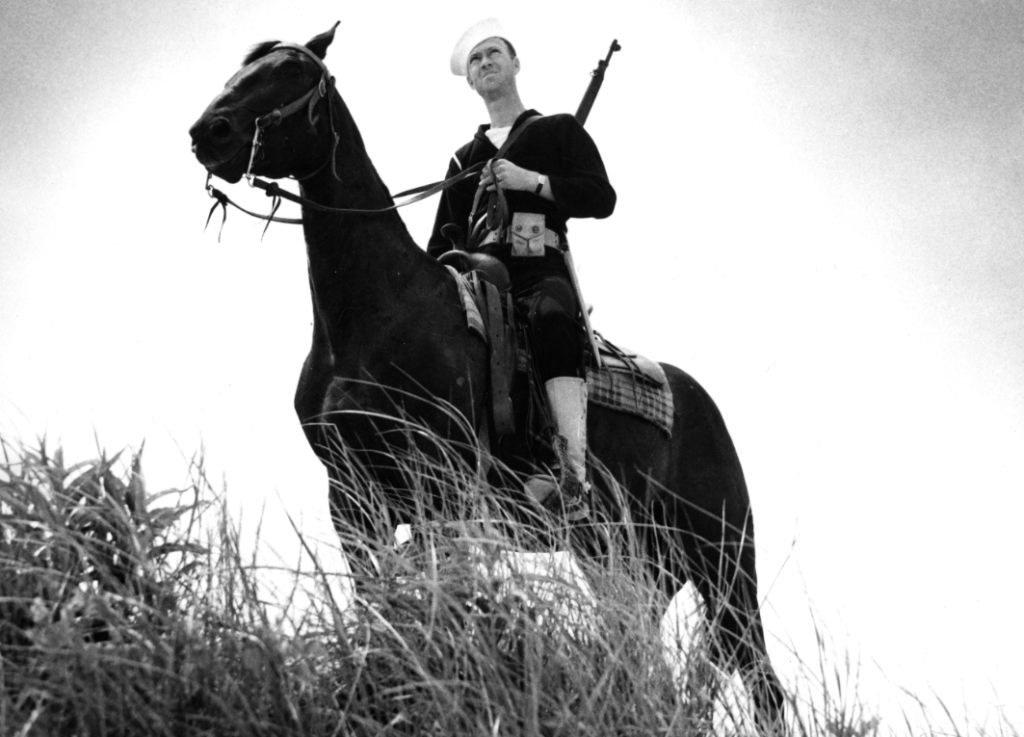
Several of these concepts benefit from black-and-white photography and cinematography, and one is specifically designed for it. This is worth addressing directly, because it may seem counterintuitive in an era of saturated social media content. But consider what black and white does: it strips away distraction and forces the eye toward form, texture, and human expression. It signals seriousness and authenticity. It is, frankly, more emotionally compelling than color in contexts where the subject matter demands gravitas.
The iconic photographs from World War II and the Korean War, including Chosin Reservoir, Iwo Jima, and the flight deck of a carrier in the Pacific, derive much of their power from the fact that they are monochrome. The Coast Guard’s operational imagery: storm seas, rescue operations, law enforcement boardings at sea, is inherently dramatic. It does not need vivid orange to communicate intensity. In fact, the orange-and-white color scheme that dominates current Coast Guard visual identity, while operationally sensible and SOLAS-compliant, tends to undercut the visual seriousness the brand needs. The MH-65 Dolphin is a magnificent piece of machinery. In full color, parked on a sunny ramp, it can look like a toy. In black and white, pitching over a gray Atlantic, it looks like what it is.
The recommendation is not to abandon color entirely, but to deploy black and white strategically, particularly for recruitment advertising, to establish a visual identity that is austere, serious, and heroic.
The Strategic Case
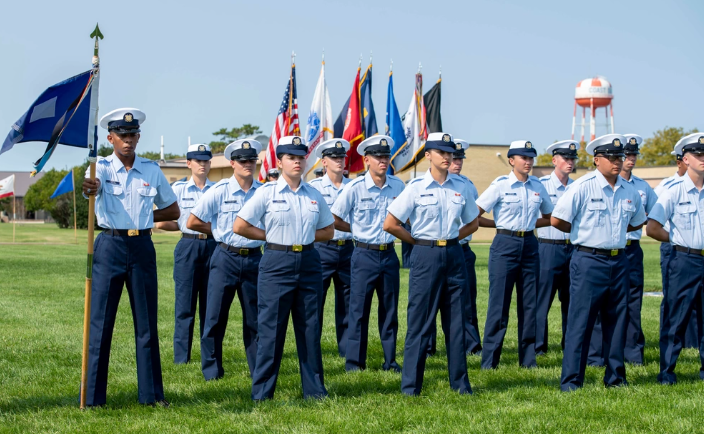
Force Design 2028 has correctly identified the need to grow the force and established the strategic imperative to build a national communications campaign. The framework proposed here addresses both the what and the how of that campaign in a way that is both authentic to Coast Guard culture and genuinely differentiating in a competitive recruiting environment.
The two-part positioning, Marine Corps Lite for the active-duty experience and MacGyver veteran for the life outcome, does not require inventing anything that is not already true. The Coast Guard already produces exactly these people. The Boatswain’s Mates, the Electrician’s Mates, the Aviation Survival Technicians, the Maritime Law Enforcement Specialists: they come out of service with real skills, real discipline, and real character. The job is simply to show that, clearly and compellingly, to the people who are deciding right now where to invest the next four years of their lives.
The Coast Guard doesn’t need to tell recruits that it’s the best branch. It needs to show them who they will become.
Semper Paratus.

_____________________________
Bruce D. Kowal served as a Quartermaster in the U.S. Navy, completing four WESTPAC deployments during the Vietnam era. He currently serves as an AUXOP with the USCG Auxiliary. In the summer of 2025, he spent time embedded at Coast Guard Station New York.
As the Voice of the Veteran Community, The Havok Journal seeks to publish a variety of perspectives on a number of sensitive subjects. Unless specifically noted otherwise, nothing we publish is an official point of view of The Havok Journal or any part of the U.S. government.
Reference: Force Design 2028 Execution Plan, by United States Coast Guard (United States Coast Guard)
Buy Me A Coffee
The Havok Journal seeks to serve as a voice of the Veteran and First Responder communities through a focus on current affairs and articles of interest to the public in general, and the veteran community in particular. We strive to offer timely, current, and informative content, with the occasional piece focused on entertainment. We are continually expanding and striving to improve the readers’ experience.
© 2026 The Havok Journal
The Havok Journal welcomes re-posting of our original content as long as it is done in compliance with our Terms of Use.


