Staff Sergeant Jeff Starling keyed his handset for a radio check. So far so good. Jeff was SSgt Sabasteanski’s team communicator and he was double-checking all his equipment to make sure that everything went smoothly during the mission. “Comm” is a fundamental task often taken for granted when it is working, but if it wasn’t there would be hell to pay. Today’s communications tasks weren’t very complicated. SSgt Starling only had to set up radios on the VHF spectrum to talk with the others in the platoon, SATCOM back to the ship, and UHF to communicate with the aircraft inserting and extracting the platoon.
As if that wasn’t enough, all the radios were encrypted and set to frequency modulation. Every radio was set to change frequencies every second or so and had to be perfectly tuned with each other in order to work. Any deviation of even a second would render the radios inoperable. This is a complex task, but one that SSgt Starling performed with a high level of proficiency and expertise. Starling spent three years at 2nd ANGLICO and four years at 5th Force Reconnaissance Company before successfully trying out for 1st Force Recon Company. In all, he had spent eight years in some of the most demanding and high-performing units in the Marine Corps. If anyone could keep comm up for the duration of the mission, he could.

Cpl Mark Baca’s job was not as complicated but no less important. He was his team’s point man and lead breacher. He was responsible for getting his team from the insert point through the breach and down to aft steering of the ship. The enemy on the ship would probably not leave their front door open but there weren’t many doors the hot blue flame of his Broco exothermic cutting torch couldn’t open. If it worked. He tested the torch. So far so good.
He looked over at SSgt William Dame, his platoon’s Explosive Ordnance Disposal (EOD) technician. SSgt Dame smiled because he knew that while Broco torches could open up most doors but there wasn’t a door in the world that could survive his explosive charges. The key to demolitions was using the bare minimum amount of explosive or detonation cord necessary to breach the door to reduce the risk to the assaulters.
The crew chief, GySgt James Paige, shook his head. There were way too many Marines manifested on his CH-46 helicopter. It just didn’t make sense. There weren’t even enough seats for all the passengers. It was a lot of weight in the aircraft. The assaulters were carrying a ton of equipment and now SOTG had added several observers to the aircraft to certify the raid.
He didn’t like it, but he would make it work. He had experienced a lot in his 20 + years of military service. He had served as a crew chief for HMX-1, the elite helicopter squadron responsible for transporting the president of the United States and his family, and had survived the bombing of the Marine Corps barracks in Beirut. Planning for life after the Corps, he had already applied to the police force back home in New Jersey and was just waiting to complete this deployment so he could retire and start a second career in law enforcement. Ultimately, like many Marines, the Marine Corps wasn’t just a job for GySgt Paige, it was a way of life.
SSgt Galloway could tell that the crew chief wasn’t happy and shared in that feeling. There were way too many people in the aircraft. It was hard enough to get a team of combat loaded Marines through the hell hole of the aircraft down to a moving ship 30 feet below. It would be much harder with all the extra people and equipment on the helicopter. Given the lack of seats, one of the observers even had to sit on an ammo can. He was not only the Assistant Team Leader, but also one of the HRST masters for this mission. He performed a final check of his equipment and buckled into his seat. Although his comfort level wasn’t where he would like it, everything appeared to be safe.
(Continue
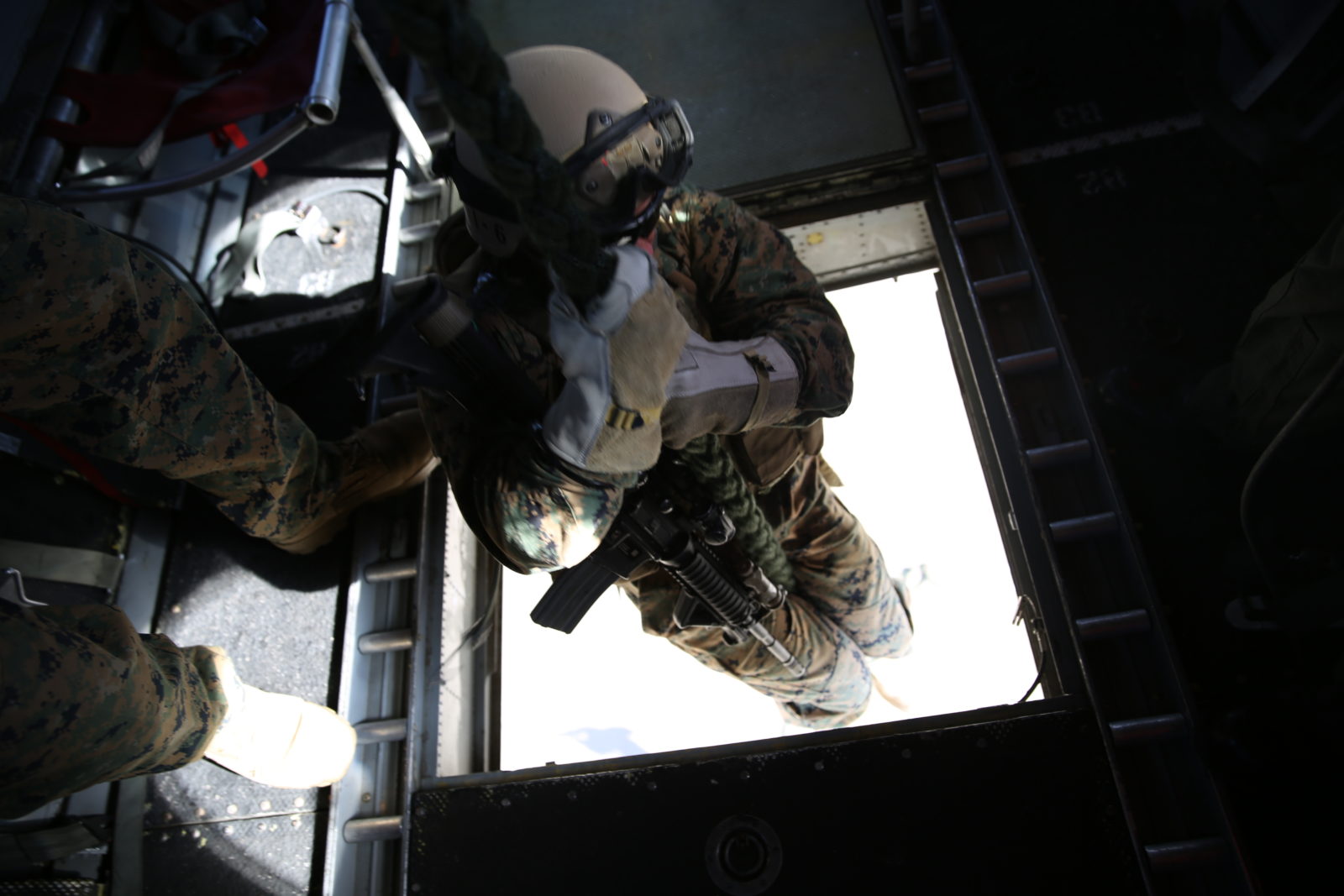
Col Zilmer watched the CH-46s take off from the flight deck of the Bonhomme Richard. This was supposed to be a nighttime raid but the helicopter pilots weren’t yet qualified for nighttime fast-roping. He knew that SOTG wasn’t happy that the raid was going during the daytime but it would at least make the operations safer.
Captain Lukehart flew his CH-46 to a holding pattern ten nautical miles behind the aft end of the Pecos and began his approach. GySgt Paige looked at the Pecos from one of the side windows. It really seemed like they were coming in fast. They received the ten-minute call. SSgt Galloway, the assistant HRST master for the mission, called for all his Marines to unbuckle their seat belts and stand up.
Hospitalman First Class Jay Asis grabbed his medical bag and shuffled behind SSgt Starling. Fast roping through the hell hole of a CH-46 wasn’t easy; fast-roping through the hell hole with combat equipment and a full medical bag was even more difficult. He tried to keep his balance as the helicopter swayed back and forth as they made their approach to the Pecos. It was imperative that he didn’t get snagged on his equipment as he went through the hell hole. Captain Andrew Smith, the co-pilot, gave the 30-second call. Everyone in the aircraft echoed it. “30 seconds!!!” It was go time.
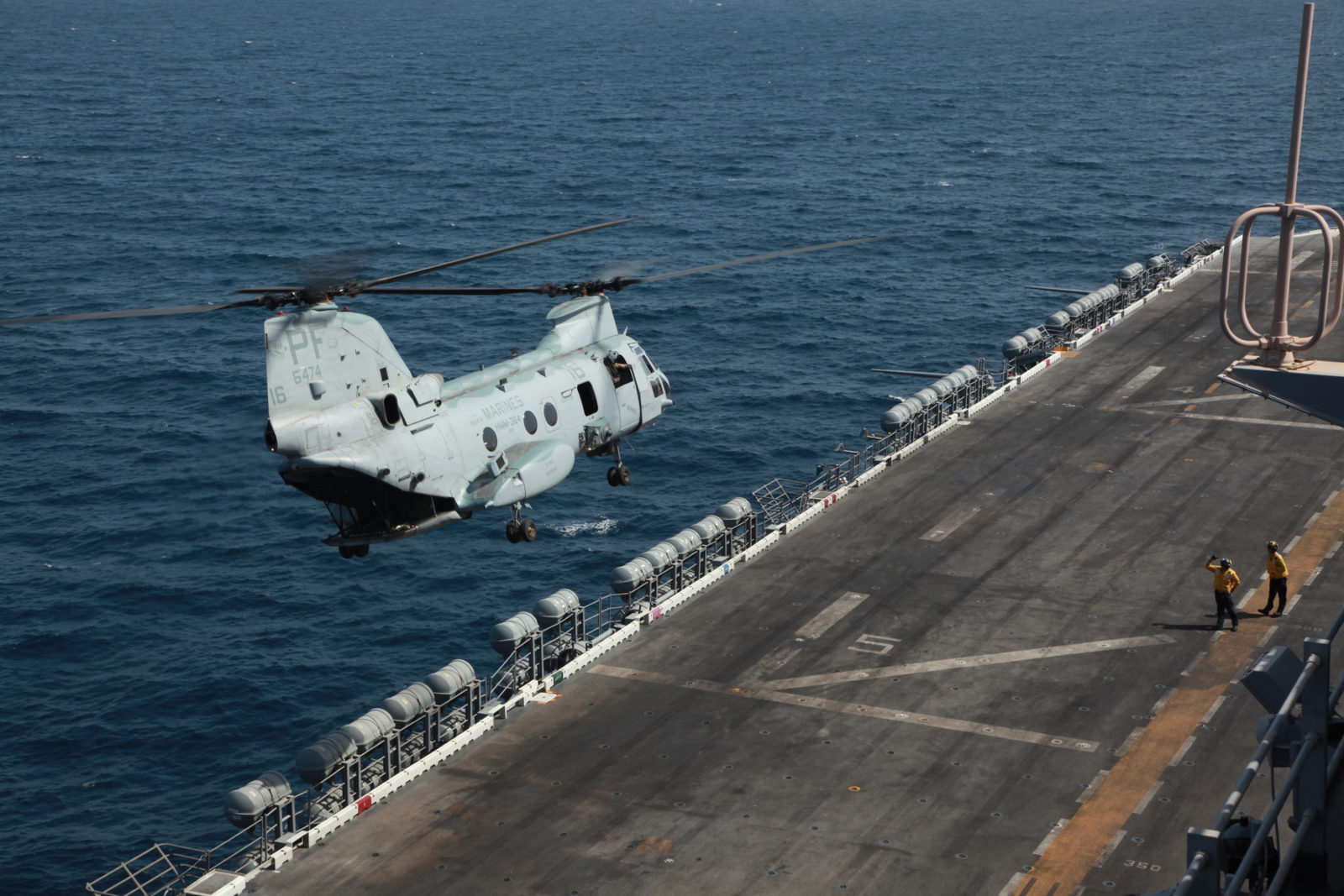
The CH-46 came in fast 20-30 feet over the deck of the Pecos. Sgt Evers heard a thump at the rear of the aircraft. It didn’t make sense. He couldn’t explain it. “POWER, POWER, POWER”. The radio erupted with calls for more engine power. Capt Lukehart applied more power. They weren’t 30 feet above the Pecos. The rear wheel of the helicopter had bounced off the deck of the ship.
The pilots hit the gas and pulled the helicopter skyward. Sgt Evers sighed. That was a close one. He sank into his seat and didn’t look outside. If he had, he would have noticed that the rear wheel had struck the emergency netting on the edge of the vessel and was hopelessly entangled in it. It was something he would think about often in the years to come.
A few seconds later everything changed. Up became down. Left became right. Water rushed into the troop compartment of the helicopter. Equipment and Marines were thrown about the aircraft. The CH-46 tumbled through the cold and murky water. GySgt Paige was next to the ramp and was one of the few Marines who could see the exit of the aircraft. He did not escape. He turned back into the helicopter and grabbed Marines by their equipment and pulled them outside.
Many of the Marines he saved were knocked unconscious by the crash and didn’t realize that they had been saved until they regained consciousness on the surface. Capt Kapitulik woke up to a nightmare. He was underwater, his leg was broken and he couldn’t tell where the exit was. He could have gone left or right. He went right. He made it to the surface. Many of his Marines did not. GySgt James Paige was one of them. He was last seen swimming back into the aircraft to save another Marine. He was never seen again.
The SEALs participating in the assault were the first on scene and recovered all the Marines who survived. Captains Lukehart and Kapitulik made it to the surface. GySgt James Paige, SSgt Vince Sabasteanski, SSgt David Galloway, SSgt Jeffery Starling, HM1 Jay Asis, and Cpl Mark Baca did not. These Marines, some of our nation’s finest, were lost on December 9th, 1999, but they will never be forgotten.
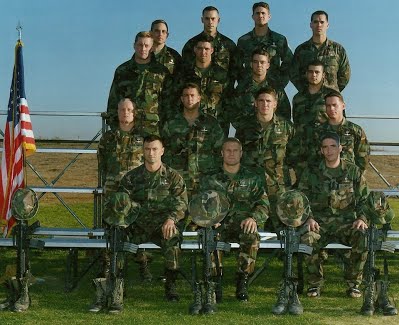
In the aftermath of this event, General James Jones, Commandant of the Marine Corps, awarded the Navy and Marine Corps Medal (the second-highest non-combatant medal awarded by the U.S. Department of the Navy) posthumously to GySgt James Paige for his heroism. The consolidated dive locker at Camp Pendleton has been named after Cpl Mark Baca.
The III MEF Special Operations Training Group HQ at Camp Hansen, Okinawa, and the Reconnaissance Communicator of the year award are both named after SSgt Jeff Starling. The Marines of 1st Force Reconnaissance Company, past, and present, with the support of the Marine Reconnaissance Foundation will ensure that none of our brothers will ever be forgotten.
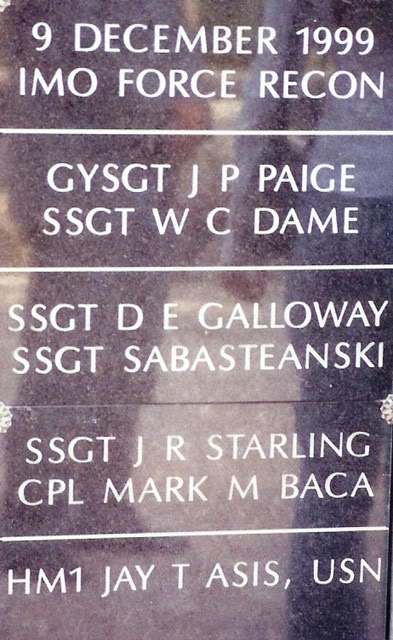
A memorial service was held on December 20th, 1999 at the base theater on Camp Pendleton to celebrate the lives of the fallen. We, the Marines of 1st Force Reconnaissance Company and the Marine Recon Foundation, invite you to join us this year as we recognize the sacrifice of these brave men at 1930 on December 5th, 2015 at O’Sullivan’s bar in Carlsbad.
If you can’t make it this year, you can catch it next year. It is the solemn promise that the men of 1st Force will continue to join together in memory of these Marines. I invite you to join them. If you cannot, consider using the link below to donate to the Marine Reconnaissance Foundation in their memory, and please raise a glass on December 9th to the brave men from 1st Force Reconnaissance Company and HMM-166 who willingly sacrificed everything for the security of our nation.
Never above you, never below you, always beside you.
Broadsword 6 sends
This first appeared in The Havok Journal on December 3, 2015.

U.S. Marines with the 15th Marine Expeditionary Unit’s Force Reconnaissance Detachment conduct military operations in urban terrain training aboard Camp Pendleton, Calif., Feb. 19, 2015. These Marines are a part of the MEU’s Maritime Raid Force. The training provides the MEU with the opportunity to train for similar environments in preparation for their upcoming deployment. (U.S. Marine Corps photo by Sgt. Emmanuel Ramos/Released). Source.
Buy Me A Coffee
The Havok Journal seeks to serve as a voice of the Veteran and First Responder communities through a focus on current affairs and articles of interest to the public in general, and the veteran community in particular. We strive to offer timely, current, and informative content, with the occasional piece focused on entertainment. We are continually expanding and striving to improve the readers’ experience.
© 2026 The Havok Journal
The Havok Journal welcomes re-posting of our original content as long as it is done in compliance with our Terms of Use.


