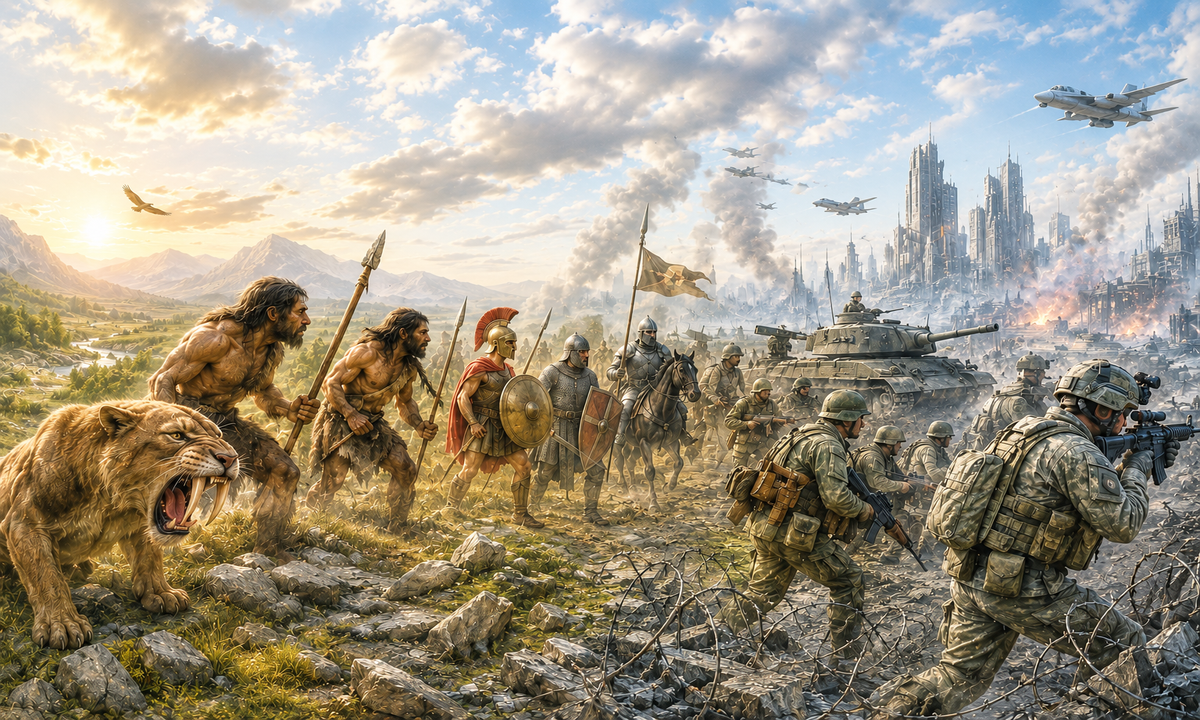
The modern world often speaks about war as though it were an aberration—a failure of diplomacy, a breakdown of civilization, or a temporary deviation from humanity’s natural state. Popular imagination tends to envision peace as the default condition of mankind and war as the unfortunate corruption of that condition.
History, anthropology, archaeology, and biology suggest something far less comforting.
War did not emerge after civilization. Civilization emerged from a world already shaped by conflict.
The uncomfortable truth is that before man was, war existed.
Not war in the modern sense of nation-states, standing armies, and industrialized violence, but conflict itself: competition over territory, mates, resources, hierarchy, and survival. Long before written history, long before organized religion, long before cities rose from river valleys, life evolved within systems defined by struggle. Predation, territorial defense, dominance hierarchies, and lethal competition existed millions of years before the first human being ever fashioned a spear.
The human species did not invent conflict. It inherited it. That is because before modern man was, war existed.
Thomas Hobbes famously described life in the state of nature as a “war of every man against every man.” While Hobbes’ formulation was philosophical rather than scientific, modern evidence suggests he understood something enduring about the human condition: absent structures capable of suppressing violence, competition and coercion emerge naturally.
This reality remains deeply unpopular in modern discourse because it collides with contemporary assumptions about human nature. Since the Enlightenment, much intellectual thought has oscillated between two competing visions of humanity. One, associated loosely with Hobbes, sees conflict as intrinsic to human existence. The other, associated with Rousseau and later romanticism, imagines early humanity as fundamentally peaceful until corrupted by civilization.
The archaeological record increasingly favors Hobbes.
Lawrence H. Keeley’s landmark work War Before Civilization dismantled the long-standing myth of the “peaceful savage” by documenting widespread evidence of prehistoric warfare across multiple continents. Mass graves, fortified settlements, skeletal trauma, scalping evidence, and patterns of organized violence all suggest that warfare was not a late invention of states, but a persistent feature of human societies long before modern civilization.
In some cases, prehistoric warfare appears to have been proportionally deadlier than modern war.
Keeley’s research argued that tribal and pre-state societies frequently suffered casualty rates vastly exceeding those of twentieth-century industrial conflicts when measured against total population. This does not mean ancient warfare possessed the technological scale of modern combat. It means violence was often intimate, constant, and existential. Entire villages could disappear. Defeat frequently meant annihilation rather than negotiation.
Civilization did not create violence. In many respects, it constrained it.
This is one of history’s central paradoxes. States, laws, and institutions are often criticized as instruments of coercion—and sometimes rightly so—but they also emerged partly because humans required mechanisms capable of suppressing endemic violence. Hobbes understood this when he argued that political authority existed primarily to prevent society from descending into perpetual conflict.
Military professionals intuitively grasp this dynamic because they live within structured violence.
The profession of arms is built upon the recognition that conflict is not an anomaly but a recurring feature of human affairs. Armies do not exist because humanity has transcended violence; armies exist because it has not. The modern military officer studies war not out of fascination with destruction, but because history repeatedly demonstrates that peace is fragile, conditional, and often temporary.
This understanding sharply contrasts with the post-Cold War illusion that globalization and economic integration had permanently pacified great-power competition.
For roughly three decades after the collapse of the Soviet Union, much of the Western world embraced the belief that large-scale conflict had become obsolete. Economic interdependence, liberal democracy, technological progress, and international institutions were expected to supersede traditional geopolitical struggle. History, it was assumed, had evolved beyond the brutal logic that governed earlier centuries.
Recent events have shattered that assumption.
Ukraine, the South China Sea, renewed nuclear competition, cyber warfare, and the fragmentation of the international order all demonstrate that conflict did not disappear. It merely adapted. Human nature remained constant beneath changing technology.
This is why the phrase “before man was, war existed” carries deeper meaning than simple cynicism. It is not merely an observation about violence. It is an observation about reality itself.
Competition is woven into biological existence. Every organism competes for survival. Predators hunt prey. Species compete for ecological dominance. Even cooperation often emerges not as an alternative to competition, but as a strategy within it. Human beings inherited these evolutionary pressures, then layered culture, ideology, morality, and politics atop them.
Civilization softened some instincts while amplifying others.
Technology transformed tribal raids into mechanized warfare. Industrialization transformed localized violence into global conflict. Nuclear weapons transformed war from a contest for territory into a potential species-level threat. Yet despite these changes, the underlying dynamics remain recognizable. Fear, scarcity, ambition, honor, revenge, and survival continue to drive human conflict much as they did thousands of years ago.
Modernity changed the tools. It did not eliminate the impulses.
This creates a tension modern societies struggle to reconcile. Liberal democracies depend upon optimism about human cooperation. They require citizens to believe institutions can mediate conflict rationally and peacefully. Yet those same societies rely upon militaries precisely because history demonstrates cooperation alone is insufficient.
The military profession therefore occupies a psychologically uncomfortable space within modern civilization. It exists as a permanent acknowledgment that violence remains foundational to political reality even in an age that prefers to imagine itself beyond such primitive concerns.
There is also a deeper philosophical implication.
If conflict predates civilization, then peace cannot be understood as humanity’s natural resting state. Peace is not passive. It is constructed, maintained, defended, and enforced. It requires institutions, deterrence, cultural cohesion, economic stability, and often military strength. Remove those stabilizing forces, and older patterns frequently reemerge with alarming speed.
The twentieth century demonstrated this repeatedly.
Europe entered 1914 believing itself modern, interconnected, and economically sophisticated beyond the barbarism of earlier centuries. Industrial progress, scientific advancement, and expanding trade were expected to make major war irrational. Instead, the continent descended into mechanized slaughter unprecedented in human history.
Civilization proved thinner than expected.
This does not mean humanity is doomed to perpetual war. Fatalism is as intellectually lazy as naïve optimism. Humans are capable of extraordinary cooperation, sacrifice, compassion, and restraint. Civilization itself is proof of that. But sustainable peace requires understanding human nature honestly rather than sentimentally.
A society unwilling to recognize the permanence of conflict risks becoming strategically fragile.
This is particularly relevant in the modern West, where prosperity has created distance from historical memory. Many citizens now experience war primarily through screens, abstractions, or ideological narratives rather than lived reality. As collective memory fades, societies begin mistaking temporary stability for permanent transformation.
History warns against that assumption.
The Roman Empire believed itself eternal. European powers believed industrial civilization had outgrown large-scale war. The architects of the post-Cold War order believed economic globalization would override geopolitical rivalry. Each assumption underestimated the persistence of competition within human systems.
The military profession cannot afford such illusions.
Soldiers, sailors, airmen, and Marines operate in a world where consequences remain stubbornly real. Strategy requires confronting human nature as it is rather than as one wishes it to be. That means accepting an uncomfortable possibility: war is not a historical accident waiting to be cured, but a recurring expression of forces deeply embedded within both biology and politics.
Before man was, war existed.
And unless human nature itself changes, conflict will remain part of the human story long after modern civilizations convince themselves otherwise.
_____________________________
Charles served over 27 years in the US Army, which included seven combat tours in Iraq and Afghanistan with various Special Operations Forces units and two stints as an instructor at the United States Military Academy at West Point. He also completed operational tours in Egypt, the Philippines, and the Republic of Korea and earned a Doctor of Business Administration from Temple University as well as a Master of Arts in International Relations from Yale University. He is the owner of The Havok Journal, and the views expressed herein are his own and do not reflect those of the US Government or any other person or entity.
As the Voice of the Veteran Community, The Havok Journal seeks to publish a variety of perspectives on a number of sensitive subjects. Unless specifically noted otherwise, nothing we publish is an official point of view of The Havok Journal or any part of the U.S. government.
Buy Me A Coffee
The Havok Journal seeks to serve as a voice of the Veteran and First Responder communities through a focus on current affairs and articles of interest to the public in general, and the veteran community in particular. We strive to offer timely, current, and informative content, with the occasional piece focused on entertainment. We are continually expanding and striving to improve the readers’ experience.
© 2026 The Havok Journal
The Havok Journal welcomes re-posting of our original content as long as it is done in compliance with our Terms of Use.