
In a previous article, I broke down the National Security Strategy (NSS), which serves as the document that sets the President’s vision for America’s role in the world. The NSS answers the big questions:
• What are America’s core interests?
• What are the primary threats?
• What principles guide our engagement abroad?
The National Defense Strategy (NDS) answers a different question:
• How does the Department of War translate that vision into military power?
If the NSS were the blueprint, the NDS is the operations order.
The NDS directly reflects the themes outlined in the NSS: America First prioritization, peace through strength, flexible realism, and a renewed emphasis on burden-sharing. But unlike the broader policy language of the NSS, the NDS operationalizes those ideas into concrete lines of effort. It is structured around four priorities: defending the U.S. homeland, deterring China in the Indo-Pacific through strength rather than confrontation, increasing burden-sharing with allies and partners, and supercharging the U.S. defense industrial base. This structure demonstrates a clear hierarchy of effort. It does not attempt to solve every global problem. Instead, it prioritizes what is most consequential to American security, freedom, and prosperity.
Defending the Homeland Comes First
The most significant shift in the document is the elevation of homeland defense to the top priority. For decades, U.S. defense planning focused outward first, assuming the homeland was largely insulated from direct threats. The NDS reverses that assumption. It emphasizes securing borders, countering narco-terrorist networks in the Western Hemisphere, protecting key terrain such as the Panama Canal and Greenland, strengthening missile and drone defenses, modernizing nuclear forces, and enhancing cyber resilience. The message is clear: sovereignty and territorial defense are foundational, not secondary. In many ways, this reflects a return to classical American strategic thinking of protecting the Western Hemisphere’s security as a prerequisite for global influence.
China as the Pacing Challenge
The second major line of effort centers on deterring China. The NSS identified China as the pacing challenge, while the NDS translates that designation into force posture and operational focus. The approach is not one of domination or regime change. Instead, it emphasizes deterrence and denial by building a strong defensive posture along the First Island Chain, strengthening Indo-Pacific alliances, and ensuring the United States maintains credible strike capabilities. The goal is to prevent any power from dominating the Indo-Pacific, the world’s economic center of gravity. This is balance-of-power logic applied to the 21st century. It reflects a sober assessment that preserving access and influence in that region is directly tied to American prosperity.
Burden-Sharing as a Strategic Necessity
The third line of effort operationalizes the NSS theme of burden-sharing. Allies are no longer treated as passive beneficiaries of U.S. protection. Instead, they are expected to assume primary responsibility for defending their regions, with critical but more limited U.S. support. Europe is expected to lead on conventional defense against Russia. South Korea is expected to shoulder primary responsibility for deterring North Korea. Middle Eastern partners are encouraged to take greater ownership of regional security. Western Hemisphere nations are expected to counter narco-terrorist networks and resist external adversarial influence. This shift reflects the reality of what strategists refer to as the simultaneity problem: the possibility of facing coordinated or opportunistic aggression across multiple theaters. Without meaningful allied investment, deterrence becomes fragile. With it, collective defense becomes sustainable.
Industrial Power as the Foundation of Deterrence
Perhaps the most consequential element of the NDS is its focus on the defense industrial base (DIB). Military strength is not simply measured in troop numbers or platforms; it is measured in production capacity, logistics depth, and sustainment resilience. The strategy emphasizes reshoring defense production, expanding munitions manufacturing, scaling advanced technologies such as artificial intelligence, and reducing regulatory barriers that impede rapid production. The document frames this as a national mobilization effort, a revival of American industrial capacity comparable to past periods of strategic competition. This connects directly to the NSS’s argument that economic security underpins national security. Without industrial strength, deterrence is hollow.
Check out my previous article, “Logistics Lead the Fight, Tactics Finishes It,” to understand why the DIB is crucial to national security.
A Clear Hierarchy of Threats
The NDS establishes a defined threat hierarchy. Direct threats to the homeland, including nuclear, cyber, missile, and terrorist threats, are treated as paramount. China is identified as the primary pacing competitor (peer adversary). Russia is acknowledged as a persistent but regionally bounded threat (near-peer adversary). Iran and North Korea are treated as serious but geographically focused challenges. Unlike previous strategies that often treated all threats as equal, this document differentiates based on severity, geography, and consequence. That prioritization reflects a realistic correlation of ends, ways, and means.
Strategic Discipline Over Strategic Drift
What ultimately distinguishes this strategy is its emphasis on focus and discipline. Homeland defense is explicitly first. China is addressed through deterrence rather than provocation. Europe is rebalanced in accordance with allied capacity. Industrial power is elevated to strategic center stage. The strategy rejects expansive ideological ambitions in favor of clearly defined national interests. It frames military strength not as a tool of perpetual intervention but as a stabilizing force designed to prevent war through credible capability.
Linking Back to the National Security Strategy
When viewed alongside the National Security Strategy, the coherence becomes evident. The NSS articulated the ends: protecting American sovereignty, preserving the balance of power, and securing peace through strength. The NDS outlines the ways and means: force posture adjustments, alliance restructuring, industrial mobilization, and prioritized resource allocation. Strategy, after all, is the disciplined alignment of ends, ways, and means. The 2026 National Defense Strategy represents an effort to bring those elements into alignment.
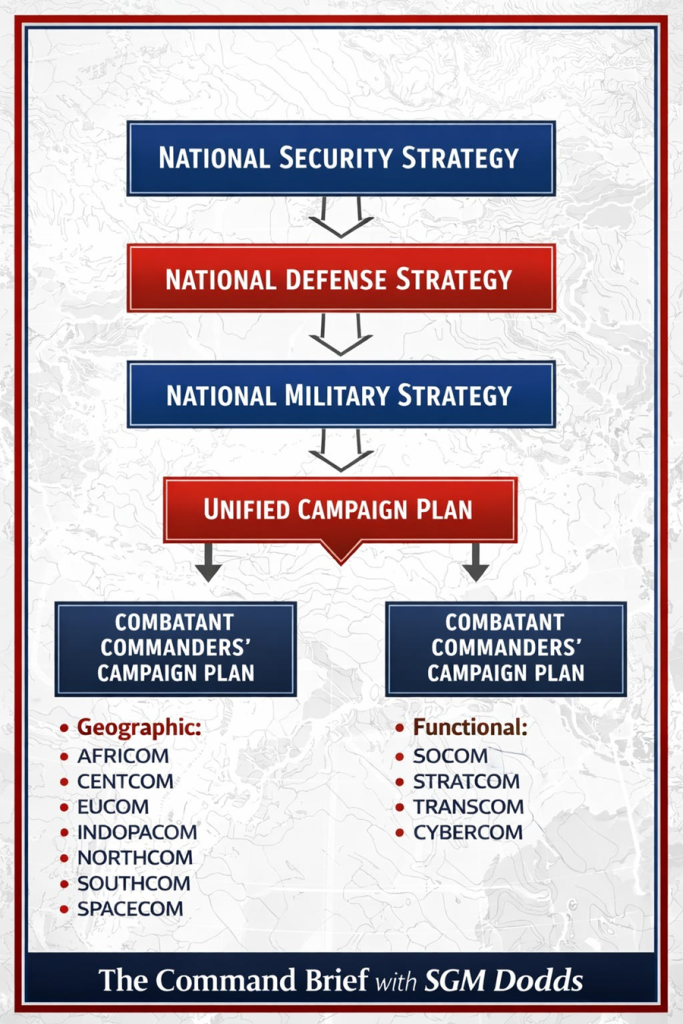
The President establishes the nation’s overarching vision through the National Security Strategy (NSS). From this guidance, the Secretary of War translates policy into defense priorities within the National Defense Strategy (NDS). The Chairman of the Joint Chiefs of Staff then operationalizes these priorities through the National Military Strategy (NMS). Collectively, these documents provide authoritative direction to the Geographic and Functional Combatant Commanders, who develop and execute campaign plans aligned with national objectives.
Final Assessment
From a senior enlisted perspective, the document ultimately restores clarity of purpose. The mission is no longer abstract. It is concrete. Each Line of Effort (LOE) ensures the force is ready to win when called upon.
• LOE 1: Defend the U.S. Homeland
• LOE 2: Deter China in the Indo-Pacific Through Strength, Not Confrontation
• LOE 3: Increase Burden-Sharing with U.S. Allies and Partners
• LOE 4: Supercharge the U.S. Defense Industrial Base
The NSS defined the vision. The NDS builds the muscle. In strategy, vision without strength is empty, and strength without direction is wasted. This strategy attempts to bind both together in pursuit of what it consistently frames as peace through strength.
References
2026 National Defense Strategy, by Department of War (Department of War), Jan. 23, 2026.
https://media.defense.gov/2026/Jan/23/2003864773/-1/-1/0/2026-NATIONAL-DEFENSE-STRATEGY.PDF
_____________________________
Sergeant Major (Retired) Daniel L. Dodds is a Military Police Senior Noncommissioned Officer. He has served in every leadership position from Patrolman to Battalion Command Sergeant Major. He is currently assigned as the Director of Operations Sergeant Major for the United States Disciplinary Barracks, the only Level III maximum-security prison in the Department of Defense. His civilian education includes an associate’s degree from Excelsior University and a Bachelor of Arts in Leadership and Workforce Development from the Army Command and General Staff College (CGSC). He is pursuing a Master of Public Administration from Excelsior University.
As the Voice of the Veteran Community, The Havok Journal seeks to publish a variety of perspectives on a number of sensitive subjects. Unless specifically noted otherwise, nothing we publish is an official point of view of The Havok Journal or any part of the U.S. government.
Buy Me A Coffee
The Havok Journal seeks to serve as a voice of the Veteran and First Responder communities through a focus on current affairs and articles of interest to the public in general, and the veteran community in particular. We strive to offer timely, current, and informative content, with the occasional piece focused on entertainment. We are continually expanding and striving to improve the readers’ experience.
© 2026 The Havok Journal
The Havok Journal welcomes re-posting of our original content as long as it is done in compliance with our Terms of Use.