Europe has two religions: Symbolism and Someone Else Paying For It.
So when Donald Trump waddles onto the world stage and starts yanking the tablecloth off the NATO brunch buffet, everyone clutches their pearls like he just suggested putting ketchup on a croissant. “How dare he threaten the sacred rules-based order,” they gasp, as if that phrase isn’t just a decorative throw pillow stitched by committees to cover up the fact that hard power still exists and always has.
Now cue the Greenland melodrama. The story, depending on which moral panic newsletter you subscribe to, is either: (A) Trump is a cartoon villain trying to “take” Greenland, or (B) Trump is a brilliant negotiator using pressure to force movement on strategic reality. What’s not in dispute is that Greenland has become a hot strategic item. There’s growing attention on Arctic routes, military positioning, and resources, and the U.S. already has longstanding defense arrangements there through the U.S.-Denmark Greenland defense agreement framework.
Here’s the part that makes polite Europe break out in hives: Trump treats geopolitics like leverage, not like a graduate seminar where everyone “affirms” things while doing the international-relations equivalent of posting a black square on Instagram.
And yes, that approach works more often than the etiquette police want to admit.
The critics keep trying to coin playground taunts, because if you can reduce a strategy to a meme, you don’t have to grapple with results. The “he backed down” storyline is especially convenient. It’s the emotional support narrative for people who confuse “not doing the most extreme option” with “losing.” This is the political-commentary version of calling someone a coward for not driving their car into a lake after threatening to do it in an argument.

Negotiation, in the real world, is not: “Hello Denmark, may we please collaboratively explore an inclusive framework for mutual benefit while we validate one another’s lived experiences of sovereignty.”
Negotiation is: “I might do the stupid thing. Do you want to find out?”
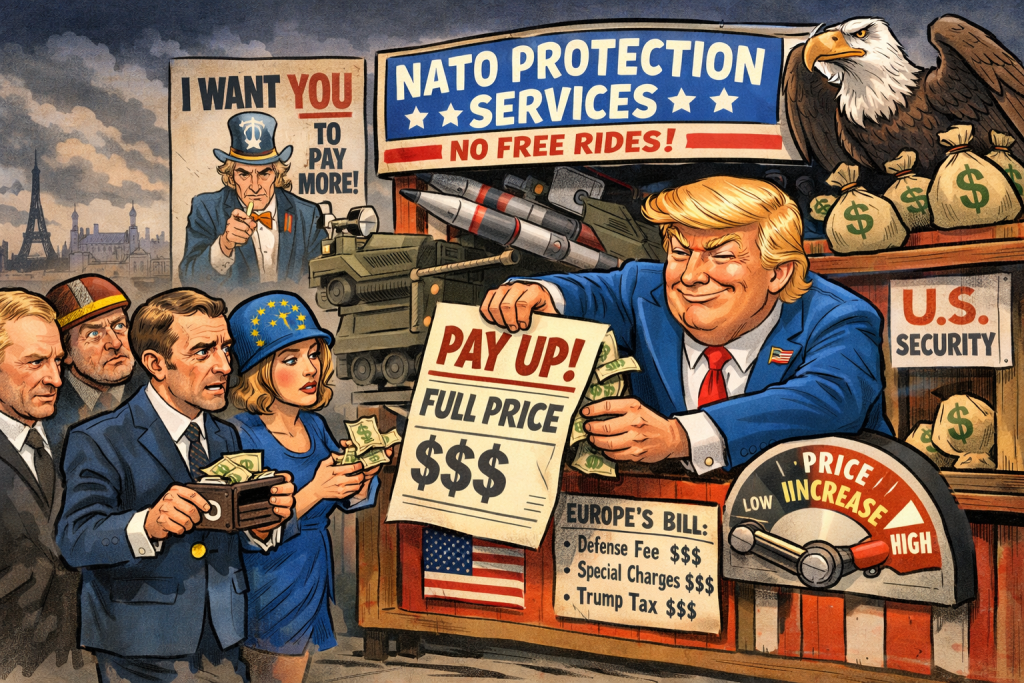
Europe hates this because it exposes the core scam. They’ve built an entire prestige economy around acting like seriousness is the same as effectiveness. They love the theater of virtue, the choreography of statements, the artisanal hand-crafted outrage. But when a guy comes in and says, “Pay more for defense or I will make your strategic anxiety problem your daily hobby,” suddenly everyone remembers where the fire extinguishers are.
Even mainstream reporting acknowledges that Trump’s Greenland pressure campaign has been tied to threats of economic pressure and tariff talk, and that a “framework” or “tentative” arrangement has been discussed publicly without full details disclosed. And you can see the European reaction pattern in real time: official condemnation, frantic alliance-worry, then the slow pivot to “okay but what’s the deal, exactly.”
This is where Trump is “correct,” in the bluntest possible sense. Not morally pure. Not aesthetically pleasing. Correct like a crowbar is correct when your house is on fire and the front door is jammed.
Because the supposed alternative, the refined alternative, the “proper” alternative, is the one we already tried. It’s a 30-year interpretive dance called “Strongly Worded Letters,” and it ends with the same finale every time: America still covers the security bill, Europe still underinvests until the sky starts falling, and everyone still pretends the arrangement is a partnership rather than a subscription.
Trump’s move is basically to stop pretending the subscription is free.
And the Greenland angle is perfect for this, because it collides three things Europe is exquisitely uncomfortable saying out loud:
First, the Arctic is becoming more strategically relevant, and pretending it’s just a polar bear screensaver is not a policy.
Second, resources matter. Not in the cute “sustainable” way where you light a candle and whisper “net zero” at your thermostat. In the industrial way, where supply chains decide who builds what and who begs for it. Rare earth processing capacity being heavily concentrated in China is part of why every country that likes having electronics is suddenly acting like geology is sexy.
Third, agreements and basing rights already exist, and they are not poetry. They are mechanisms. The U.S.-Denmark arrangements on Greenland have explicit pathways and history for U.S. presence and modernization.
So Trump’s “uncomfortable truth” isn’t that he discovered leverage. It’s that he made everyone admit they were living off it.
And notice how the most offended people are always the ones who benefit most from the old arrangement. The minute you question the arrangement, they start screaming “rules-based order” the way a toddler screams “mine” over a toy they didn’t pay for.
Do I think Trump is running some mystical 40-dimensional chess? No. He’s running two-dimensional real estate math: ask high, create panic, force motion, accept the version that achieves the underlying objective, then let your critics declare victory for you because you didn’t literally annex the moon.
The funniest part is that his opponents help him. They loudly insist he’s a reckless barbarian, then scramble to accommodate the pressure he applied, then declare him “unserious,” as if seriousness is measured by how gently you lose.
If this whole Greenland episode ends in expanded basing access, longer-term security guarantees, resource development openings, or any de facto shift in American operating rights, then the scoreboard matters more than the choreography.
And Europe can keep cosplay-worrying about sovereignty while quietly enjoying the one sovereignty they never quite funded: the freedom to be protected while disapproving of the protector.
That’s the deal. That’s the ugly truth. That’s why Trump’s method keeps scoring points while the “polite” method keeps collecting awards for Best Intentions in a Noncompetitive Category.
_____________________________
Tammy Pondsmith was once banned from a Davos canapé station for asking whether “rules-based order” pairs better with champagne or with the tears of unpaid defense budgets.
As the Voice of the Veteran Community, The Havok Journal seeks to publish a variety of perspectives on a number of sensitive subjects. Unless specifically noted otherwise, nothing we publish is an official point of view of The Havok Journal or any part of the U.S. government.
Buy Me A Coffee
The Havok Journal seeks to serve as a voice of the Veteran and First Responder communities through a focus on current affairs and articles of interest to the public in general, and the veteran community in particular. We strive to offer timely, current, and informative content, with the occasional piece focused on entertainment. We are continually expanding and striving to improve the readers’ experience.
© 2026 The Havok Journal
The Havok Journal welcomes re-posting of our original content as long as it is done in compliance with our Terms of Use.