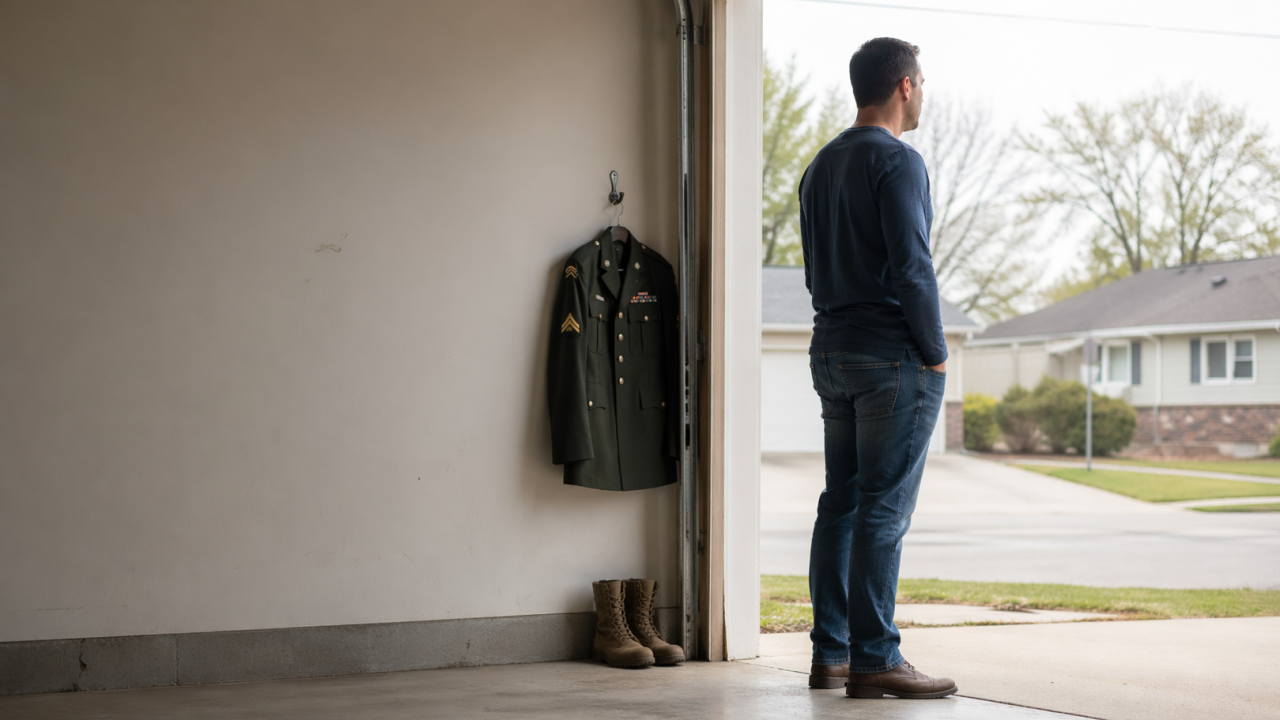
There’s a moment no one really prepares you for.
It’s not the firefight. Not the deployment. Not even the long, dull stretches of waiting punctuated by adrenaline spikes that hit like lightning. Those things get talked about. Briefed. Debriefed. Turned into stories.
No, the moment that sneaks up on you is much quieter than that.
It’s the day you come home—and realize that nothing fits quite right anymore.
We spend a lot of time talking about transition in the military. TAP classes, resumes, LinkedIn profiles, translating MOS codes into civilian language. It’s all well-intentioned, and some of it’s even useful.
But it misses the point.
Because transition isn’t about jobs.
It’s about identity.
In uniform, everything is structured. You know your place. You know your people. You know the standard, and whether you’re meeting it. There’s a clarity to it—even when it’s hard, even when it’s chaotic.
Especially when it’s chaotic.
Then one day, it’s gone.
You wake up without a formation to be at. No one’s calling you by your rank. No one needs you to lead, or follow, or just be present in the way that mattered before.
And for the first time in a long time, you’re on your own.
Here’s the part people don’t like to say out loud:
That freedom can feel like loss.
You miss the stupid things. The dark humor. The shared misery. The way a glance across a room could say more than a paragraph ever could.
You miss being part of something that didn’t have to be explained.
And no matter how good your life is on the outside—good job, good family, everything squared away—there’s still that quiet question sitting in the back of your mind:
Was that the most meaningful thing I’ll ever do?
That question can eat at you if you let it.
Some guys try to outrun it. They stack accomplishments, chase money, build businesses, stay busy enough that they never have to sit still long enough to think.
Others go the opposite direction. They get stuck. Disconnected. Drifting between jobs, relationships, identities that never quite stick.
Most of us land somewhere in the middle—functioning, but carrying something we don’t fully understand.
The truth is, you don’t replace what the military gave you.
You don’t recreate it in a corporate office or a suburban neighborhood or a startup grind.
And trying to do that will only leave you frustrated.
What you can do—what you have to do—is build something new that’s just as real.
Purpose doesn’t disappear when you take off the uniform. But it does stop being assigned.
Now, you have to choose it.
That might mean leading in a different way. Mentoring. Teaching. Building something that matters to people who don’t wear the same patch you did.
It might mean showing up for your family with the same consistency you once brought to your unit.
Or it might mean something quieter—being the steady, reliable presence in a world that feels increasingly unsteady.
Here’s the hard part:
There’s no rank structure for this.
No promotion board. No clear metric for success.
Just you, deciding every day what kind of man you’re going to be now that no one’s telling you.
And maybe that’s the point.
Because the best leaders I ever knew weren’t defined by their rank anyway. They were defined by what they did when no one was watching. When it wasn’t required. When it didn’t come with recognition.
That doesn’t change when you leave the military.
If anything, it matters more.
Coming home isn’t the end of the mission.
It’s just the point where the mission stops being written for you.
And for better or worse—that part’s on you now.
_____________________________
Charles served over 27 years in the US Army, which included seven combat tours in Iraq and Afghanistan with various Special Operations Forces units and two stints as an instructor at the United States Military Academy at West Point. He also completed operational tours in Egypt, the Philippines, and the Republic of Korea and earned a Doctor of Business Administration from Temple University as well as a Master of Arts in International Relations from Yale University. He is the owner of The Havok Journal, and the views expressed herein are his own and do not reflect those of the US Government or any other person or entity.
As the Voice of the Veteran Community, The Havok Journal seeks to publish a variety of perspectives on a number of sensitive subjects. Unless specifically noted otherwise, nothing we publish is an official point of view of The Havok Journal or any part of the U.S. government.
Buy Me A Coffee
The Havok Journal seeks to serve as a voice of the Veteran and First Responder communities through a focus on current affairs and articles of interest to the public in general, and the veteran community in particular. We strive to offer timely, current, and informative content, with the occasional piece focused on entertainment. We are continually expanding and striving to improve the readers’ experience.
© 2026 The Havok Journal
The Havok Journal welcomes re-posting of our original content as long as it is done in compliance with our Terms of Use.


