Volume 2, Issue 7
If you served in the military no matter what branch of service you were in, you learned at some point the importance of having space to maneuver. Whether you were maneuvering pairs of boots, a tank, a ship, or a fighter jet, having adequate physical space was essential to executing maneuver smoothly and safely. Likewise, when we encounter challenges in life, our minds need maneuver space to mentally negotiate difficult moments. This series will highlight each month a different brief cognitive tool that you can use in your daily life to potentially create more maneuver space. Remember having maneuver space, or space to think, is a gift in life. Once you create it, use it to your advantage!
Establishing Boundaries in Relationships
Managing a relationship is a lot like running a range in the military. One of the first things you are told when you arrive at a range, is where the left and right limits are. These range markers are designated for safety and indicate the area where you can fire a particular weapon system. These are what we call boundaries. Boundaries are also important in life, particularly in relationships. Part of building strong relationships, is first identifying the potential obstacles that can cause friction. These obstacles keep us from being able to effective mentally maneuver through relational disagreements, misunderstandings, and challenges. Just like at a range, a good way to mark an obstacle is to establish a boundary.
What are Boundaries in Relationships?
In relationships, we have various life experiences where we receive specific message about how important our needs/wants are. This happens in our families, in the military, in our vocational careers, and in romantic relationships. Sometimes we receive messages that our needs/wants are not important and we learn to deny, hide, or minimize the importance of our needs/wants. In other times, we receive messages that the only way to get our needs/wants met is to use force, threats/intimidation, or manipulation.[1] Ultimately in both cases, we set up boundaries that hold others at a distance or prioritize our needs/wants without considering another person. While these types of boundaries may help us feel safe, they don’t build mutual respect and connection in relationships. In any type of relationship, nobody wants to feel abandoned, devalued, or rejected. The below model is a potential way of displaying this visually.
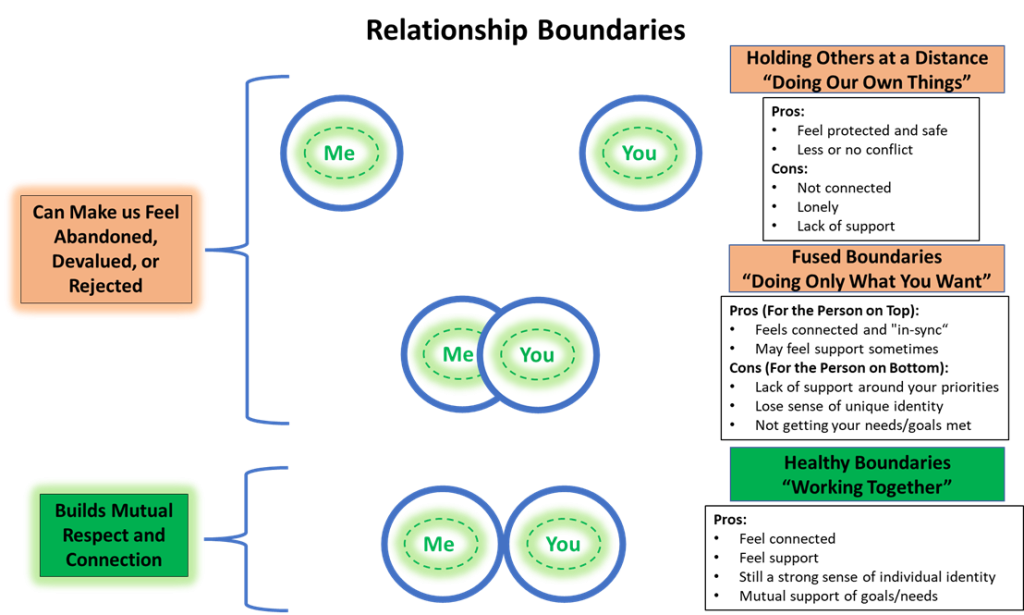
How to Set Healthy Boundaries in Relationships[3]
When we create healthy boundaries, we feel mutually connected and supported by the other person but can still embrace a strong sense of our own individual identity. Some potential ways to facilitate health boundaries more effectively can be:
- Each person having the space and time to identify their needs and goals.
- Mutual communication and support of needs and goals.
- Finding ways to balance your needs/wants and their needs/wants
- Negotiate/advocate when there is conflict between competing needs/wants
- Work together to eliminate emotional, physical, or financial abuse/aggression.
As noted, in any type of relationship, nobody wants to feel abandoned, devalued, or rejected. In relationships, both consciously and unconsciously as humans, we look for support, admiration, and acceptance. On the range in the military, boundaries kept us safe. Healthy boundaries in relationships build mutual respect and connection. Ultimately, when we create healthy boundaries, we can maneuver through relationship obstacles more efficiently and effectively.

About the Author: Mr. Bongioanni is a licensed mental health counselor who alsoworks for the U.S. Department of Veterans Affairs. He is also a senior leader in the U.S. Army Reserve. His professional interests include human behavior, applied psychology, and military cultural competence. The views expressed are those of the author and do not necessarily reflect the official policy or position of the U.S. Department of Veterans Affairs, the U.S. Department of Defense, or the U.S. Government.
[1] U.S. Department of Veterans Affairs, Skills Training in Affective & Interpersonal Regulation (STAIR), Session #7 What are Boundaries, January 2013, 2.
[2] U.S. Department of Veterans Affairs, Skills Training in Affective & Interpersonal Regulation (STAIR), Session #7 Boundaries in Relationships, January 2013, 1.
[3] Cloitre, M., Kulkarni, M., Jackson, C., Weiss, B., and Gupta, C. STAIR Group Essentials, Version 2.0 August 2015, U.S. Department of Veterans Affairs, 82.
As the Voice of the Veteran Community, The Havok Journal seeks to publish a variety of perspectives on a number of sensitive subjects. Unless specifically noted otherwise, nothing we publish is an official point of view of The Havok Journal or any part of the U.S. government.
Buy Me A Coffee
The Havok Journal seeks to serve as a voice of the Veteran and First Responder communities through a focus on current affairs and articles of interest to the public in general, and the veteran community in particular. We strive to offer timely, current, and informative content, with the occasional piece focused on entertainment. We are continually expanding and striving to improve the readers’ experience.
© 2026 The Havok Journal
The Havok Journal welcomes re-posting of our original content as long as it is done in compliance with our Terms of Use.