Launching a product is a high-stakes sprint: your packaging must grab attention, protect the goods, and clear compliance—fast.
Pressure is rising. The global packaging market already tops 1.17 trillion dollars and, according to Smithers, will hit about 1.42 trillion by 2028—roughly 3.9 percent growth each year. Suppliers that pair speed, sustainability, and smart design will win that spend.
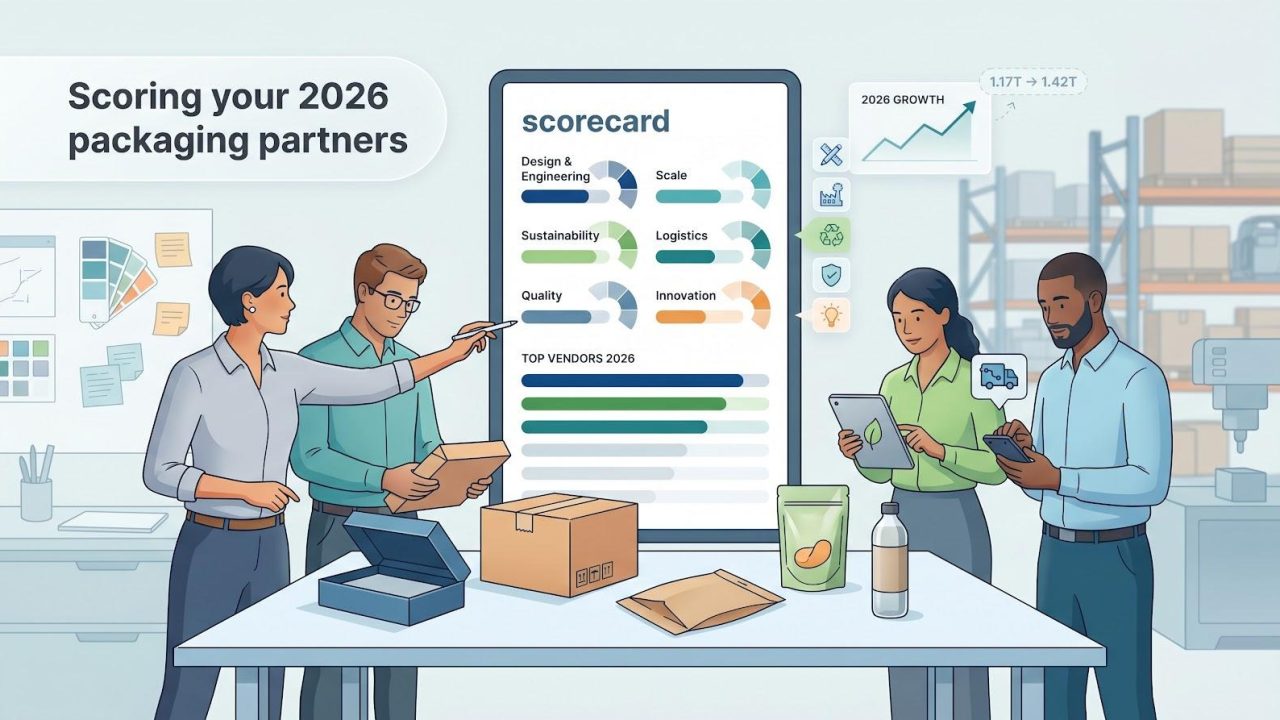
We scored dozens of vendors across six launch-critical criteria and cut the field to the four partners worth your first call. Here’s the data.
How we scored the field
You deserve more than gut feel. We built a transparent scorecard that weights what launch teams say matters most.
First, we listed every packaging supplier gaining traction in 2024–2025 market reports, trade-show chatter, and buyer forums. From that list we dropped any vendor without documented sustainability goals, quality certifications, or North-American service, with no shortcuts.
Next, we rated the remaining companies on six criteria. Design and engineering strength and manufacturing scale each count for twenty percent of the total because smart concepts and raw capacity keep timelines safe. Sustainability commitments, logistics integration, quality systems, and innovation share the other sixty percent in roughly equal slices. In plain English: if a supplier lacks green credibility or supply chain muscle, it won’t crack our top four.

Scoring stayed strict. We assigned zero to five points per factor using public data such as annual reports, certification directories, and customer case studies, then multiplied by the weight. The math surfaced four clear leaders, each topping eighty percent overall. We broke minor ties by favoring broader material portfolios and faster documented lead times, both crucial when a launch pivots late.
Why share the recipe? Because when you pitch this shortlist to procurement, you can point to the numbers, not just prose. And if one of your priorities outranks ours—say logistics over design—you can reset the weights in minutes and spot your own winner. That is objectivity you can bring to the kickoff meeting.
1. Zenpack Packaging: custom partner for design-driven launches
Your launch needs packaging that does more than close a box. It should tell a story, fit like a glove, and land on time without drama. That’s the daily brief inside Zenpack’s studio in San Jose, California.
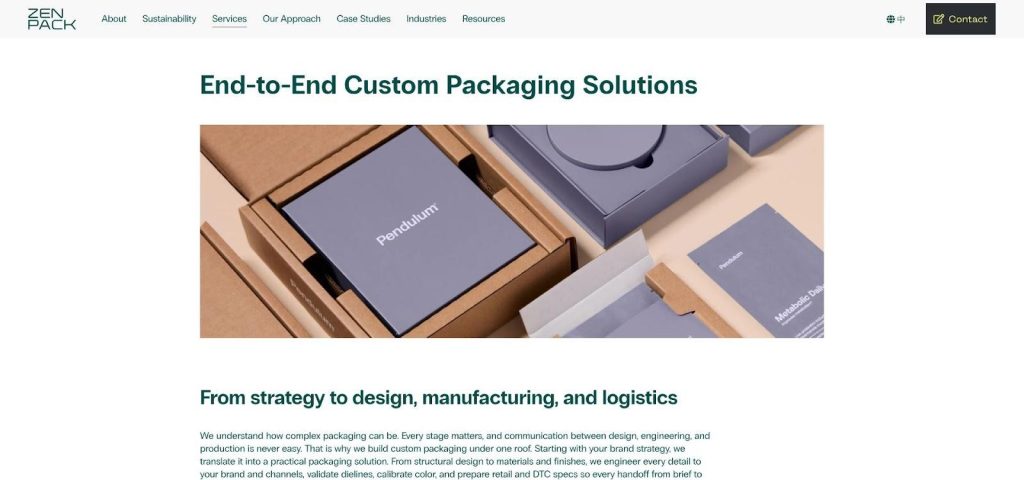
Zenpack custom packaging website screenshot
ZenPack Packaging was founded by designers who watched brilliant products stumble at the manufacturing stage and built a four-step process—strategy, design, manufacturing, and logistics—to keep every handoff aligned under one roof. The same team that sketches your concept also oversees tooling, color calibration, and the move to fulfillment, so nothing gets lost in translation.
Today, in-house engineers prototype smart structures while graphic artists polish the visuals, then the same team guides those files to the factory floor. Nothing gets lost in translation, and you get one point of accountability from sketch to shipment.
Agility is their second calling card. Zenpack runs digital print jobs as low as a few hundred units for pilot drops and influencer kits, then scales to tens of thousands through partner plants in Asia and North America. You can test packaging with real customers early, pivot, and still hit the rollout date.
Sustainability comes baked in. The team steers clients toward FSC-certified boards, soy inks, and right-sized designs that cut freight emissions. Need life-cycle data for an investor deck? They pull it from their own audits instead of sending you to a consultant.
Expect white-glove service. Zenpack assigns a project manager who replies within one business day, organizes samples, and surfaces cost trade-offs in plain language. Past clients, ranging from Silicon Valley gadgets to boutique skincare, credit that communication for saving weeks during crunch time.
Where Zenpack shines is the unboxing moment. Magnetic lids that click shut, nested compartments that reveal accessories in sequence, and soft-touch finishes that whisper premium are all engineered to survive a rough cross-country ride. If first impressions drive your brand, lock this partner in early.
One caution: craft and close support aren’t the cheapest line on a P&L. Per-unit prices beat a separate agency plus box vendor yet sit above commodity corrugated. For plain-brown cartons at extreme volume, choose someone else. For launches where brand experience equals sales, Zenpack earns its top slot.
2. Smurfit WestRock: scale, reach, and rock-solid reliability
When your forecast jumps from ten thousand units to ten million overnight, you need a packaging partner that treats volume like a warm-up lap. Smurfit WestRock does exactly that.

Smurfit WestRock global packaging company homepage screenshot
Formed in 2024 when Europe’s Smurfit Kappa and America’s WestRock joined forces, the company commands roughly thirty-two billion dollars in annual revenue and fields about one hundred thousand employees across more than five hundred plants on both sides of the Atlantic (German Wikipedia entry).
That footprint solves a classic launch headache: distance. With mills, box plants, and design centers in thirty-plus countries, Smurfit WestRock can build corrugated shippers beside your U.S. co-packer, fold luxury cartons near your Paris fulfillment center, and recycle the offcuts locally. Less freight, fewer border delays, tighter launch windows.
Scale doesn’t mean cookie cutter. The company runs “Experience Centers” where engineers pressure-test designs in ISTA labs, tweak board grades, and iterate display prototypes until everything ships flat and pops up perfectly on the retail floor. Its in-house fiber loop, which collects old corrugate, pulps it into new linerboard, and converts it back into boxes, keeps recycled content high without sacrificing strength.
Logistics integration is another quiet asset. Many enterprise clients give Smurfit WestRock onsite vendor-managed inventory programs. Those teams monitor consumption, top up stock automatically, and stage truckloads just in time for production. Your launch team spends less time chasing pallets and more time perfecting the product.
Sustainability credentials add up quickly. The merged firm has science-based carbon targets, removed PFAS from key coatings, and reports an average of fifty-five percent recycled fiber in its primary raw materials. Pair that with chain-of-custody certifications such as FSC, and compliance reporting for retailers becomes a copy-paste exercise.
Where are the pain points? Minimum order quantities can dwarf startup demand, and lead-time agility trails boutique shops. Custom finishes beyond paper, such as molded foam or magnetic closures, often require outside partners, adding coordination overhead.
Still, if your brief reads “global rollout, industrial volumes, zero margin for error,” Smurfit WestRock is the safe bet. It turns packaging into infrastructure: reliable, repeatable, and ready to scale with your ambition.
3. Amcor: advanced materials for products that cannot fail
Some launches hinge on shelf life, sterility, or tight regulatory codes. In those moments, a plain paper box won’t cut it. Enter Amcor.
The Switzerland-based company specializes in high-performance flexible films, PET bottles, and medical blister packs. With more than two hundred production sites across forty countries and roughly fourteen billion dollars in annual sales, Amcor brings deep polymer science to your packaging brief. According to a 2025 Amcor press release, the company is also driving progress in advanced recycling for food and healthcare markets.
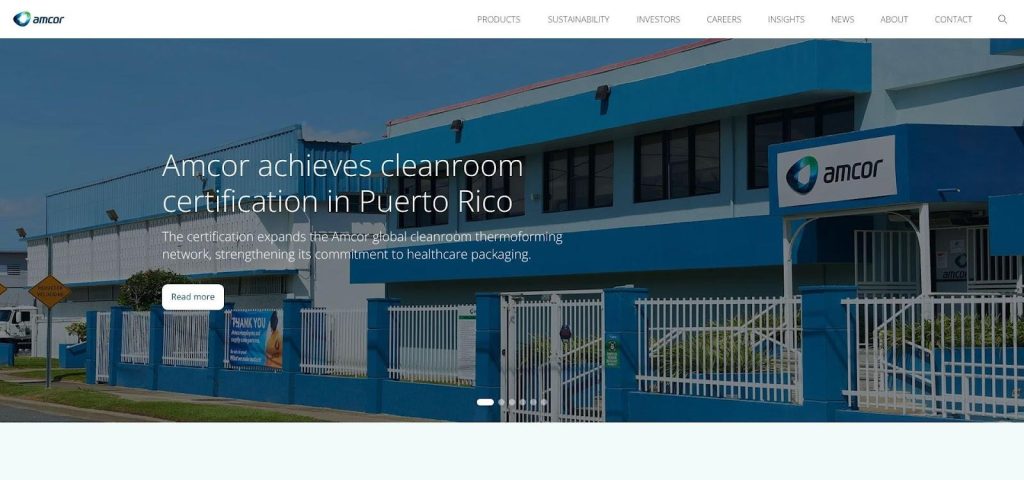
Amcor advanced packaging materials global solutions website screenshot
R&D is its heartbeat. Engineers fine-tune oxygen barriers for coffee, dial in tamper-evident seals for prescription drugs, and prototype fully recyclable retort pouches that survive sterilization without peeling. That depth of know-how is why multinationals trust Amcor with everything from surgical device trays to carbonated soft-drink bottles.
Quality systems match pharmaceutical rigor. Plants operate under ISO 13485, BRCGS, and FDA audits, so lot traceability, clean-room extrusion, and validation paperwork come standard. If your compliance officer needs answers, Amcor already speaks the language.
Sustainability progress is measurable, not cosmetic. The company pledged to make all products recyclable or reusable by 2025 and now reports that more than seventy percent of its portfolio meets that goal. It also earned an AA ESG rating from MSCI in 2025, confirming steady gains in recycled content and carbon cuts.
Global reach equals local supply. Whether you fill sachets in São Paulo or vials in Wisconsin, Amcor likely has a plant within a day’s drive, trimming freight miles and customs risk.
There are trade-offs. Minimum order sizes skew large, and design changes move slower than with boutique converters. High-barrier films cost more than commodity LDPE, so budgets need breathing room.
Still, for launches where failure isn’t an option—think food safety, medical sterility, or multi-market beverage debuts—Amcor’s lab-coated expertise and supply resilience justify every penny.
4. Mondi: sustainability-first solutions that still perform under pressure
If your brand promise centers on eco credibility, Mondi helps you walk the talk without sacrificing function.
The Anglo-European group posts about seven billion euros in annual sales and operates more than one hundred plants across Europe, the Americas, and Asia. Its engineers work with both paper and plastics, so one supplier can deliver the corrugated shipper, the barrier pouch inside it, and even the release liner on your labels. Every layer is tuned to work together.
According to a 2024 Mondi press release, its paper-based Protective Mailer replaced plastic bubble envelopes and earned a Eurosac bronze, while other solutions captured multiple WorldStar awards.
The team’s EcoSolutions approach drives those results. Engineers audit each component and ask three blunt questions: Can we remove material? Can we switch to paper? Can we close the loop? That framework produced offerings like Hug&Hold, a paper six-pack carrier that drops shrink film, and FunctionalBarrier Paper that blocks grease yet recycles in curbside streams.
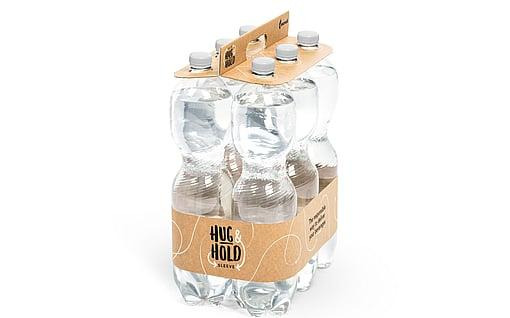
Mondi Hug&Hold sustainable paper six-pack carrier product image
Mondi’s supply chain is vertically integrated, from FSC-certified forestry to converting plants. That control keeps fibre sourcing transparent, stabilises pricing, and lets Mondi adjust recycled content targets quickly when regulations shift.
For launches targeting Europe, the fit is smooth. Plants sit near major co-packing hubs in Germany, Poland, and the UK, trimming cross-border red tape. North American coverage is thinner, so U.S.-only brands may face longer transit times or higher freight costs.
Cost lands mid-pack: greener substrates and award-winning engineering outprice commodity boxes but often undercut premium boutique converters, especially once you add carbon accounting value.
Bottom line: choose Mondi when you need packaging that shouts sustainability in every unboxing video while still protecting the goods through a rough logistics chain. Your marketing team gains a circular-economy headline; your operations team keeps reliable throughput. Everyone wins.
How the four stack up, at a glance
We’ve covered a lot. Use this table to spot the right fit fast, then jump back to any full profile for details.
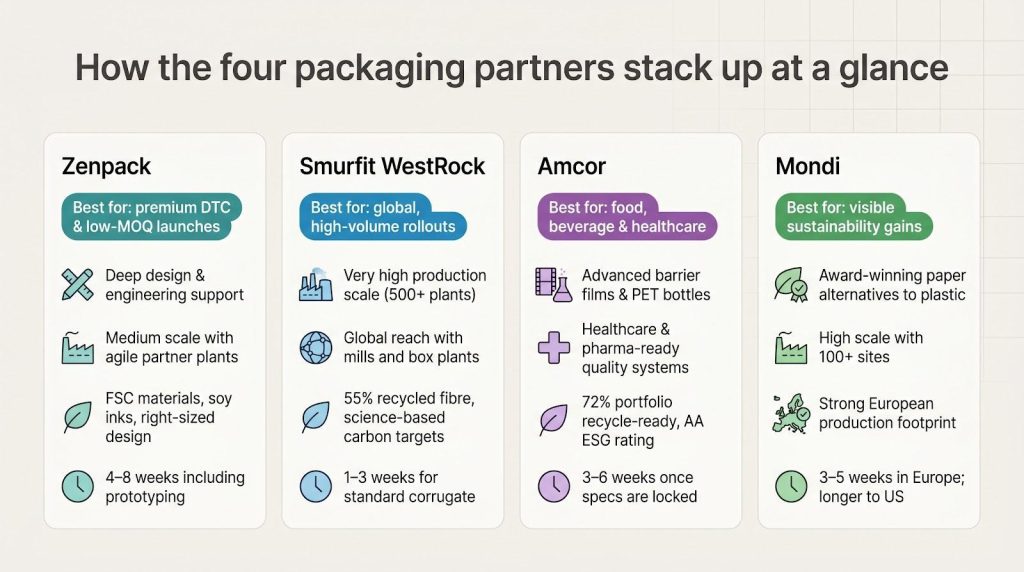
| Company | Design help | Production scale | Sustainability edge | Typical lead time | Key certifications | Best for |
| Zenpack | In-house creatives and packaging engineers guide every project | Medium; agile partner plants in US and Asia | FSC materials, soy inks, right-sized design | 4–8 weeks including prototyping | FSC chain-of-custody, ISO 9001 at partner sites | Startups, premium DTC, low-MOQ pilot runs |
| Smurfit WestRock | Regional design labs and ISTA test centers | Very high; 500+ plants, 32 B USD revenue | 55 percent recycled fibre, science-based carbon targets | 1–3 weeks for standard corrugate, longer for specials | ISO 9001/14001 across network, FSC | Global CPG or industrial launches that need huge volume |
| Amcor | Material scientists optimise barrier films; limited graphic design | Very high; 200+ sites, 14 B USD sales | 72 percent portfolio recycle-ready, AA MSCI ESG rating | 3–6 weeks once specs are locked | ISO 13485, BRCGS, FDA-compliant lines | Food, beverage, and healthcare launches with strict shelf-life demands |
| Mondi | Collaborative EcoSolutions workshops | High; 100+ sites, 7 B EUR revenue | Award-winning paper replacements for plastic | 3–5 weeks in Europe; longer to US | FSC, PEFC, multiple WorldStar awards | Brands that prioritise visible sustainability gains |
Remember, the right partner hinges on your constraints. If brand experience and low MOQs lead, Zenpack wins. If volume spikes keep you up at night, Smurfit WestRock’s capacity calms nerves. Food safety and sterile barriers tilt the choice to Amcor, while eco bragging rights with solid performance steer you toward Mondi.
What’s changing in 2026—and why it matters before you sign a PO
Packaging is racing ahead. Four shifts should shape every supplier conversation you start this year.

Sustainability moves from “nice” to non-negotiable. California’s rule that all single-use packaging be recyclable or compostable by 2032 signals where U.S. law is headed, while Europe’s PPWR deadlines bite even sooner. Ask vendors for proof such as FSC certificates, PFAS-free declarations, and life-cycle data before you fall in love with a dieline.
Speed becomes a competitive weapon. Crowdfunding and social drops shrink concept-to-launch windows, yet buyers on Reddit still complain about four-week lead times. Partners with digital presses, regional plants, or on-demand box lines keep you agile when a TikTok mention spikes demand overnight.
Packaging turns smart. Brands add QR codes that reveal AR demos or trace a product’s journey from factory to fridge. Your vendor must handle variable-data printing and tamper-proof codes without scrambling production schedules, or you miss out on post-purchase engagement.
Supply-chain resilience goes local. After years of ocean-freight headaches, more teams split volumes between a domestic plant for urgent runs and an offshore mill for cost control. Suppliers with multi-region footprints, or tight partnerships, give you built-in backup instead of leaving you to juggle alternate plans.
Keep these shifts in mind and the shortlist we covered above will serve you long past the first launch date.
Buy Me A Coffee
The Havok Journal seeks to serve as a voice of the Veteran and First Responder communities through a focus on current affairs and articles of interest to the public in general, and the veteran community in particular. We strive to offer timely, current, and informative content, with the occasional piece focused on entertainment. We are continually expanding and striving to improve the readers’ experience.
© 2026 The Havok Journal
The Havok Journal welcomes re-posting of our original content as long as it is done in compliance with our Terms of Use.


