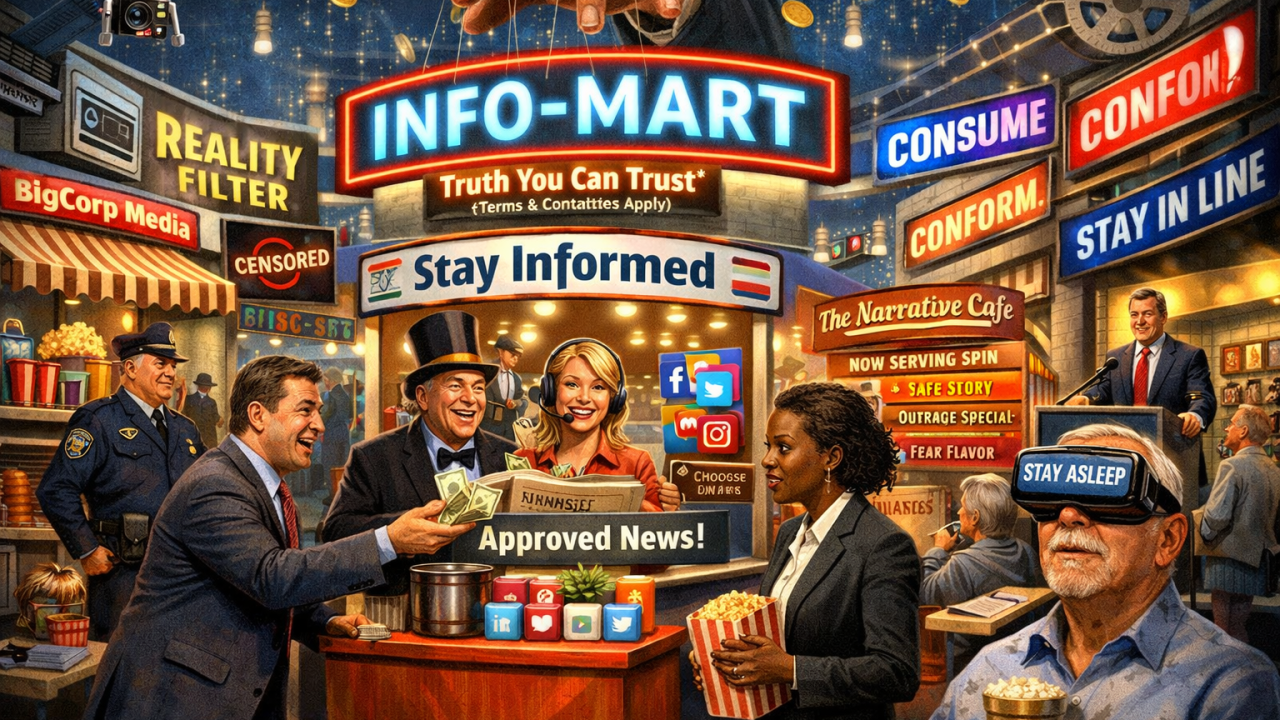
The old fairy tale says we live in a marketplace of ideas. How adorable. That phrase always arrives dressed like a civics teacher and leaves smelling like a lobbyist. What we actually live in is a company food court where six landlords own the floor, the kiosks, the security office, and half the napkins, then act wounded when you notice every meal tastes faintly of sponsor-approved despair.
The broad scam is simple. Institutions sell central control as freedom of choice. They flood the zone with branded options, then call it pluralism. You get a thousand channels, twelve streaming apps, infinite scroll, podcasts by the million, and somehow the same handful of narratives keep waddling onto your plate wearing different hats. One is “news.” One is “content.” One is “community.” One is “trust and safety.” Amazing how every age invents a new euphemism for “shut up and consume what the adults have arranged.”
That is the real pathology here. Not a mustache-twirling cabal. Not a secret room full of villains petting endangered cats. Nothing so cinematic. The truth is much more insulting. It’s a system run by managers, financiers, consultants, public relations necromancers, and political professionals who all insist they are merely responding to incentives while they actively build the incentives, rig the scoreboard, buy the referees, and issue a statement about preserving democratic norms. Nobody has to coordinate perfectly when everyone is paid to fear the same things and protect the same revenue stream. Herd behavior with stock options is still herd behavior.
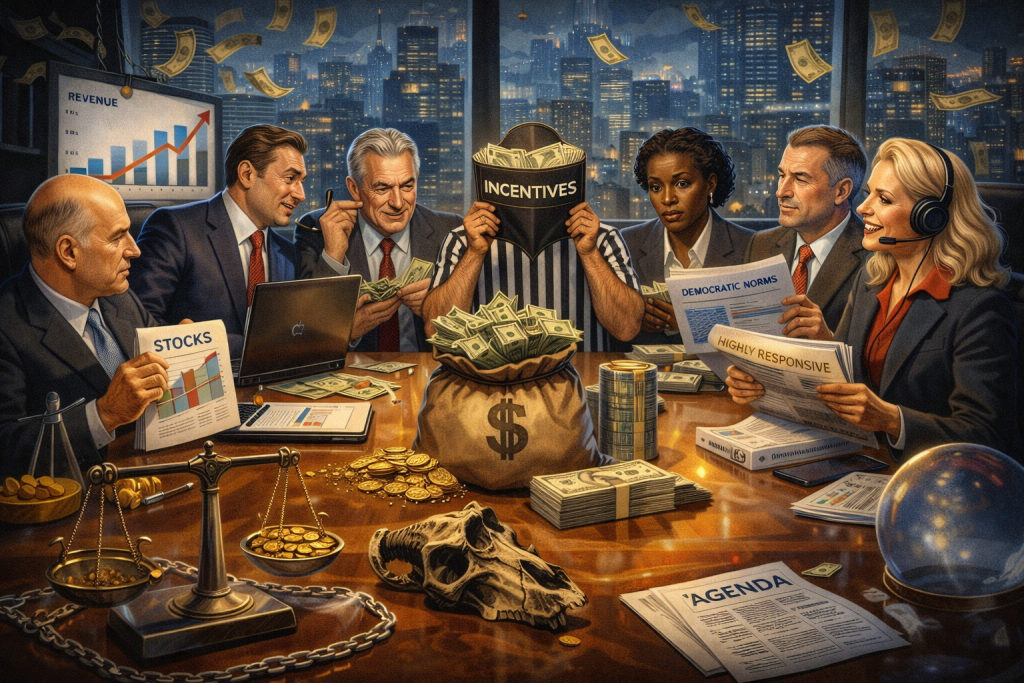
Concentrated control doesn’t produce one official ideology so much as one official temperament. Don’t alarm advertisers. Don’t endanger access. Don’t offend regulators who can make life expensive. Don’t give the audience anything too clarifying, because a confused citizen is a marvelous repeat customer. Keep people stimulated, tribal, morally winded, and just informed enough to chant. The point is not always to make the public believe one specific lie. That’s amateur hour. The point is to narrow the range of respectable thought until the truth feels rude, impolite, or somehow beyond the scope of this evening’s programming.
That’s why every institution now speaks in the same moist dialect of managed concern. They’re always “having conversations.” They’re always “grappling with complexity.” They’re always “committed to transparency” in the way a casino is committed to responsible gaming. When powerful organizations say they want to build trust, lock your wallet and count the spoons. Trust, in elite language, means public obedience with better graphics. The modern information system doesn’t need to censor everything. It only needs to rank, demote, frame, repeat, and surround. It can bury you under relevance. It can kill a fact by seating it next to ten hysterics and calling the whole buffet balance.
And then comes my favorite punchline: this arrangement is marketed as the natural outcome of free enterprise. Right. As if concentrated media power just floated down from the sky like divine pollen. As if deregulation, mergers, cross-ownership deals, gatekeeping platforms, and cozy state-corporate courtship were all examples of nature healing. Please. There is nothing free-market about a handful of entities deciding what gets amplified, monetized, suppressed, or memory-holed while lecturing the country about openness. That’s not a market. That’s a velvet rope with branding guidelines.
The consequences are not abstract. Local reporting gets gutted because it’s less profitable than scale. Entertainment and news merge into one giant emotional vending machine. Politics becomes a permanent panic attack with theme music. Public relations graduates become the high priests of reality. Even dissent gets packaged, sponsored, optimized, and sold back as identity merchandise. We have reached the point where people think choosing between approved narratives is independent thought. That’s not citizenship. That’s menu anxiety.
So what would help, besides a meteor and better neighbors?
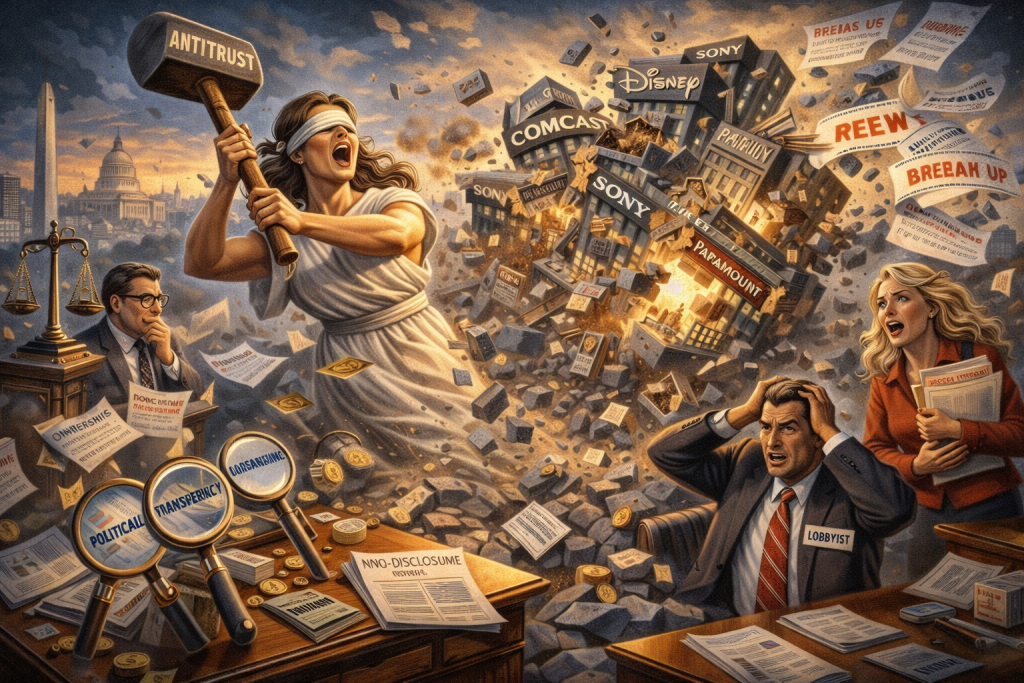
Start with old-fashioned antitrust that remembers size is not a personality trait but a public hazard. Break up companies whose control over distribution and production lets them steer both supply and perception. Restore hard ownership limits across platforms and markets. Force radical transparency for major investors, political partnerships, algorithmic ranking criteria, and sponsored influence. If an outlet, platform, or entertainment giant has interests that shape what you see, that should be visible in plain English, not buried in legal mulch.
Then rebuild local and independent reporting with actual muscle, not sentiment. Tax incentives for local ownership. Nonprofit and public-interest models insulated from party control. Easier paths for small publishers to access distribution and ad infrastructure without kneeling before platforms that treat them like tenant farmers. Support portability and interoperability so audiences can leave giant systems without social exile. Make it easier to subscribe directly, fund directly, and verify directly.
And for the public, yes, there is homework. Irritating, grown-up homework. Read laterally. Follow ownership. Ask who benefits from timing, framing, omission, and repetition. Stop confusing virality with importance. Stop outsourcing judgment to logos, vibes, and people with studio lighting. Freedom of thought is not a mood. It is labor. Annoying labor. The kind that leaves a mark.
Because if you let five corporations, three bureaucracies, and a battalion of panic merchants furnish your reality, don’t flatter yourself that you’re thinking. You’re just leasing your conscience in a food court and calling it lunch.
_____________________________
Tammy Pondsmith is Senior Fellow for Applied Contempt at the Institute for Public Nonsense, where she studies how bureaucrats turn cowardice into policy and sell it back to taxpayers as virtue.
As the Voice of the Veteran Community, The Havok Journal seeks to publish a variety of perspectives on a number of sensitive subjects. Unless specifically noted otherwise, nothing we publish is an official point of view of The Havok Journal or any part of the U.S. government.
Buy Me A Coffee
The Havok Journal seeks to serve as a voice of the Veteran and First Responder communities through a focus on current affairs and articles of interest to the public in general, and the veteran community in particular. We strive to offer timely, current, and informative content, with the occasional piece focused on entertainment. We are continually expanding and striving to improve the readers’ experience.
© 2026 The Havok Journal
The Havok Journal welcomes re-posting of our original content as long as it is done in compliance with our Terms of Use.

