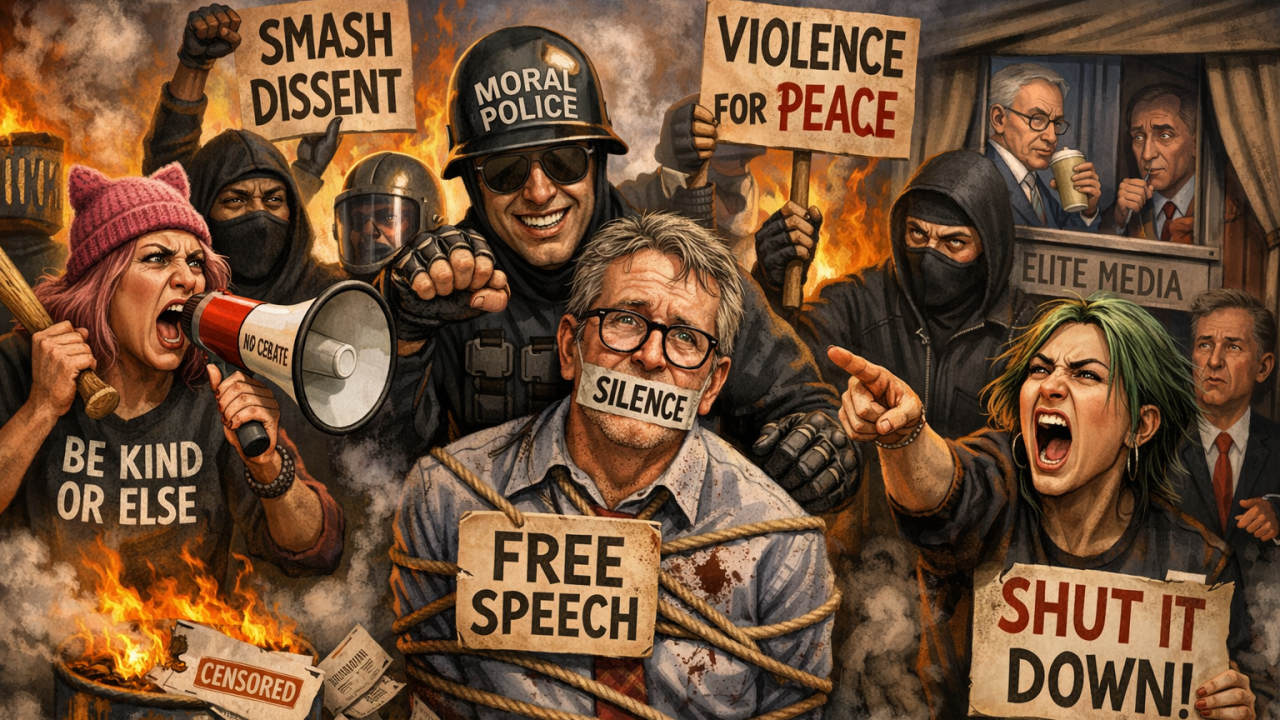
The rotten miracle of modern public life is that people can act like a street gang and still think of themselves as the safety committee.
That is the thesis. Everything else is costume changes.
We’ve built a culture where intimidation is no longer merely tolerated if it arrives wrapped in the right moral language. In fact, it is often admired. Harassment becomes “accountability.” Threats become “community response.” Bullying becomes “protecting vulnerable people.” A mob discovers a thesaurus, and suddenly shoving, screaming, stalking, blacklisting, and trying to make public life physically miserable for opponents is not thuggery at all. It is ethics with very loud accessories.
This is one of the more deranged developments of the past decade. Not because it is new. Human beings have always enjoyed moral permission slips for ugly behavior. The novelty is the bureaucratic polish. In earlier times, the village fanatic at least had the decency to foam at the mouth in obvious plain sight. Now he has a statement of values, a nonprofit vocabulary, and the dead-eyed confidence of someone who has mistaken a panic attack for a philosophy.

Once you decide your opponents are not merely wrong but illegitimate, every restraint starts to look optional. If they are not people with arguments but contaminants with opinions, then ordinary standards no longer apply. Debate becomes complicity. Due process becomes privilege. Basic civility becomes surrender. The goal is no longer to answer a position. The goal is to make holding that position socially painful, professionally dangerous, and, if possible, physically risky. This is not activism. It is emotional blackmail with signage.
And the institutions that enable it are even worse than the zealots. The zealots are at least honest about their appetite. It is the administrators, executives, editors, consultants, local officials, and assorted human packing peanuts of authority who do the real damage. They never endorse the intimidation outright. Heavens, no. They simply explain it. They contextualize it. They locate the “understandable anger.” They issue pained little statements about tensions in the community while refusing to say the one sentence that would require an actual spine: no cause, however fashionable, entitles you to terrorize people you dislike.
Cowardice now comes with branding guidelines.
This is why public intimidation spreads. Not because the aggressors are so strong, but because the surrounding class is so spineless. When rules are enforced selectively, people notice. When some viewpoints require barricades while others get escorted in under the halo of presumed virtue, people notice. When violence is denounced in theory but excused in practice if the target is sufficiently unfashionable, people notice. And once enough people notice that legality depends on ideology, the social contract starts to smell like a practical joke.
Then comes the really poisonous part. The people performing intimidation nearly always cast themselves as the endangered party. This is essential to the racket. They provoke, menace, swarm, obstruct, threaten, and then clutch their pearls the instant anyone suggests consequences. It is the old dodge of the sanctimonious bully. Throw the first punch, then write an essay about feeling unsafe. The point is not consistency. The point is moral asymmetry. They want the right to escalate and the right to narrate themselves as victims of escalation. It is a marvelous arrangement if you are a dishonest child in an adult body.
Real solutions are not mysterious. They are just unfashionable because they require adults.

First, enforce public order rules without ideological favoritism. Assault is assault. Obstruction is obstruction. Menacing conduct is menacing conduct. None of these things become more poetic because the person doing them has read three slogans and half a graduate seminar. Police and prosecutors do not need a richer inner life here. They need a backbone and a calendar.
Second, institutions must stop laundering intimidation through euphemism. A university, newsroom, city office, party apparatus, or nonprofit should not need six committees and a feelings glossary to say that trying to shut people up by force or fear is unacceptable. Write the standard. Publish it. Apply it to everybody. No golden children. No sacred tribes. No special exemption for those currently high on their own righteousness.
Third, stop rewarding the performance economy that turns public cruelty into status. A shocking amount of modern political behavior is just careerism in war paint. People discover that a viral outburst, a menacing confrontation, or a ritual denunciation earns applause, clicks, donations, invitations, and a little temporary throne made of attention. Fine. Remove the rewards. Stop booking professional harassers as thought leaders. Stop treating tantrums as courage. Stop confusing visibility with credibility. A ring light is not a moral credential.
Finally, recover the old, boring, essential rule of pluralistic life: in a free society, you are going to live among people whose views you find wrong, stupid, offensive, or insane. Your job is not to convert every disagreement into an emergency. Your job is to maintain conditions where disagreement does not become a contact sport for narcissists with civic language.
Because once politics becomes a costume ball for people who want to feel heroic while behaving like dockside extortionists, you no longer have a democratic culture. You have a tantrum cartel with a press strategy. And nothing says moral progress quite like being shoved around by people who insist they’re doing it for humanity.
_____________________________
Tammy Pondsmith is Senior Vice President of Institutional Side-Eye, and she has spent years watching cowardly people call themselves principled until the room smells like burnt hair and legal disclaimers.
As the Voice of the Veteran Community, The Havok Journal seeks to publish a variety of perspectives on a number of sensitive subjects. Unless specifically noted otherwise, nothing we publish is an official point of view of The Havok Journal or any part of the U.S. government.
Buy Me A Coffee
The Havok Journal seeks to serve as a voice of the Veteran and First Responder communities through a focus on current affairs and articles of interest to the public in general, and the veteran community in particular. We strive to offer timely, current, and informative content, with the occasional piece focused on entertainment. We are continually expanding and striving to improve the readers’ experience.
© 2026 The Havok Journal
The Havok Journal welcomes re-posting of our original content as long as it is done in compliance with our Terms of Use.


