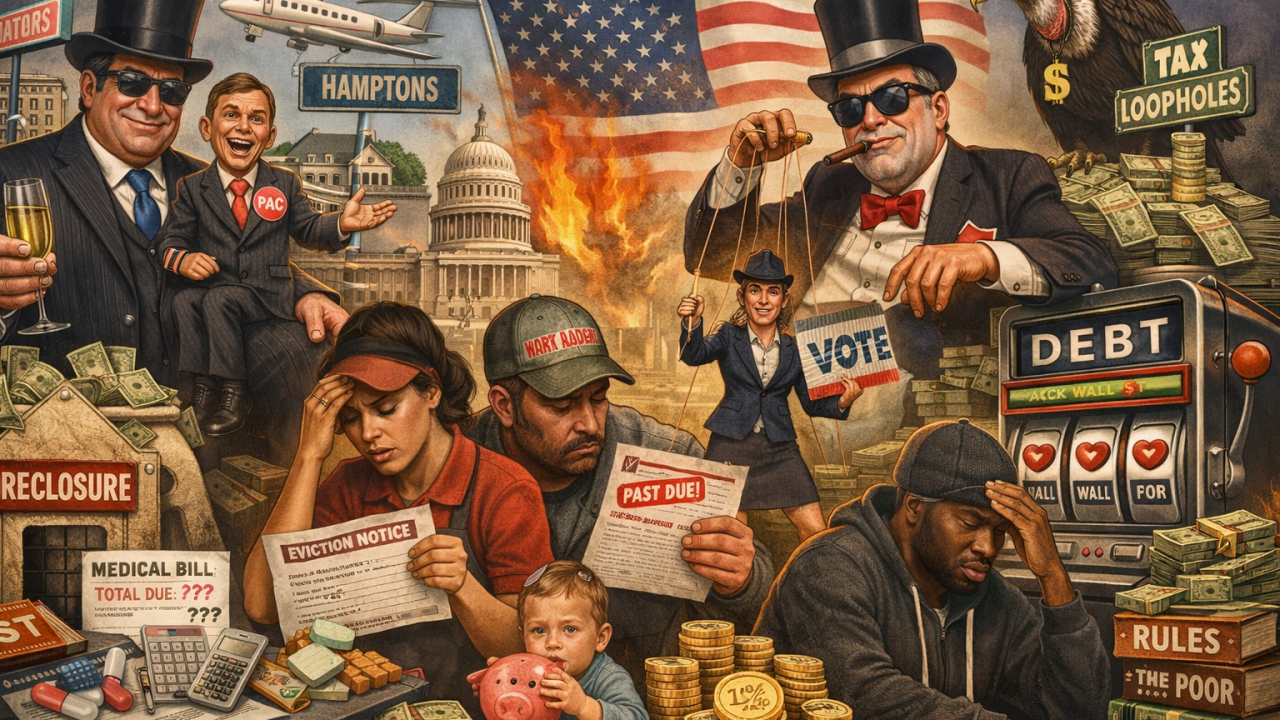
If Americans ever truly understood how money works in this country, there wouldn’t be a revolution by morning because this is still America and half the country would first need coffee, a rideshare, and twelve contradictory podcasts to confirm their feelings. But there would be outrage. Real outrage. The kind that makes expensive people nervous.
Because the central scam in America is not merely that money is unevenly distributed. Inequality is old. Kings figured that out before indoor plumbing. The real scam is that the machinery of money has been made deliberately opaque, then wrapped in moral language so the victims feel guilty while the looters feel sophisticated. It is one of the great achievements of modern public relations that a person drowning in bills can be made to feel irresponsible while a hedge fund manager strip mines a hospital and gets called “disciplined.”
That takes talent. Evil talent, but talent.
America has created a financial culture where confusion is profitable, and clarity is treated like a threat. Your paycheck arrives like an apology. Your rent rises like it got accepted to Yale. Your groceries now cost enough to require a small prayer circle. Your insurance exists in the same way dragons exist. People talk about it a lot, but when you actually need one in the wild, good luck. And through all of this, a certain species of aggressively moisturized finance goblin keeps appearing on television to explain that the problem is consumer behavior.

Yes, obviously. The problem is a teacher bought eggs and gasoline in the same week. The problem is a family wanted both asthma medication and electricity. The problem is that people insist on decadent luxuries such as housing, root canals, and not dying in a parking lot.
Meanwhile, the people making the rules have designed an economy that functions like a casino run by guys who use the phrase “summer in the Hamptons” as if it were an organ. They have created a society where a citizen can work full time, budget carefully, avoid obvious stupidity, and still get kneecapped by one bad transmission, one surprise medical scan, one rent hike, one layoff, one lawsuit from an algorithm wearing a necktie and calling itself a servicer. Then, once flattened, that same citizen gets a lecture about resilience.
Resilience is now the national insult. It’s what comfortable people praise in others when they have no intention of reducing the cause of the suffering. “Americans are resilient” is just elite code for “we have decided to continue feeding you into a wood chipper, but with patriotic music.”
And the best part is the sanctimony. The delicious, frosted, gold leaf sanctimony. The system doesn’t just rob people. It grades them while doing it. If you’re poor, it’s a character flaw. If a bank buries you in fees, that’s a business model. If a corporation corners a market and raises prices, that’s efficiency. If private equity buys a necessary service, drains it like a tick, and leaves the carcass for the public to mourn, that’s innovation. America took greed, handed it a consultant, and taught it to say “friction” instead of “human misery.”
Then there’s politics, which is where the whole theater drops the mask and starts tap dancing on your throat. You are told to vote like democracy depends on it, then expected not to notice that legislation often arrives pre-perfumed by donors, lobbyists, trade groups, and the kind of think tank fellows who look like they were assembled in a vineyard. Campaign cash floods the system, industries practically write their own supervision, and the public gets to participate by choosing which smiling avatar will explain why nothing fundamental can change because the bond market might get the vapors.
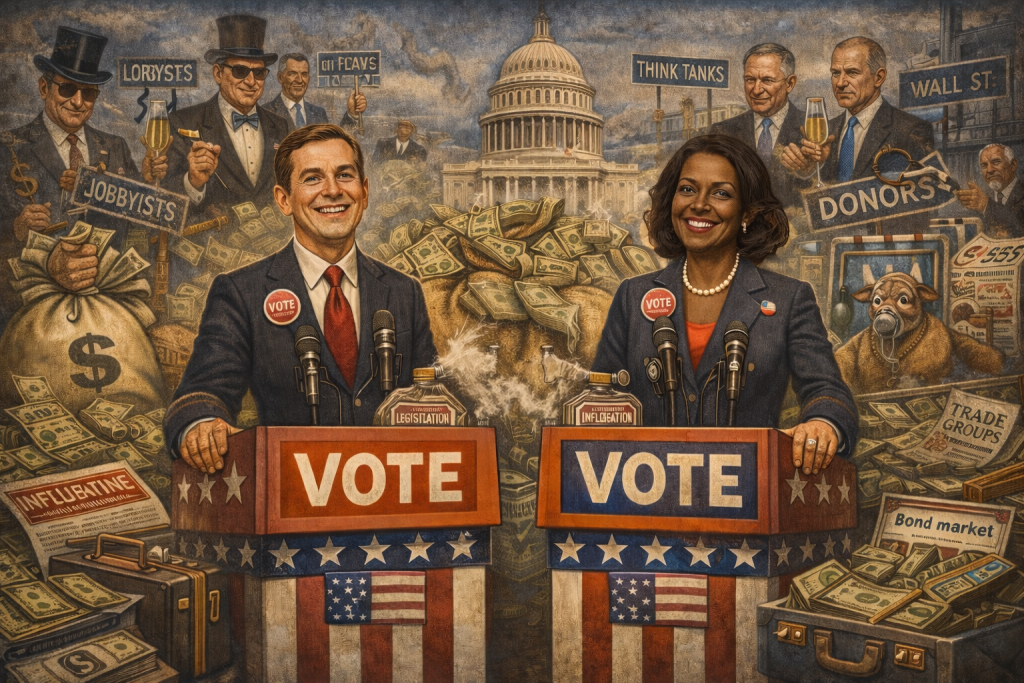
This is the part where some earnest ghoul says, “The economy is actually doing quite well by traditional metrics.” Oh, fabulous. Thank God the metrics are okay. I’ll let the family paying interest on groceries know the sacred metrics are feeling optimistic. Nothing comforts a person staring at a pharmacy receipt quite like hearing that aggregate indicators remain robust. That’s not analysis. That’s numerology for cowards.
And yet here is the most insulting thing of all. None of this is inevitable. This isn’t weather. It’s policy. It’s design. It is a chain of decisions made by people with names, offices, donors, calendars, and very serious opinions about your belt-tightening. A country does not accidentally become a place where work is mandatory, stability is optional, and wealth reproduces faster than rabbits on a vitamin drip. People built this. People maintain it. People profit from it.
Which means people can change it.
Start with ruthless simplicity.
1. Make the paperwork readable.
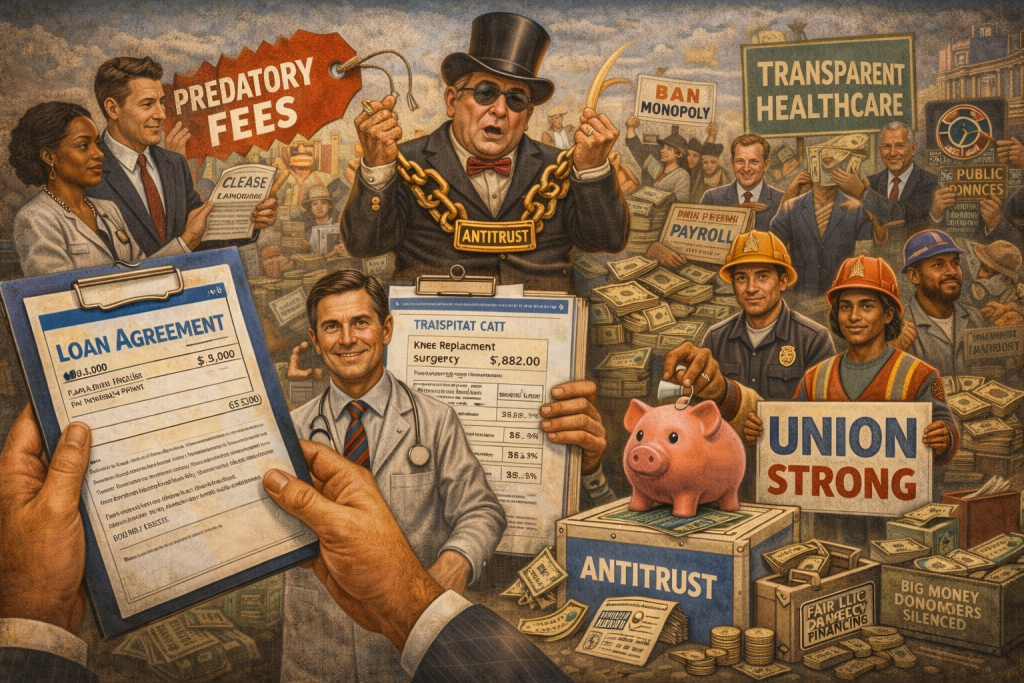
Every loan, credit card, lease, and medical payment plan should come with a mandatory one page summary in plain English. Not legal Esperanto. Not fine print written by men who bill in six minute increments. One page. Big type. It should tell you the interest rate, every fee, what you’ll pay if everything goes right, and what you’ll owe if life does what life does and kicks you in the liver.
2. Stop turning small mistakes into profit centers.
Cap late fees and overdraft fees so a missed payment does not blossom into a month long financial mugging. Ban overdraft charges on small debit card purchases. A person should not buy cough medicine and wake up in a Dickens novel.
3. Shut down debt soaked corporate pillaging.
Block private equity takeovers of hospitals, nursing homes, mobile home parks, and large residential landlords when the business model is clearly “buy it, drown it in debt, fire half the staff, and call the wreckage innovation.” If a deal depends on gutting workers, maintenance, or patient care, the deal is the problem.
4. Enforce antitrust law like monopolies are still bad.
Because they are. Stop approving mergers that leave a handful of companies controlling groceries, internet access, housing, meatpacking, prescription drugs, or hospital systems in an area. If people in one city have three choices and all three are owned by the same parent company wearing different hats, that is not a market. That is a ventriloquist act.
5. Tax work less like a sin and wealth less like a spa treatment.
Move wages and investment income closer together in the tax code. Raise taxes on stock buybacks that exist mainly to pump executive bonuses and goose share prices while workers get a pizza party and an email about grit. Stop treating money that sits still more tenderly than people who actually move their bodies for a living.
6. Make healthcare prices real and visible before the robbery.
Require hospitals, insurers, and drug companies to publish actual binding prices in one searchable format before treatment, not after the fact when the bill arrives looking like a ransom note drafted by Satan’s accountant. Patients should know what a scan, surgery, or ambulance ride will cost before somebody wheels them into fluorescent destiny.

7. Build emergency savings into payroll by default.
Set up automatic rainy day accounts tied to paychecks, with workers enrolled automatically unless they opt out. Add small employer matches and allow penalty free withdrawals for car repairs, medical emergencies, rent spikes, and the other cheerful little surprises that currently turn one bad week into a family extinction event.
8. Protect unions like democracy depends on people comparing notes.
Because it does. Speed up union elections, ban mandatory anti union propaganda meetings, and impose real penalties on companies that retaliate against organizers. Not symbolic penalties. Not a sternly worded bureaucratic cough. Real money. The kind executives can feel in their prayer lives.
9. Drag campaign finance out of the yacht catalog.
Match small donations with public funds so ordinary people are not financially outgunned by every lobbyist with a steakhouse reservation. Require immediate disclosure of major contributions. Ban lobbyists from fundraising for the officials they are paid to influence. Government should not look like an auction where the opening bid comes with valet parking.

That is what actual reform looks like. Not a motivational poster about literacy. Not another sermon about personal responsibility from a man whose net worth has its own weather system. Clear rules. Visible prices. Smaller traps. Stronger workers. Less legalized bribery. The point is not to make capitalism sweet. The point is to make it stop acting like a feral raccoon in a necktie.
None of these ideas are mystical. None require the moon, a dragon egg, or bipartisan enlightenment. They require political will and public attention, which is why the system works so hard to keep everybody distracted, atomized, enraged at one another, and too exhausted to trace the wiring. Confused people are manageable. Informed people are dangerous. A citizen who thinks he’s failing is easier to control than a citizen who realizes he’s being farmed.
That’s the truth Americans are never supposed to say out loud. The machine is not malfunctioning. It is performing beautifully for the people it was built to serve. The crisis is not confusion. The crisis is comprehension. The moment enough people understand that their private shame is actually public design, the whole smug little pageant starts shaking. Then all the highly credentialed parasites who’ve spent forty years calling extraction “efficiency” are going to discover a sound they do not enjoy.
It is the sound of the audience finally understanding the trick.
_____________________________
Tammy Pondsmith once got banned from a donor retreat after asking why every economic miracle somehow ends with billionaires levitating and waitresses financing insulin.
As the Voice of the Veteran Community, The Havok Journal seeks to publish a variety of perspectives on a number of sensitive subjects. Unless specifically noted otherwise, nothing we publish is an official point of view of The Havok Journal or any part of the U.S. government.
Buy Me A Coffee
The Havok Journal seeks to serve as a voice of the Veteran and First Responder communities through a focus on current affairs and articles of interest to the public in general, and the veteran community in particular. We strive to offer timely, current, and informative content, with the occasional piece focused on entertainment. We are continually expanding and striving to improve the readers’ experience.
© 2026 The Havok Journal
The Havok Journal welcomes re-posting of our original content as long as it is done in compliance with our Terms of Use.


