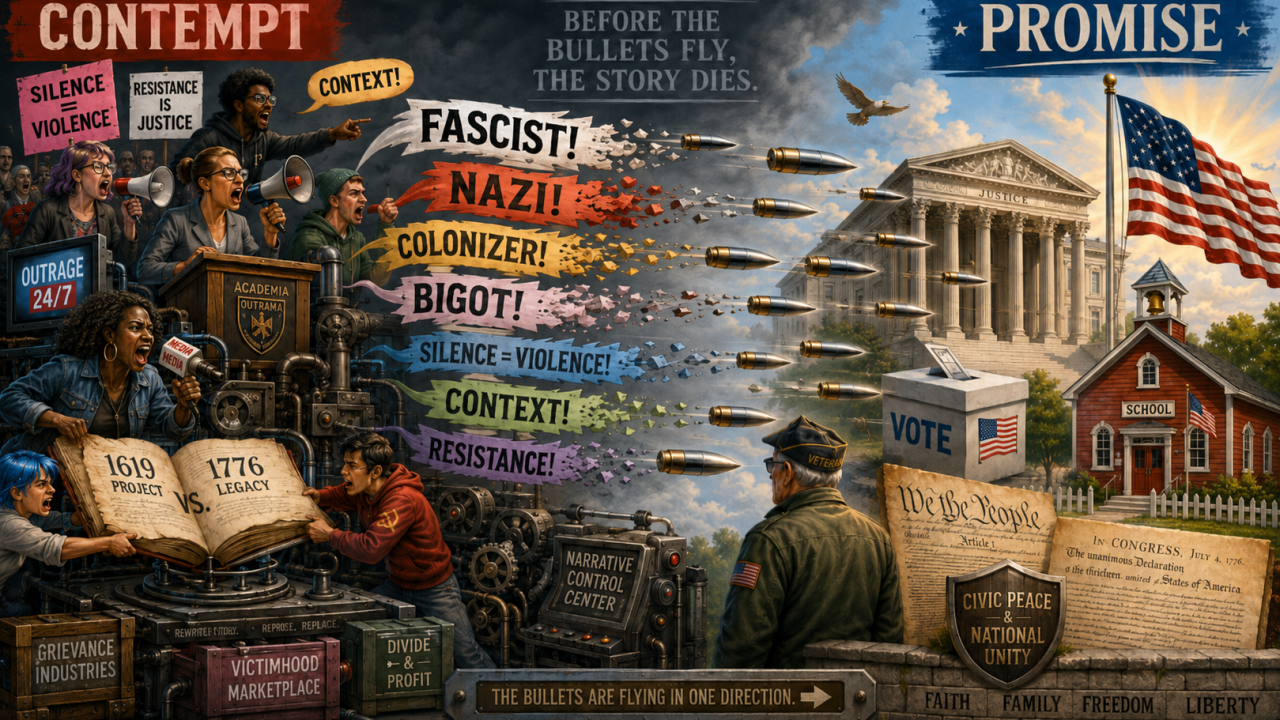
Before the bullets fly, the story dies.
That’s the part nobody wants to discuss because it’s less dramatic than a mugshot, less clickable than a manifesto, and harder to fit onto a yard sign between a rainbow fist and a typo. Political violence doesn’t just wander in one day wearing steel-toed boots and asking where the hors d’oeuvres are. It gets invited. It gets dressed up. It gets given language. It gets given moral permission.
First, the country is declared illegitimate. Then its institutions are declared instruments of oppression. Then the people who defend those institutions are declared fascists, racists, colonizers, bigots, Nazis, or whatever fresh little demon label just rolled off the grievance assembly line. Then, when someone finally decides that debate is too slow and violence has better pacing, the same people who spent years marinating the culture in contempt clutch their ethically sourced pearls and ask, “How could this happen?”
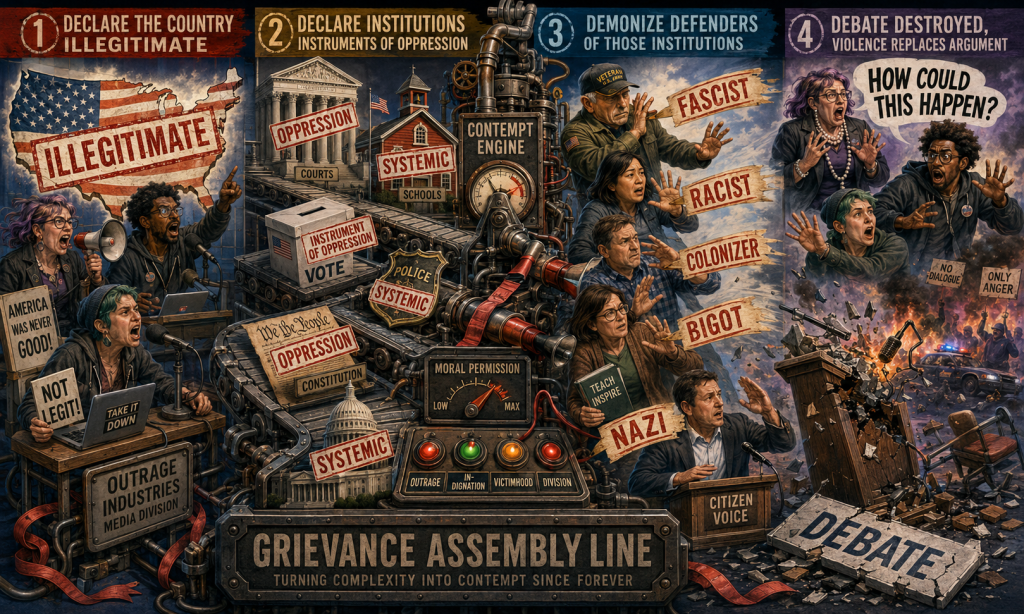
Oh, I don’t know, Professor Gaslight. Maybe when you teach an entire generation that America is a crime scene, the Constitution is a hate document, the flag is a gang symbol, law enforcement is organized cruelty, free speech is violence, silence is violence, disagreement is violence, and actual violence is sometimes “resistance,” eventually someone opens the wrong door in the haunted house you built.
The 1619 Project did not invent America’s arguments over slavery. Let’s be serious. Americans have been arguing over slavery since before America was officially America, which is one of those facts that tends to ruin the cartoon version of history preferred by people whose entire intellectual life is just a bumper sticker with Wi-Fi.
Slavery was real. Slavery was monstrous. Slavery was not a footnote, a clerical error, or a minor smudge on the nation’s good china. It was a catastrophic moral evil that brutalized human beings and made a mockery of the principles announced in 1776. Anyone who tries to wave that away with “everybody did it back then” should be legally required to spend six uninterrupted hours listening to a community theater production of their own excuses.
But here is the grown-up distinction, and I realize grown-up distinctions are now considered microaggressions against people who majored in vibes. Slavery was America’s great contradiction. It was not America’s creed.
The creed was this: all men are created equal, rights come from the Creator, governments exist to secure those rights, and when government becomes destructive of those rights, the people have the authority to alter or abolish it. That language did not excuse slavery. It indicted slavery. It created the moral vocabulary by which slavery could be judged, condemned, resisted, and eventually destroyed.
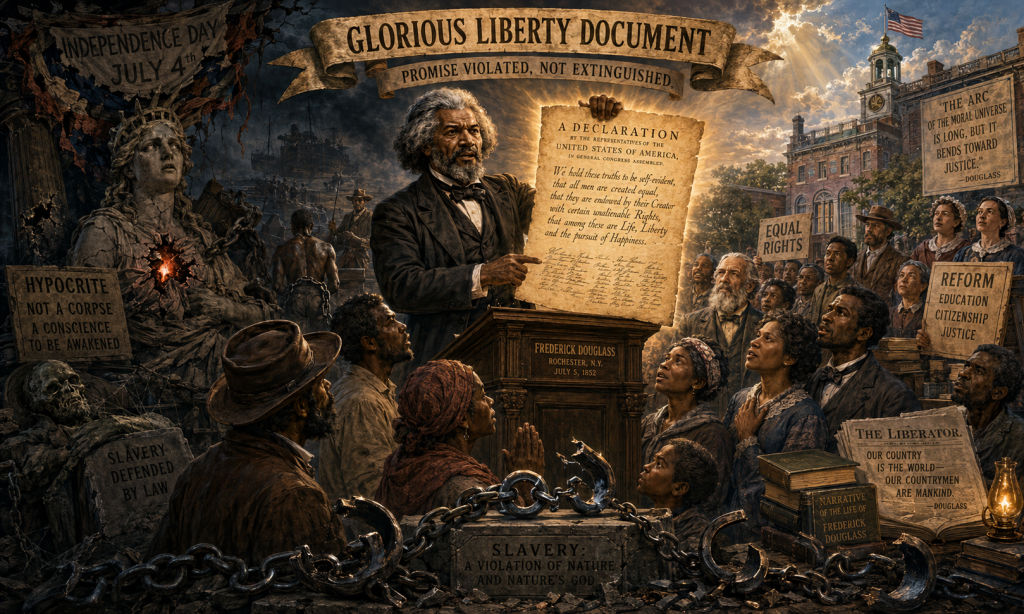
That is why abolitionists could appeal to the Declaration. That is why Frederick Douglass, while absolutely scorching the hypocrisy of Independence Day in 1852, still understood the Declaration as a “glorious liberty document.” He wasn’t saying America had fulfilled its promise. He was saying the promise was real enough to prosecute the nation for violating it. That’s the difference between calling a man a hypocrite and calling him a corpse. One assumes there’s still a conscience to wake up. The other is just pathology with a book club.
The 1619 Project’s deepest problem is not that it talks about slavery. America should talk about slavery. Bring the documents. Bring the slave narratives. Bring the laws. Bring the plantation ledgers. Bring the speeches. Bring the court cases. Bring the whole unbearable archive and make every adult in the room sit up straight.
The problem is that the project’s larger cultural function has been to move slavery from America’s central contradiction to America’s source code. It reframes the national story around the arrival of enslaved Africans in Virginia in 1619 as the “foundational” American date, replacing the moral and political significance of 1776 with a darker origin myth. The Pulitzer Center’s own educational materials say the project “challenges us to reframe U.S. history” by marking 1619 as “our nation’s foundational date.” That is not a footnote. That is a hostile takeover of the national operating system.
And yes, I can already hear the graduate seminar gremlins hissing, “But it’s more complicated than that.” Wonderful. We love complexity. Let’s invite complexity over, give it a chair, and let it testify. Because when complexity does show up, it immediately starts making the 1619 activists look like they showed up to a chess match with a kazoo and a concussion.
Take the claim that the American Revolution was fought in large part to protect slavery. That claim was so sloppy that historian Leslie Harris, who helped fact-check the project, later wrote that she had strongly warned against it. The New York Times eventually clarified language that had suggested protecting slavery was a primary motivation for all colonists, changing the claim to “some colonists.” That’s not a tiny tweak. That’s the historical equivalent of saying, “When I said everyone at the wedding poisoned the soup, I meant cousin Dale looked suspicious near the ladle.”
Were some colonists motivated by the preservation of slavery? Yes. Were there brutal compromises with slavery at the founding? Yes. Did slaveholding founders often fail their own principles in grotesque ways? Yes, and if hypocrisy were an Olympic sport, several of them would’ve needed a second mantle.
But the Revolution cannot be honestly reduced to a slaveholders’ protection racket. That is not history. That is a political sermon wearing a fake mustache.
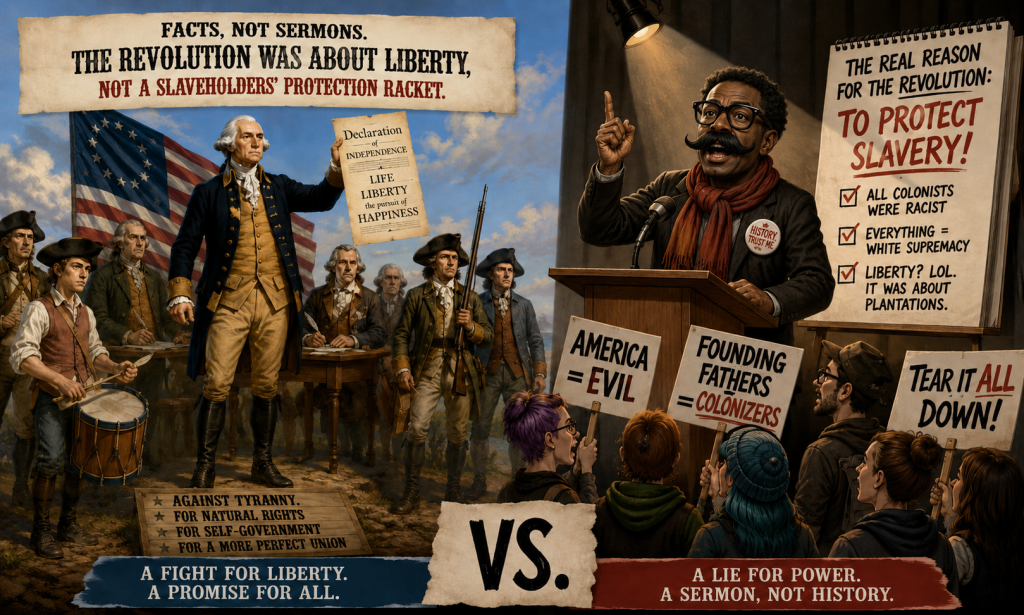
Jefferson’s rough draft of the Declaration included a passage condemning the slave trade, and Congress deleted it. That deletion matters. It tells us something ugly about compromise, cowardice, regional interest, and the moral limits of the coalition that birthed the country. It also tells us something else, something the 1619 catechism doesn’t want to linger on because it causes the narrative to develop a limp: antislavery arguments were present at the creation. They were not imported later by benevolent aliens from Planet Equity. They were there, inside the argument from the beginning, fighting against the hypocrisy of men who had declared universal rights while tolerating bondage.
The Constitution also compromised with slavery, shamefully. Yet it avoided using the word “slave” and created the possibility of ending the international slave trade, which Congress did effective 1808. Was that enough? No. Was it morally adequate? No. Was it meaningless? Also no. History is not a children’s menu where you pick “hero” or “villain” and get crayons with your ideology.
America’s story is tragic because it failed its own ideals. It is also magnificent because those ideals survived the men who betrayed them.
That is the part the 1619 worldview cannot tolerate. It has no room for a flawed inheritance that can be redeemed. It wants permanent indictment. It wants original sin without atonement, confession without forgiveness, history without gratitude, and citizenship without obligation. It wants every American child to inherit guilt, resentment, or suspicion, depending on pigmentation and politics, because nothing says “healthy republic” like turning third graders into tiny parole officers of the dead.
And once you teach people that the country is rotten at the root, don’t act shocked when they stop watering the tree.
This is where the bullets come in.
Political violence exists across ideologies. Say it plainly. The far right has a long and deadly record. Jihadist violence has left bodies and scars across the country. There are cranks, cultists, racial supremacists, religious fanatics, accelerationists, nihilists, and basement goblins from multiple ideological zip codes. Anyone pretending otherwise is selling you a hat, a newsletter, or both.
But the current permission structure for political violence has shifted in a very specific and dangerous way. A faction of the modern Left has normalized the idea that violence is acceptable when aimed at the allegedly oppressive. That doesn’t mean every Democrat is hiding brass knuckles in a NPR tote bag. Most people, across parties, still oppose political violence. That matters. But the radical edge does not need a majority. It needs moral fog, institutional cowardice, and a chorus of respectable people willing to explain why the latest attack is “understandable in context.”
That phrase should be fired into the sun.
“Understandable in context” is how cowards launder approval while keeping their hands technically dainty. It’s the rhetorical hand sanitizer of people who want the thrill of revolution and the liability coverage of moderation.
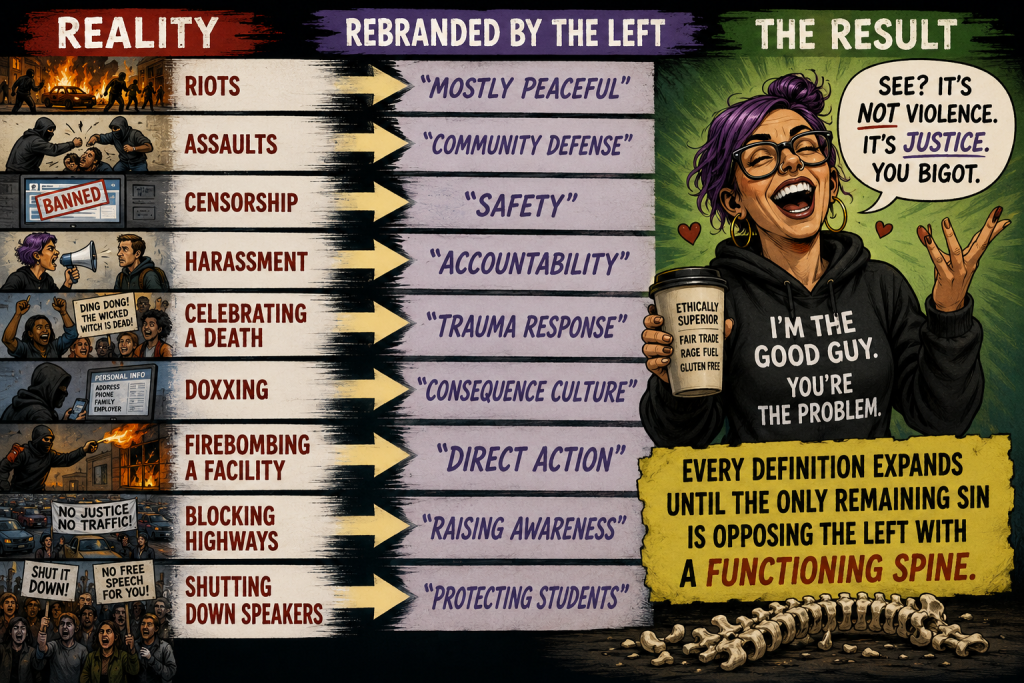
We’ve watched this move for years. Riots become “mostly peaceful.” Assaults become “community defense.” Censorship becomes “safety.” Harassment becomes “accountability.” Celebrating a death becomes “trauma response.” Doxxing becomes “consequence culture.” Firebombing a facility becomes “direct action.” Blocking highways becomes “raising awareness.” Shutting down speakers becomes “protecting students.” And somehow, every definition expands until the only remaining sin is opposing the Left with a functioning spine.
Free speech is violence, they tell us, while actual violence is speech.
That’s not a political philosophy. That’s a toddler with a brick and thesaurus.
The intellectual trick is always the same. First, redefine harm so broadly that words become violence. Then redefine violence so selectively that violence becomes justice. Once that switch happens, civilization starts losing altitude fast. Debate becomes complicity. Neutrality becomes oppression. Law becomes fascism. Restraint becomes cowardice. And the maniac with a gun becomes, in the diseased imagination of the ideological sewer, someone who “snapped” for reasons we must sympathetically unpack over a six-part documentary scored by a cello having a nervous breakdown.
No.
Adults know the difference between explanation and excuse. We can study why people radicalize without pretending the assassin is a weather event. We can analyze motives without composing love letters to madness in the passive voice. And we can say, with the full force of moral sanity, that political murder is evil even when the victim held opinions your podcast circle finds spicy.
The Left’s problem here is not merely that some extremists commit violence. Every society has extremists. The problem is that too many institutions have become allergic to condemning left-coded violence in the same immediate, thunderous language they use for right-coded violence. If a right-wing lunatic does something evil, we get national soul-searching before the blood has dried. Every conservative who once liked a Facebook page called “Traditional Pancakes for Liberty” is dragged to the microphone and asked to denounce seven times before sunrise.
If a left-wing radical does something evil, the room suddenly becomes a graduate seminar in nuance. We’re told to avoid politicizing tragedy. We’re warned about backlash. We’re instructed to consider root causes. We’re reminded that emotions are high. We’re handed a 900-word explainer on alienation, social media, capitalism, climate dread, student loans, loneliness, and probably gluten.
Funny how responsibility returns to fashion the moment the perpetrator wears the wrong ideological jersey.
That double standard is poison. It tells radicals they have patrons. It tells victims they have categories. It tells ordinary citizens that the rules are fake. And when people conclude the rules are fake, they eventually stop obeying them.
A republic cannot survive if half the country believes the law is just a costume worn by power. It also cannot survive if the other half is told that defending the republic makes them morally suspect. That is the razor wire wrapped around the American throat right now.
The 1619 Project matters in this argument because historical legitimacy is the floor beneath civic peace. If the floor is ripped out, everyone starts falling. If America is nothing more than slavery, conquest, exploitation, and racism in a powdered wig, then patriotism becomes complicity. The flag becomes evidence. The Constitution becomes contraband. The police officer becomes an occupier. The border agent becomes a Nazi. The judge becomes a colonial functionary. The school board parent becomes a domestic threat. The veteran becomes a sucker in camouflage who fought for Exxon, Raytheon, and a bald eagle screensaver.
And once those labels stick, anything can be done to such people in the name of justice.
That’s the danger. Not honest history. Not teaching slavery. Not teaching Jim Crow. Not teaching the Trail of Tears, Japanese internment, redlining, or any other national disgrace. Teach it all. Teach the wounds so thoroughly that no demagogue can exploit ignorance.
But teach the whole story.

Teach that Britain and America became central forces in ending the transatlantic slave trade. Teach that abolitionists appealed to founding principles, not because those principles were fraudulent, but because they were powerful. Teach that Black Americans were not merely victims of America, but builders, soldiers, witnesses, reformers, inventors, pastors, parents, litigants, voters, writers, workers, martyrs, and citizens who forced the nation to honor its own promises. Teach that the Civil War was fought over slavery and that hundreds of thousands died in the conflict that ended it. Teach that Reconstruction was a second founding, betrayed and unfinished. Teach that civil rights activists did not ask America to abandon the Declaration. They demanded America obey it.
That is truth. It doesn’t need a fog machine.
The 1619 worldview offers something easier and uglier: America is guilty all the way down. That story flatters the bitter, empowers the mediocre, and gives pseudo-intellectual cover to the professionally enraged. It turns citizenship into accusation. It turns history into therapy for people who think gratitude is a fascist residue. It offers the thrill of moral superiority without the burden of building anything.
And building is the part they hate.
Destroying a statue is easy. Understanding the man on the pedestal is harder. Screaming “colonizer” at a grandmother in a flag sweater takes no talent. Reading Douglass, Lincoln, King, Washington, Jefferson, Harriet Jacobs, Booker T. Washington, Ida B. Wells, Thomas Sowell, Shelby Steele, and John McWhorter might require attention spans longer than a TikTok tantrum, which is apparently ableist now.
The modern Left’s revolutionary theater has become a substitute for moral discipline. It’s easier to accuse than to persuade. Easier to chant than to govern. Easier to tear down than to repair. Easier to sneer at America than to understand why millions of people still risk everything to come here. That last fact really does ruin the party, doesn’t it? If America is such a uniquely evil hellscape, why do so many people keep trying to enter it? Are they all confused? Did they miss the seminar? Should we put a trigger warning on the Statue of Liberty?
Maybe, just maybe, America remains attractive because its founding promise is still real, even when America fails it. People do not flee toward perfection. They flee toward possibility.
The Left’s current ideological sickness is that it conflates criticism with contempt. Criticism says, “This country has failed its principles, and we must make it live up to them.” Contempt says, “This country is a lie, and anyone who loves it is either stupid or evil.” Criticism can reform. Contempt can only corrode.
And corrosion has consequences.
So what do we do, besides scream into the national ceiling fan until our souls leave our bodies?

First, teach primary sources again. Not worksheet mush. Not activist fan fiction with discussion questions. Put students in front of the Declaration, the Constitution, the Federalist Papers, slave narratives, Douglass, Lincoln, the 13th, 14th, and 15th Amendments, Plessy, Brown, King’s “Letter from Birmingham Jail,” and the Civil Rights Act. Let them see the argument across time. Let them wrestle with contradiction. If your curriculum can’t survive primary sources, it’s not education. It’s daycare for propaganda.
Second, stop treating patriotism as embarrassing. Patriotism isn’t worship of government. That’s for creeps and bureaucrats with soft hands and hard drives full of regulations. Patriotism is loyalty to a people, a place, a memory, a promise, and a set of principles worth correcting ourselves toward. The cure for bad patriotism is mature patriotism, not national self-loathing in a cardigan.
Third, restore moral symmetry. Political violence is evil when your enemies do it and evil when your allies do it. No exceptions for “context,” no discount codes for rage, no ideological Groupon for assault. If your side cannot condemn its own monsters, your side is breeding them.
Fourth, punish violence consistently. Arrest people who commit crimes. Prosecute them. Protect public officials, judges, candidates, journalists, speakers, and ordinary citizens from intimidation. A society that lets mobs veto speech will eventually let assassins veto elections.
Fifth, stop teaching children that disagreement is danger. Disagreement is the gymnasium of citizenship. If students cannot hear an opposing argument without requiring a fainting couch and a twelve-person affirmation squad, they are not being educated. They are being emotionally upholstered.
Sixth, make institutions viewpoint-neutral again. Universities, corporations, media organizations, and nonprofits need to stop serving as luxury spas for one ideology and haunted escape rooms for everyone else. The rule should be simple: same standards, same consequences, same rights. If that sounds radical, congratulations, you’ve been living inside a velvet totalitarian pamphlet.
Seventh, rebuild civic life locally. The national conversation is mostly a dumpster with a ring light. Build somewhere else. School boards. Veterans groups. Churches. Synagogues. Rotary clubs. Local history projects. Reading groups. Youth sports. Food drives. Town halls. Neighborhood associations. Put Americans back in rooms where they have to know each other as human beings before some algorithm turns them into enemy cartoons.

Eighth, make historical gratitude intellectually respectable again. Gratitude doesn’t require amnesia. You can be grateful for America and furious at its failures. You can love the Declaration and despise the fact that the men who signed it didn’t fully live it. You can honor the Union dead and still study Reconstruction’s betrayal. You can teach slavery without teaching despair. You can teach racism without teaching racial fatalism. You can teach American sin without denying American grace.
That’s the mature path. Which, naturally, is why so many of our cultural elites avoid it like it’s a salad at a county fair.
The central question is brutally simple: Is America a lie, or is America a promise?
If it’s a lie, then contempt is logical. If it’s a promise, then duty is logical. The 1619 worldview pushes the lie. The American tradition, at its best, insists on the promise.
The promise has been broken repeatedly. That is true. It has also been repaired, expanded, defended, and paid for in blood. That is also true. The people who can only tell you the first half aren’t brave truth-tellers. They’re narrators with one eye covered, one fist raised, and one Venmo link in the bio.
The bullets are flying in one direction because the moral imagination of one direction has grown dangerously comfortable with dehumanization. Again, this does not absolve the right of its extremists, its sins, or its lunatics. Condemn them all. Put every political thug, from every faction, under the same moral floodlight and watch the cockroaches file a class-action lawsuit.
But right now, the Left has a special problem with transforming resentment into righteousness and righteousness into permission. Its cultural priests have spent years telling people that America is violence, speech is violence, borders are violence, police are violence, capitalism is violence, whiteness is violence, tradition is violence, and normal families are apparently a war crime with a mortgage. When you call everything violence, don’t be surprised when actual violence loses its taboo.
America doesn’t need a bedtime story. It needs a true story.
The true story is that America was born in contradiction but also in genius. It declared a principle broader than its founders’ virtue. It gave future generations the tools to condemn the past and improve the present. It sinned deeply. It also produced the language and institutions by which those sins could be challenged. It enslaved, and it emancipated. It segregated, and it desegregated. It excluded, and it amended. It failed, and it fought. It buried its sons by the hundreds of thousands over the question of whether the Declaration meant what it said.
That isn’t a nation beyond redemption. It’s a nation still on trial, with the verdict dependent on whether its people are brave enough to defend truth against both propaganda and despair.
The 1619 Project wants Americans to begin with accusation. I say begin with reality. All of it. The horror and the hope. The chains and the charter. The lash and the liberty bell. The hypocrisy and the heroes. The graves and the glory. The unfinished work.
Because if we surrender the American story to people who hate America, we shouldn’t act stunned when the next generation concludes there’s nothing left to preserve.
And veterans care about this with particular fury, because men and women who carried the flag into danger didn’t do it so some credentialed resentment merchant could teach their children and grandchildren that the country they served is just a blood-soaked scam with fireworks.

Tammy’s Little Pile of Source Grenades for Anyone Who Wants to Argue
Pulitzer Center, The 1619 Project Curriculum
https://pulitzercenter.org/lesson-plan-grouping/1619-project-curriculum
Pulitzer Center, About The 1619 Project
https://1619education.org/
PBS NewsHour, discussion of the 1619 Project clarification from “all colonists” to “some colonists”
https://www.pbs.org/newshour/show/how-the-1619-project-underscores-connection-between-slavery-and-modern-america
Leslie M. Harris, “I Helped Fact-Check the 1619 Project. The Times Ignored Me.”
https://www.realclearinvestigations.com/articles/2020/03/08/investigative_issues_i_helped_fact-check_the_1619_project_the_ny_times_ignored_me_122722.html
Library of Congress, deleted slavery passage from the Declaration of Independence
https://www.loc.gov/exhibits/creating-the-united-states/interactives/declaration-of-independence/slavery/enlarge5-transcribe.html
National Archives, The Slave Trade
https://www.archives.gov/education/lessons/slave-trade.html
National Constitution Center, Frederick Douglass and “What to the Slave Is the Fourth of July?”
https://constitutioncenter.org/the-constitution/historic-document-library/detail/frederick-douglass-what-to-the-slave-is-the-fourth-of-july-1852
CSIS, “Left-Wing Terrorism and Political Violence in the United States”
https://csis-website-prod.s3.amazonaws.com/s3fs-public/2025-09/250925_Byman_Left_Wing.pdf
CSIS, U.S. Terrorism Incidents Dataset
https://www.csis.org/programs/warfare-irregular-threats-and-terrorism-program/us-terrorism-incidents-dataset
Pew Research Center, Americans say politically motivated violence is increasing
https://www.pewresearch.org/short-reads/2025/10/23/americans-say-politically-motivated-violence-is-increasing-and-they-see-many-reasons-why/
PRRI, Political Violence in America
https://prri.org/research/political-violence-in-america-public-perceptions-polarization-and-accountability/
_____________________________
Tammy Pondsmith is a semi-feral republic enthusiast, historical sarcasm sommelier, and unpaid exterminator of ideological termites who keeps a pocket Constitution in one hand and a verbal flyswatter in the other.
As the Voice of the Veteran Community, The Havok Journal seeks to publish a variety of perspectives on a number of sensitive subjects. Unless specifically noted otherwise, nothing we publish is an official point of view of The Havok Journal or any part of the U.S. government.
Buy Me A Coffee
The Havok Journal seeks to serve as a voice of the Veteran and First Responder communities through a focus on current affairs and articles of interest to the public in general, and the veteran community in particular. We strive to offer timely, current, and informative content, with the occasional piece focused on entertainment. We are continually expanding and striving to improve the readers’ experience.
© 2026 The Havok Journal
The Havok Journal welcomes re-posting of our original content as long as it is done in compliance with our Terms of Use.