The cleverest racket in public life is not corruption. Corruption is almost refreshingly honest. It leaves fingerprints, invoices, cousins on payroll, and a marina somewhere. The truly sophisticated scam is moral explanation as self-exoneration. That trick is much classier. You take a social failure, wrap it in a grand historical indictment, repeat the approved diagnosis until it becomes etiquette, and then make absolutely certain nobody looks too hard at the incentives operating right now under the supervision of highly credentialed people with strategic plans and catered lunches.
That is the central fraud of modern institutional life. Our ruling class has perfected a form of moral theater in which every current failure is explained by some immense inherited evil, while every present administrator is cast as a tragic bystander doing his best with a very difficult legacy. The dead are always guilty. The living are always convening. The policy architects, program directors, compliance officers, consultants, and prestige journalists who turned confusion into a full employment plan are never asked the vulgar question of whether they have made anything worse. They are too busy describing the weather they helped create as if it were an act of God.
This is not because the explanation is necessarily false in every part. History matters. Obviously. Only a fool thinks human beings spring each morning from the dew with no memory, no institutions, and no accumulated damage. But history has become the preferred explanation of cowards precisely because it is so useful in protecting the present. If a problem is caused by current incentives, then somebody might have to repeal something, defund something, admit error, or lose status. Intolerable. If the problem is caused by an enormous moral inheritance, then everyone currently in charge may continue speaking in the tones of grave humanitarian concern while changing nothing except the size of the budget.
Better still, they can profit from it.
That is the part polite people prefer to leave in the fog, because it sounds crude, and polite people hate nothing more than precision that ruins a career. But once moral injury becomes institutional capital, the incentive is no longer to solve it. The incentive is to administer it, narrate it, brand it, workshop it, certify it, and invoice around it. Pain becomes programming. Breakdown becomes a department. Failure becomes a conference. A permanent condition of grievance is vastly more valuable to a managerial class than recovery ever could be. Recovery has the terrible vice of ending the grant cycle.
So the approved explanations survive not merely because they flatter vanity, though they certainly do that. They survive because they are useful to people who derive money, authority, immunity, and relevance from keeping the moral emergency permanently half-resolved. Never resolved, of course. That would be catastrophic for the ecosystem. You cannot build a durable professional identity around a wound that closes. The scar is terrible for business.
This is why so much public analysis now sounds like liturgy performed by accountants. Every disparity must be folded into the same solemn script, provided that script never implicates the institutions currently producing perverse incentives, degraded norms, lowered expectations, and bureaucratic dependence. Any attempt to discuss present tradeoffs is treated as indecent. Ask what behavior is being subsidized, what standards have been abandoned, or what habits have been excused in the name of compassion, and the room instantly fills with people who look as though you have proposed juggling infants over a bonfire.
Real compassion, by contrast, is not afraid of cause and effect. It wants human beings to flourish in reality, which means it cares about incentives, norms, conduct, honesty, discipline, and the uncomfortable possibility that a benevolent intention may produce a rotten result. Counterfeit compassion cannot tolerate this. It is attached not to outcomes but to posture. It prefers the emotional prestige of caring to the practical risk of correction. It would rather preserve a flattering story than repair a degrading system. That is not kindness. It is vanity with a grant writer.
Of course prejudice exists. Human beings have been sorting, snubbing, scapegoating, and romanticizing one another since before they had indoor plumbing. But modern institutions have discovered that broad moral narratives are far more lucrative than concrete accountability. They can invoke suffering in general terms while avoiding scrutiny of the specific mechanisms by which they themselves distribute rewards, excuse failure, and multiply dependency. They can call this sensitivity, or equity, or awareness, or progress, and then stare in injured disbelief when somebody notices that the people presiding over the emergency seem to be doing extremely well.
That is why repeated assertions matter so much. A useful explanation does not need to be especially true. It needs to be ritually familiar, socially protective, and profitable to the people who enforce it. Once installed, it organizes status. It tells one class that it is enlightened, another that it is suspect, and everyone else that silence is less expensive than honesty. Before long, an entire bureaucracy is feeding on the same moral carcass while insisting it is performing emergency surgery.
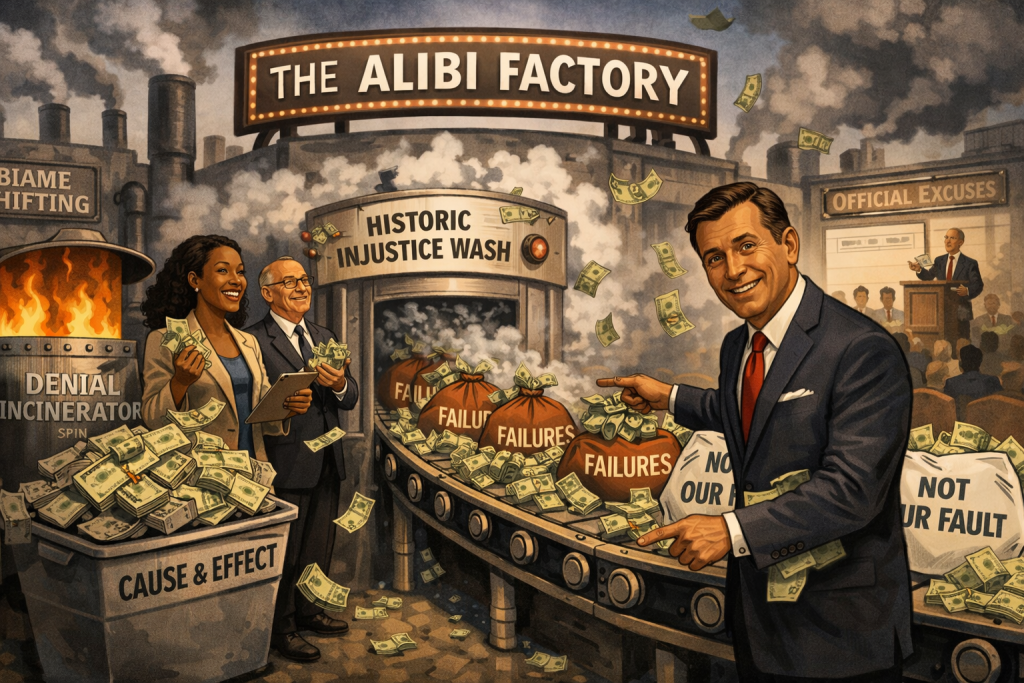
So here we are, in the Alibi Factory, where failure is washed, packaged, and returned to the public as righteousness. The machine protects the people who run it, enriches the people who narrate it, and flatters the people who applaud it. And because every scam eventually acquires a mission statement, the whole operation is called compassion right up until you notice that the one thing nobody in the building can afford is a cure.
_____________________________
Tammy Pondsmith, Senior Vice President of Institutional Autopsies, has spent years identifying the exact moment a respectable organization conflates self-worship with compassion and calls the body count a pilot program.
As the Voice of the Veteran Community, The Havok Journal seeks to publish a variety of perspectives on a number of sensitive subjects. Unless specifically noted otherwise, nothing we publish is an official point of view of The Havok Journal or any part of the U.S. government.
Buy Me A Coffee
The Havok Journal seeks to serve as a voice of the Veteran and First Responder communities through a focus on current affairs and articles of interest to the public in general, and the veteran community in particular. We strive to offer timely, current, and informative content, with the occasional piece focused on entertainment. We are continually expanding and striving to improve the readers’ experience.
© 2026 The Havok Journal
The Havok Journal welcomes re-posting of our original content as long as it is done in compliance with our Terms of Use.