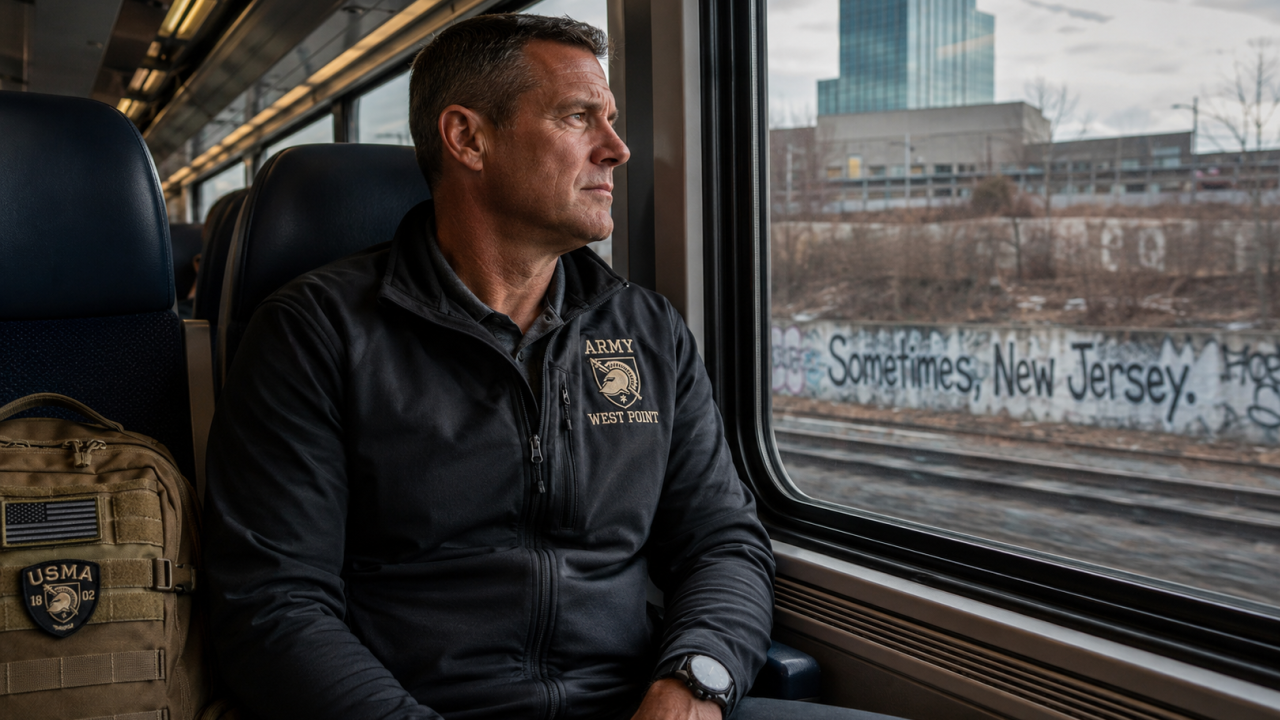
I had a lot on my mind on 14 October, 2025 as I rode the Amtrack train from Washington, D.C. to New York City. I had been in our nation’s capital to speak at an event put on by the Ranger Legacy Foundation, and there was a lot to unpack from the experience.
To begin with, even though it was objectively a short trip, in my entire adult life I had never taken a train ride as long as the one I took from a station near my home outside of West Point, NY, to New York City, to Washington, D.C., and back again. You see a lot of… “interesting” things on public transportation, especially in major cities. And this trip was certainly no exception.
At my wife’s suggestion, I bought a business class ticket on Amtrack for this travel. I got on the train, and moved to what I thought was my seat. I was surprised to find that it was a four-seater consisting of two benches facing each other. There was a family of three taking up three of the four seats, and I filled in the fourth, which had a number that matched my ticket. There were other seats open in the same general area, but since that was my seat, that’s where I sat. I’ll just say that I wasn’t very impressed with “business class.” It seemed a little… “coach.”
It wasn’t until the conductor came around to check tickets that I found out that I wasn’t in the right spot. Although my seat number was correct, I was in the wrong section. I’m sure the family I sat with wondered why the tall weird old guy had to sit with them, when there were so many other open seats around. But eventually I got to my actual seat, which was much nicer and allowed me to work on my speech as we made the trip down.
At a stop along the way, I gained a seatmate. A man dressed in work clothes and wearing a hard hat took the seat beside me. I immediately noticed his boots, which were military-issue desert boots. We politely said hello to each other. As the train got underway, he made a comment about my backpack, which was a military-style tan pack with MOLLE loops.
“Nice pack,” he said.
“I like your boots,” I replied.
Recognizing each other as fellow veterans, we had about a very pleasant 20 minute discussion about our respective military careers (he had spent some time in the Navy, I was retired Army) and we went our separate ways. As he left, I noticed he was wearing a sheathed fixed-blade knife on his belt. I thought it was unusual; I always just carried a folder.
My trip was during the 2025 government shutdown, which is over now but at the time was the longest in US history. This affected a lot of what I did as a government civilian. I had planned on attending the annual AUSA conference in D.C. while I was in town, because it coincided with the Ranger Legacy event. Concerned about “optics,” we were not allowed to go to the conference, even if we didn’t use government funds to do it. But the Army had allowed a bunch of general officers to travel to D.C. to participate in the AUSA event in the nation’s capital. I guess those “optics” were OK. I was invited, but not allowed to go because of the “optics” of attending, even though I’m a civilian and no one would know if I had any .gov or .mil affiliation. Oh yeah and I was also not getting paid because of the shutdown. So all of that was on my mind, too.
One of the first things I noticed when I pulled in the station in D.C. was the absolutely amazing architecture. The pictures I took of it just don’t do it justice. I walked outside to meet my ride. There was a light drizzle, but it didn’t seem to bother anyone.
When I was waiting for the Uber to arrive to take me from Union Station to my hotel, I noticed an overweight woman walking back and forth on the sidewalk carrying a big TRUMP flag on a pole. A Trump flag? In public? In Washington, D.C.? “That’s bold,” I thought. But as she turned, I saw the flag actually said “FUCK TRUMP.” Yeah, that tracks. That’s kind of the sentiment I was expecting here. I also saw that she had a sign that took people to a site where they could send her donations. That tracks too; protesting Trump is big business for a lot of people. If nothing else, she was getting her steps in, I suppose. And she was lawfully exercising her rights without interfering with anyone else’s.
But on the ride to D.C., and on the way back, what I thought most about was the remarks I gave at the Ranger Legacy event. I was surprised to have been invited; I wasn’t a Ranger by any definition, tab or scroll, although I served alongside Rangers on six of my seven combat deployments, and helped write a book about the Ranger Regiment a number of years ago. I also work closely with a number of former Rangers in my current job with the Modern War Institute at West Point, and have interviewed a number of them for podcasts like The Spear. The organizer of the Ranger Legacy event, a longtime friend to the veteran community and to me personally, invited to me speak at the gathering, but I was reluctant. What was I, a guy who never spent a day in the Ranger Regiment and never even earned a Ranger tab, going to say to a bunch of Rangers?
She said, “You can tell them how the Ranger Regiment taught you how to dance.”
Yeah. Yeah, I can do that.
She was referring to an article I wrote for my blog, The Havok Journal, a few years ago. The article is about a revelation I had when I took my youngest daughter to a daddy-daughter dance at West Point and reflected the sacrifices so many people made in the Global War on Terror. It highlighted some of the interactions I had with members of the Ranger Regiment during my deployments with 5th Group, the 160th SOAR, and JSOC. In the piece I discussed my reluctance to dance–because I suck at it–but came to the realization that so many of my fellow veterans don’t even have the ability to do so even if they wanted to… because they’re dead. In the exuberance that only young children belting out their favorite Disney songs on the dance floor can express, I came to the realization that I would never “not dance” again. Because I can. I can do it for them, the ones who no longer can. And my experiences with the Ranger Regiment helped me get there.
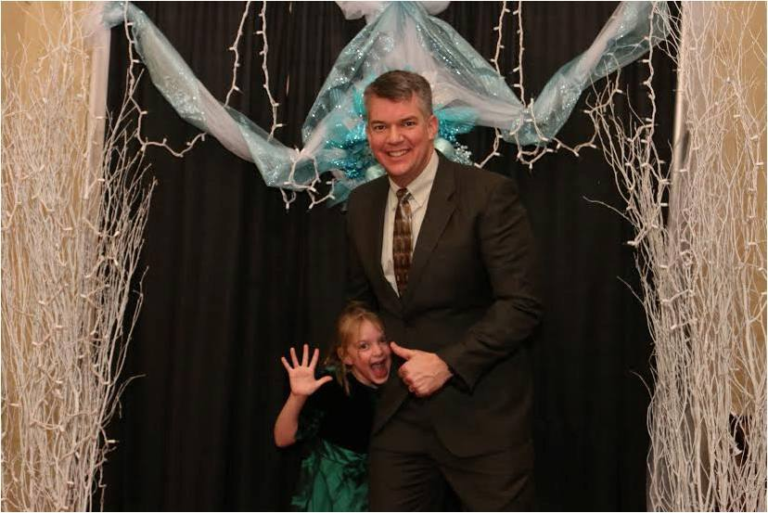
My speech that night at the Ranger Legacy event was more or less a little bit of scene-setting and then a recitation of my Havok Journal article. I was extremely nervous, anxious even, about being there. There was a lot of imposter syndrome happening, and I was unsure how the Rangers would receive me, and what I had to say.
Fortunately for me my speech was well received, and I discovered there were even a few people in the room that I knew from my combat deployments. The Rangers were gracious hosts and I ended up staying at the event much longer than I anticipated. I was grateful for the opportunity.
The next morning, I woke up early to start my return trip. I discovered that there were only a few places in Union Station open for early breakfast. Wendy’s was one of them. Even at this early hour, the homeless were up and hustling. I watched one homeless woman, barefoot and wearing a nightgown, talk someone in line in front of me into buying her breakfast. She got a breakfast sandwich of some type and the largest, sugariest soda they had, and then toddled off back to her cart-bound belongings.
While I sat eating my Wendy’s breakfast, a young black man with dreadlocks and a tank top approached me. He asked if I had been in the Army, clued in, I’m sure, by the ARMY WEST POINT logo on the back of my jacket. He looked homeless, and I thought he was going to ask for money, but he didn’t. I immediately noticed a pentagram dangling from a necklace. A satanist? That’s interesting. We had a brief conversation and then he abruptly walked off, holding his left hand down in a “devil’s horns” gesture. Strange. Did that guy just put a hex on me? Everything about trains is weird…
Eventually it was time for me to board my train. I went to the right seat, in the right section, this time and began the journey home.
_____
With all of that as backstory, we now get to the main plot. On the train ride home I thought through all of the experiences I had in that short 24 hour period. The politics. The homelessness. The confusion of where I was supposed to sit. The conspicuous hypocrisy of the AUSA event. The interesting conversations with everyone from fellow vets to homeless-looking satanists. The anxiety of potential rejection. The thrill of seeing old comrades-in-arms. The moment of clarity that I had at that dance with my young daughter. All of it.
But the strongest feeling I had was one of gratitude. It was the kind of gratitude that came with knowing that, “but for the grace of God, there go I.” If my life had been shaped just a little differently, if my choices were just a little different, or if luck had not been on my side for 50+ years, it could have been me. I could have been homeless, or drug addicted, or carrying around a vulgar political sign in the rain while panhandling for donations. I could have been one of the ones we raised a toast to at the Ranger Legacy event, “gone too soon.” I’m grateful that my friend, the organizer, talked me into going. And I’m grateful to America for giving me the opportunity to build the life that my family and I have today.
And that brings me to the vingnette from which this article gets its name. As the train home slowed to a stop in northern New Jersey, I noticed the graffiti on the buildings, embankments, and bridges that the train passed. It was everywhere. Most of it was garden-variety urban decay, but some of it was well done art. There was one bit of graffiti that really got my attention.
Unlike most of the other graffiti, it wasn’t a street name or a vulgarity. It wasn’t a cartoon or a political slogan. It simply said “Sometimes, New Jersey.” I don’t know why, but that really stood out to me.
I didn’t get a picture of it, so I had ChatGPT re-create it for me. It more or less looked like this:

Intrigued by this rather cryptic phrase, I Googled “sometimes, New Jersey” and found out that it’s the name of a song by a group called Saves the Day. The song is not not super long; in fact, it only lasts about a minute. Unfortunately, it’s also not super intelligible when you listed to it. So here are the lyrics:
Called you up to see if maybe we could hang.
Told you I was nervous and feeling lonely.
I bit my lip.
You were like fucking hell yeah.
Made me smile, thought about how beautiful the night would be.
I thought maybe we could drive around talking about your town or stay at home.
I could win you over acting cool.
Real fucking romance.
I never lived in New Jersey, I had never heard of the song Sometimes, New Jersey or the band Saves the Day. Stream-of-consciousness punk rock was never my thing. So basically, I can’t really relate to this song.
But it got me thinking about “sometimes.” And America. And what I experienced in Washington, D.C. that weekend. It prompted me to write this:
Sometimes, America gets it right.
Sometimes, we don’t.
We reach for connection, for justice, for progress, for sanity and unity, and sometimes we find it.
Other times, we trip over our own contradictions.
We get it right when we show up for each other: in floods, in fires, in fear.
When we innovate, include, and invest in one another.
When we push through cynicism to make good on the promises written in our founding documents.
But sometimes, America gets it wrong.
When we forget the people on the margins.
When we trade long-term progress for short-term comfort.
When we divide faster than we unite.
When we fail to enforce and uphold our beliefs and our boundaries.
When we trade our freedoms for the illusory comfort of security.
And yet, we keep trying.
That’s what I love most about this country: we still reach.
We argue, we rebuild, we reinvent. We stumble forward, together or not at all.
America isn’t perfect.
But perfection was never the point.
The point was becoming.
Sometimes, we get it right.
Sometimes, we don’t.
But we still believe we can.
Sometimes.
Sometimes, America.
_____________________________
Charles served over 27 years in the US Army, which included seven combat tours in Iraq and Afghanistan with various Special Operations Forces units and two stints as an instructor at the United States Military Academy at West Point. He also completed operational tours in Egypt, the Philippines, and the Republic of Korea and earned a Doctor of Business Administration from Temple University as well as a Master of Arts in International Relations from Yale University. He is the owner of The Havok Journal and the co-author of the book Violence of Action: The Untold Stories of the 75th Ranger Regiment in the War on Terror. His views expressed here are his own and are not necessarily reflective of the policy of the US Army or the United States Government.
As the Voice of the Veteran Community, The Havok Journal seeks to publish a variety of perspectives on a number of sensitive subjects. Unless specifically noted otherwise, nothing we publish is an official point of view of The Havok Journal or any part of the U.S. government.
Buy Me A Coffee
The Havok Journal seeks to serve as a voice of the Veteran and First Responder communities through a focus on current affairs and articles of interest to the public in general, and the veteran community in particular. We strive to offer timely, current, and informative content, with the occasional piece focused on entertainment. We are continually expanding and striving to improve the readers’ experience.
© 2026 The Havok Journal
The Havok Journal welcomes re-posting of our original content as long as it is done in compliance with our Terms of Use.


