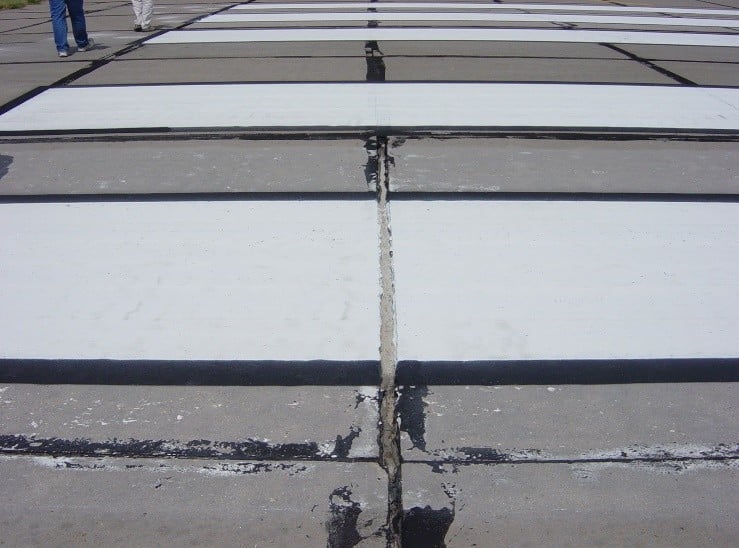
The airport manager called in a panic. Not blowing up in a social media sort of way—but instead, like a bomb. That spring, and both years prior, when the weather got warm, his concrete runway would buckle in the middle… violently, with no warning.
We were his engineering firm. It was our job to solve his problems. Our team grabbed cameras, tape measures, calculators, and went to investigate.
Sure enough, several slabs in the runway center had just popped up out of the ground like big toy cars crashed together by giant invisible hands. Very weird. By the time we arrived, his city crew had removed the damage and poured new slabs. In the process, they first tried sawing, but the concrete saw blade got pinched and had to be cut out with a torch. That was our first clue: things were still moving under that pavement. When they jackhammered out the main slab, it broke violently free, popping up under the workers’ feet. At the moment of breaking, the rest of the concrete slid so much and so fast that their truck tires left skid marks. We joked that the work crew likely left a few of their own while riding a mile-long slab during its mini-earthquake!
***
Concrete can have all sorts of problems with age, but this one was a head-scratcher—it wasn’t even July-hot yet. We took core samples and sent them off for a host of laboratory tests. In addition to heat, some chemical reactions can cause concrete to expand over time. We looked up and down the whole runway and the story started to take shape.
While the joints in the middle of the runway were pinched together to a hair’s width, the joints at each end had separated by a couple of inches. Things were moving. Pavement is not supposed to move!
Concrete joints should be straight and generally way less than three inches wide
***
We dug out the old construction records from 20 years prior. The five-inch slab was simply paved right on the native soil that had been rolled smooth. That’s not how we’d do it in the 21st century, but the technique was common back in the day.
Back at the office, we laid out all our data like good nerds. We received our lab core results, which held more clues. The concrete did have some Alkali Silica Reactivity (ASR), which caused some expansion and cracking. It also had too little entrained air compared to the original concrete recipe. Believe it or not, you actually need a certain amount of air bubbles in your concrete to help mitigate freeze/thaw cycles.
Then we looked at the survey points—and had our “Aha!” moment.
While the runway had ASR, air, and age problems, what it really had was a gravity problem. The two runway ends were higher than the middle. In nerd parlance, the runway was built as a large longitudinal sag curve—shaped like a big bowl. The cause of our runway blow-up was decidedly low-tech: the runway was sliding into itself. Groundwater perched under the pavement literally greased the skids, minimizing friction between the slab and the soil underneath. Early warm temperatures just exacerbated the whole thing—and boom: buckled concrete.
At the time, ASR was a very trendy topic. Many big brains around the country were talking about how to mitigate deleterious (reactive and bad) aggregate used in concrete. Bad chemistry doesn’t just happen on a blind date—sometimes it happens with cement powder, water, and all the wrong rocks. These days, concrete mix designers go through great pains to find the right rocks. Several esteemed colleagues with whom I spoke were convinced ASR was the main culprit and wanted to take time to do more show-and-tell writeups. I’ve rarely learned more about a single topic just to argue that the topic was not my issue.
If you want to trigger your civil engineer friends…
***
But we stuck to our guns. Gravity was the true culprit in our giant concrete slip-and-sliding runway dilemma. Our dramatic exploding pavement problem had a pretty boring answer. Occam’s Razor states that the simplest solution is often the correct one. That principle pointed directly to our fix—big-brain lab topics notwithstanding. The most cost-effective solution for the 20-year-old pavement was just to rip it all out and build it back better… which we promptly did the following summer.
That project always reminds me: when a solution—or even a cause—isn’t immediately apparent, don’t get too caught up in the minutiae. Stay strong even when there are geeky details offering a tempting foray into new problem-solving areas that we STEM types love so much. That’s science. Fixing a problem? That’s engineering.
Flexing that big brain and writing up a thesis might work in academia, but it won’t get you far in a construction time-is-money setting. Sometimes it pays to step back, remember the good Friar Occam, and noodle on the simplest answer. Odds are greater than zero that’s the answer you needed in the first place.
__________________________
David is a father, husband, son, boss, writer, beekeeper, outdoorsman, occasional teacher, compulsive elk hunter, Afghanistan veteran, and living proof that anyone is trainable. He is a 1994 South Dakota School of Mines graduate. David spent 12 years in the Army and Army Reserve as an Engineer Officer before that career was cut short with Afghanistan injuries. He spent decades as a consulting civil engineer working in communities all around the American West and now oversees his firm’s engineering department. David continues to amaze both friend and foe being an engineer who can write a story.
As the Voice of the Veteran Community, The Havok Journal seeks to publish a variety of perspectives on a number of sensitive subjects. Unless specifically noted otherwise, nothing we publish is an official point of view of The Havok Journal or any part of the U.S. government.
The Havok Journal seeks to serve as a voice of the Veteran and First Responder communities through a focus on current affairs and articles of interest to the public in general, and the veteran community in particular. We strive to offer timely, current, and informative content, with the occasional piece focused on entertainment. We are continually expanding and striving to improve the readers’ experience.