Meta Description: Hands-on creative challenges help veterans rebuild focus, routine, and calm after service, why wooden puzzles can support recovery and resilience.
Leaving the military can feel like stepping out of a world where the mission is clear, the standards are explicit, and the day is structured down to the minute into a life that often isn’t. You may still have drive, discipline, and capability in abundance, but the “container” that once shaped your energy is gone.
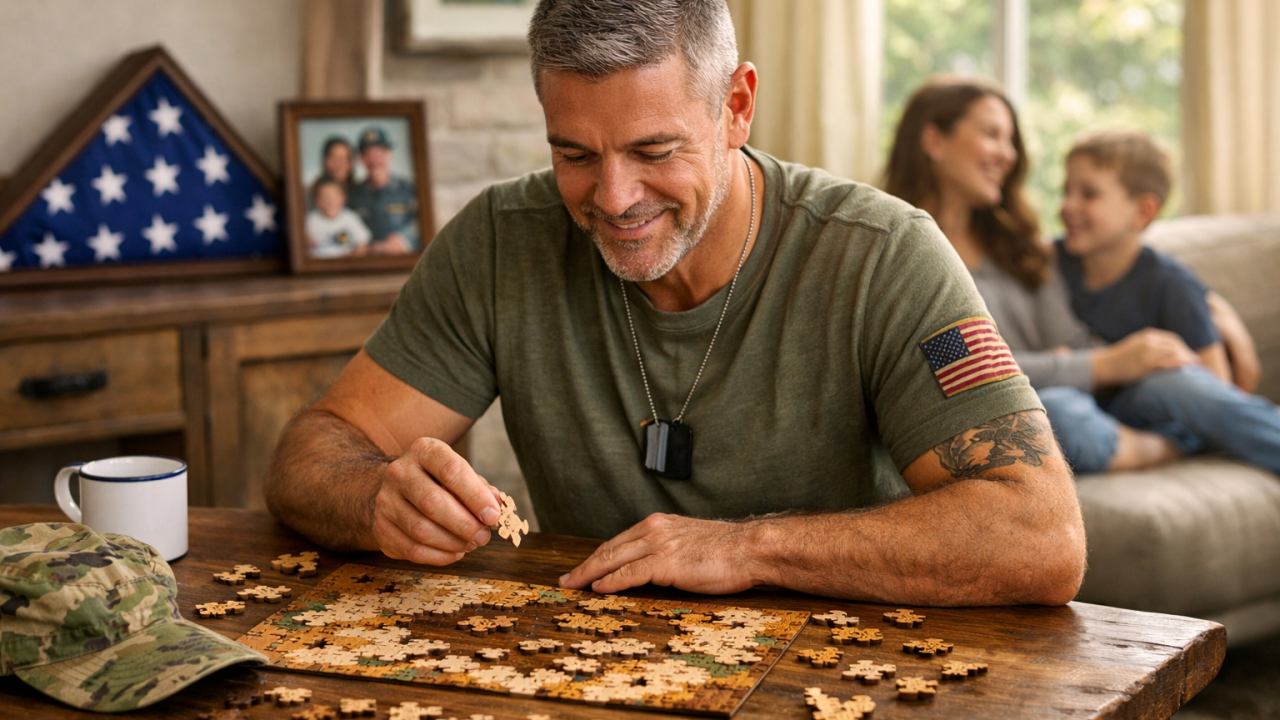
One simple starting point is wood puzzles for adults, a tactile challenge that rewards patience, problem-solving, and a sense of completion. This isn’t about nostalgia or “keeping busy.” It’s about rebuilding a reliable rhythm of focus and recovery, one small, real-world win at a time, using creative challenges that ask for your attention and give something back.
The Post-Military Gap: Structure, Identity, and the “Next Mission”
The transition isn’t just a job change. It’s often a system change: different norms, different expectations, different feedback loops. Many veterans describe the first stretch of civilian life as strangely unstructured, as if the calendar is full yet the days don’t “lock in” the way they used to.
Research groups studying transition outcomes consistently describe reintegration as complex: it can affect routines, identity, family roles, and access to support. RAND Europe’s work on military-to-civilian transition highlights how the process is experienced differently across individuals and families, and why ongoing support and clearer pathways matter, not just at separation, but over time. That “over time” part is the key: transition isn’t an event, it’s a period.
In that period, hands-on creative challenges can act like a bridge: not a substitute for purpose, but a practical tool for restoring structure, attention, and confidence, especially when the bigger goals are still forming.
Why Hands-On Challenges Work: Focus, Feedback, and Stress Regulation
Creative effort is often misunderstood as soft or optional. In reality, it can be a form of training: attention training, frustration tolerance training, and recovery training.
The strongest hands-on activities share three qualities:
- Clear constraints (there is a boundary and a goal)
- Immediate feedback (pieces fit or don’t; progress is visible)
- A defined finish (you can complete it and be done)
That combination matters when your nervous system is already carrying a load. When stress is high, abstract “self-care” advice can feel unhelpful because it’s vague. A hands-on task is the opposite: specific, grounded, and measurable.
The American Psychiatric Association has reported that many adults use creative activities to help manage stress and anxiety. Its July 2023 poll found 65% engage in creative activities in their free time, and 46% do so to relieve stress and anxiety. Those numbers don’t prove that any single hobby is a cure-all, but they do show something important: people turn to creativity when they need regulation and relief.
The Brain Responds to Clear Feedback Loops
A good hands-on challenge creates a loop you can trust: attempt → feedback → adjust → progress. That’s not just satisfying; it’s stabilizing.
The American Psychological Association’s stress guidance emphasizes practical coping strategies, things that reduce overload and help you return to baseline. If your baseline has been disrupted (sleep changes, irritability, constant vigilance, or the “always on” feeling), you don’t need a perfect plan; you need a reliable reset.
This is where a creative task becomes more than a pastime. It becomes a predictable environment where you can practice steadiness: staying with a problem, managing frustration, and completing something that doesn’t demand you be “on duty” for anyone else.
Why Wooden Puzzles Fit So Well: A Quiet, Complex Win
Not every creative activity works for every person. Some are too open-ended (blank canvases can feel like pressure). Some are too stimulating (fast screens can keep the system revved). Some feel like yet another performance. Wooden puzzles occupy a useful middle ground: structured enough to be soothing, challenging enough to be engaging, and tactile enough to feel real.
There’s also emerging evidence that puzzling engages multiple cognitive abilities. A widely cited paper on jigsaw puzzling in Frontiers in Aging Neuroscience (available via NIH’s PubMed Central) reports that jigsaw puzzling strongly engages multiple cognitive functions and suggests that it may be a cognitively stimulating leisure activity. Again, this isn’t a promise of transformation. It’s a practical point: if you want a task that reliably absorbs attention, puzzles are built for that.
Tactile Problem-Solving Beats “Infinite Scroll” for Recovery Time
A screen-based feed is designed to be endless. That can be fine, until you’re using it as recovery. When the activity never ends, your nervous system never gets the “finish” signal. Hands-on challenges, by contrast, give your brain a clean boundary: start here, end there.
That boundary matters in post-military life because so much else can feel ambiguous. A tactile task offers a different kind of control, control you can feel in your hands, not just think about in your head. And when you complete it, the win is visible. You can point to it. You can say, “That’s done.” Small completions don’t replace big purpose, but they do rebuild confidence in your ability to move from effort to outcome.
Turning a Hobby Into a Steady Practice (Without Making It Another Job)
A creative routine only helps if it stays supportive. If you turn it into another performance metric, it stops being recovery and starts being pressure.
The goal is not “become a puzzler.” The goal is create a repeatable recovery lane that fits your life.
Here’s what tends to work best:
- Keep it short enough to succeed. Consistency beats intensity.
- Keep it reachable. A setup that takes 10 minutes to start will lose to your couch most days.
- Keep it optional. If it feels like an obligation, you’ll resist it.
When stress rises, simple strategies (like breathing, movement, and grounding) matter, but so do activities that hold your attention gently and give you a sense of control. APA’s stress guidance emphasizes healthy coping actions that are doable in real life; you can use that lens to choose a creative practice that actually sticks.
The 30-Minute Reset Protocol (Solo or Team)
If you want a concrete way to make this useful, try a simple 30-minute block:
- 2 minutes: Clear a small workspace. Remove distractions.
- 25 minutes: Work the puzzle (or any hands-on creative challenge) with one rule: no multitasking.
- 3 minutes: Stop on purpose. Take a breath. Note one thing you improved (speed, patience, strategy, calm).
Optional team version: set it up with a partner, roommate, or family member and treat it like a short “reset session,” not a social event you have to host.
The point is not the puzzle itself, it’s practicing focus without pressure and completion without adrenaline.
Choosing the Right Challenge and Knowing When to Get Backup
The right creative challenge should feel like engagement, not escalation.
A good match usually has:
- Moderate difficulty: challenging enough to hold you, not so hard that it spikes frustration
- A clear finish line: a defined endpoint you can reach
- A calming pace: something you control, not something that controls you
And it’s also worth saying plainly: hobbies can support wellbeing, but they are not a replacement for professional care when you need it. If you’re noticing persistent sleep disruption, frequent anger, panic symptoms, heavy isolation, or you’re stuck in a loop that’s getting tighter instead of looser, support is not a weakness, it’s a smart next step. RAND’s transition research emphasizes the complexity of reintegration and the importance of appropriate support structures; the transition landscape is real, and so are the stakes.
Hands-on creative challenges are valuable because they’re accessible: you can start small, you can do them privately, and you can build a stable routine without needing perfect motivation. In post-military life, when motivation can come and go, that matters.
If you can give yourself one reliable, tactile “mission” a few times a week, something you can start, work, and finish, you’re not just passing time. You’re rebuilding the skills of steadiness and self-direction that carry over into everything else.
Buy Me A Coffee
The Havok Journal seeks to serve as a voice of the Veteran and First Responder communities through a focus on current affairs and articles of interest to the public in general, and the veteran community in particular. We strive to offer timely, current, and informative content, with the occasional piece focused on entertainment. We are continually expanding and striving to improve the readers’ experience.
© 2026 The Havok Journal
The Havok Journal welcomes re-posting of our original content as long as it is done in compliance with our Terms of Use.