
By Joseph William Rucker Jr., MD
I did not want to go into the Army, and I sure didn’t choose Walter Reed. In the fall of 1968, with the war in Vietnam at its peak and a college transcript that did me no favors, I did what a lot of young men my age were doing. I enrolled in a master’s program at Michigan State, hoping graduate school might keep the draft board off my back. It didn’t. The following year my number came up in the lottery, and I was ordered to report for induction.
I was 23 when I got on the bus in Lansing headed for boot camp at Fort Knox. Older than most of the 18-year-olds around me, and a lot less sure of myself than I let on. Eight weeks later my orders came down: Walter Reed Army Medical Center, Washington, D.C. I reported that August. I remember thinking it was a strange kind of luck, ending up at a place that had cared for presidents and Supreme Court justices, when I was just a college washout with a biology degree and no real idea what I was doing.
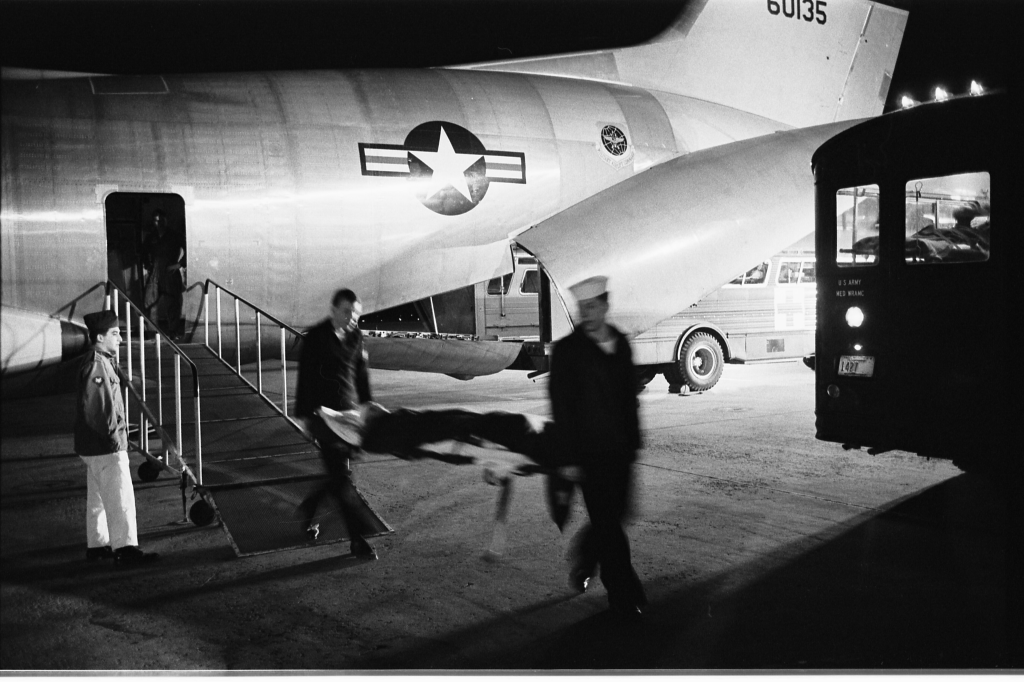
The Army had a term, “medical assistant,” that covered everything from lab work to bedside care. Because I’d majored in biology and had spent time in my father’s office drawing blood and developing X-rays, they decided I qualified. So they put me to work helping manage the postoperative care of wounded soldiers coming home from Vietnam. Specifically, the ones with serious head and neck injuries.
That’s how I met Jake.
He came in on a September morning, 21 years old, with a bandage wrapped around most of his lower face. A projectile had taken out a good part of his jaw. He’d been stabilized at a hospital in San Diego and sent to us for reconstruction. When I walked up to his bed and he lifted his head, I saw a sadness in his eyes I hadn’t seen since I was a boy visiting a dying relative. He couldn’t speak. He just waved when I introduced myself.

Nobody warns you about the first time you unwrap a dressing like that. I’d learn eventually that you’re never supposed to let your face show what you’re thinking, because patients watch you for the verdict. I didn’t know that yet. I cringed, and then I apologized for it. “Sorry, Jake,” I told him. “I’m new to this. I’ve never seen an injury like yours.” He waved it off like he was shooing a fly.
For months I fed him through a tube twice a day, because he couldn’t take food by mouth. I watched him go through one reconstructive procedure after another. Bone grafts to rebuild the jaw. Tissue flaps rotated in from his neck and cheek to close what the injury had taken. Somewhere in those weeks I stopped just doing my job and started paying real attention. I asked his surgeon if I could observe the last two procedures. Watching the planning, including which flap to use based on blood supply, shape and location, and then watching it done in real time was unlike anything I’d seen. But the best part wasn’t the surgery. It was watching Jake afterward. Eating on his own again. Gaining weight back. Smiling more than he had when I met him. The reconstruction didn’t just rebuild his face. It gave him back something else too.
Not one family member visited him the whole time he was in that ward, or even wrote. I never learned why. On a cold morning in mid-December, with a small Christmas tree someone had set up near the entrance, I walked in and found his chart missing from the rack and his mattress rolled up at the foot of an empty bed. The ward clerk told me his bed had been empty since 5 a.m. That was it. No goodbye, no forwarding address, nothing. I never saw Jake again.
I stood there a long moment, and it hit me that patient care was about a lot more than drugs and surgical technique. What that reconstructive process had actually restored, in the end, was Jake’s dignity.
I wish I could tell you a light came down from heaven that day and pointed me toward medical school. It didn’t happen like that. What I did instead was sit down and write myself an honest assessment. The bad column was long: no money coming from home for more school, a 2.3 GPA against medical schools that wanted better than a 3.0, five years I’d mostly wasted. The good column was shorter, but it held up better. The Army had already taught me nobody takes care of you if you don’t take care of yourself. I had a biology degree. I didn’t want a life of scraping by. And if a Black man in Mississippi could become a physician back in the 1920s with every door in the world shut in his face, I didn’t have much of an excuse.
A little over a year later, still stationed at Walter Reed, I hitched a ride on an Army flight down to Mississippi to sit with my grandfather. He’d been an Army medical officer himself, back in World War I, working out of tents near the front lines with none of what we had at Walter Reed. No real antibiotics, none of the equipment, just what he could carry and what he knew. I told him I wasn’t sure I was smart enough for medical school. He told me what he always told me: “You will always find roadblocks in your path, but you don’t let them smother your resolve. You step back, you evaluate, you adjust, and you find a way around them.”
I didn’t choose the assignment that sent me to that ward. Fifty years later, I’m still grateful I got it.
The level of one’s willpower is determined by how one rebounds after hitting rock bottom.
_____________________________
Joseph William Rucker Jr., MD, is a retired plastic and reconstructive surgeon and a U.S. Army veteran who served during the Vietnam era, including an assignment at Walter Reed Army Medical Center. He went on to a 30-year career in reconstructive surgery in Eau Claire, Wisconsin, following in the footsteps of his grandfather, an Army medical officer and family doctor in Mississippi. One Pocket is his debut memoir.
As the Voice of the Veteran Community, The Havok Journal seeks to publish a variety of perspectives on a number of sensitive subjects. Unless specifically noted otherwise, nothing we publish is an official point of view of The Havok Journal or any part of the U.S. government.
Buy Me A Coffee
The Havok Journal seeks to serve as a voice of the Veteran and First Responder communities through a focus on current affairs and articles of interest to the public in general, and the veteran community in particular. We strive to offer timely, current, and informative content, with the occasional piece focused on entertainment. We are continually expanding and striving to improve the readers’ experience.
© 2026 The Havok Journal
The Havok Journal welcomes re-posting of our original content as long as it is done in compliance with our Terms of Use.


