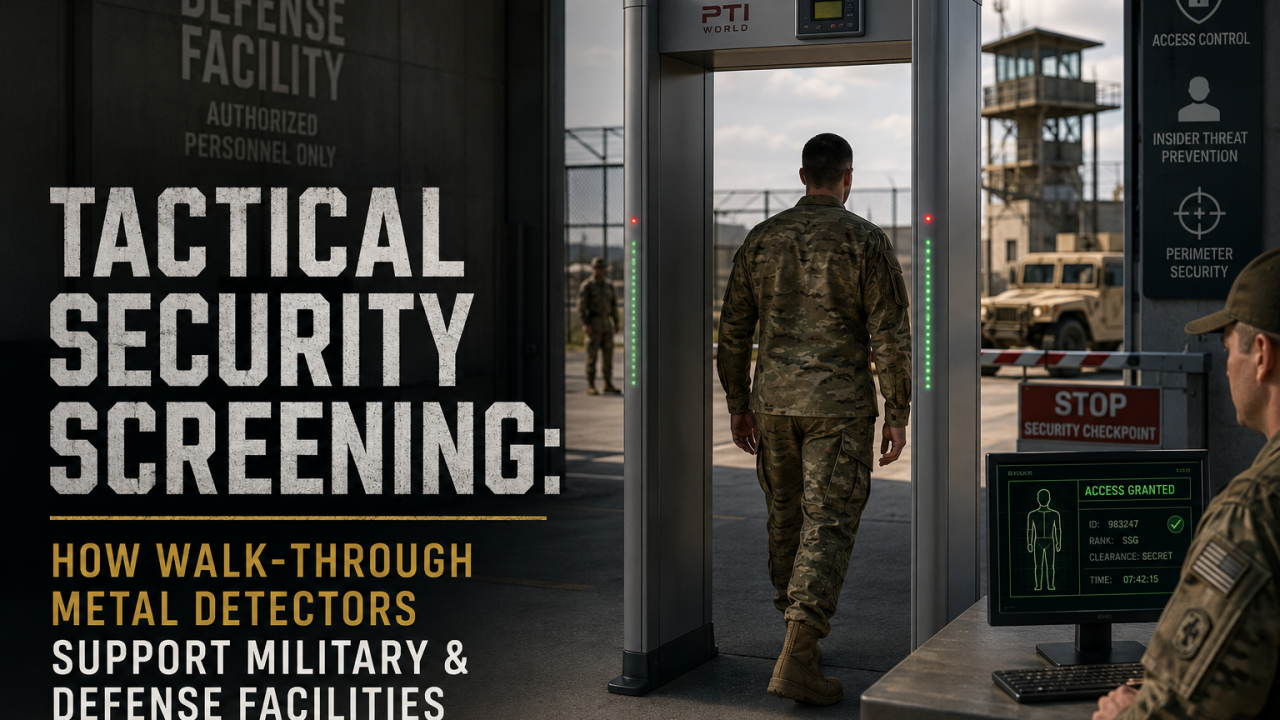
Security at the Threshold
Military and defense facilities represent some of the most controlled access environments in the world. The physical perimeter – fencing, guard posts, vehicle barriers – is the most visible part of that security architecture. But the checkpoint experience itself, the moment personnel or contractors transition from civilian space into secured zones, is where walk-through metal detection plays a critical and often underexamined role.
The threat environment at defense installations is not limited to external actors. Insider threats – personnel who exploit their authorized access for unauthorized purposes – are consistently ranked among the most difficult security challenges in the defense sector. A walk-through metal detector at access points does not eliminate insider risk, but it creates a layer of accountability that changes the calculus for anyone considering unauthorized movement of materials.
Defense environments demand detection systems that can be configured for a wide range of sensitivity requirements. PTI World’s walk-through metal detectors offer adjustable detection zones and sensitivity settings that can be tuned for the specific threat profile of any access control point – from contractor entry gates to classified material handling areas.
Access Control Architecture in Defense Settings
A military installation is rarely a monolithic secured zone. Most facilities operate with multiple security tiers – outer perimeters, inner perimeters, and restricted areas within those. Walk-through detectors are deployed differently across each tier based on threat probability, personnel volume, and the nature of what is being protected.
At outer perimeter checkpoints processing large volumes of uniformed and civilian personnel, throughput matters as much as detection sensitivity. Systems need to maintain consistent screening without creating backlogs that delay operational tempo. At inner perimeters near armories, secure communications facilities, or research areas, sensitivity takes precedence over speed. Systems deployed here may be calibrated to detect smaller metallic objects – including components that could be used to construct improvised devices – that outer perimeter units would be set to ignore.
Addressing Insider Threats
The most well-publicized security failures at defense facilities have frequently involved authorized personnel rather than external attackers. Walk-through metal detectors, positioned thoughtfully within the movement paths that personnel take when leaving secured areas, create a routine accountability checkpoint that is difficult to argue against and equally difficult to consistently evade.
This deterrence value is distinct from detection value. Even when a detector does not catch every attempted removal of materials, the knowledge that detection systems are present and active changes behavior. Personnel who might otherwise consider taking unauthorized items out of a facility reconsider when screening is a routine part of exit procedures.
Integration With Military Access Control Systems
Modern defense facilities increasingly integrate physical screening equipment with digital access control systems. Badge readers, biometric verification, and visitor management platforms can be linked to detector logs to create unified audit trails. When a detector alert occurs, the system can immediately associate it with a specific access credential – accelerating investigation and reducing the response burden on security personnel. For facilities evaluating their approach to layered screening, PTI World’s resource on X-ray baggage scanners provides useful context on how different screening technologies complement walk-through detection in high-security environments.
Environmental and Operational Factors
Defense installations present environmental challenges that civilian security deployments rarely encounter. Outdoor checkpoints exposed to temperature extremes, humidity, and electromagnetic interference from nearby communications or radar equipment require detectors with robust shielding and wide operational temperature ranges. Systems used in such environments need to maintain consistent sensitivity calibration regardless of ambient conditions – a standard that consumer or light commercial equipment cannot reliably meet.
Operational tempo also matters. Military facilities may operate around the clock with shift changes that produce sudden surges of personnel movement. Detection equipment deployed in these environments needs fast reset times, durable construction, and minimal maintenance requirements to avoid creating security gaps during high-traffic periods.
Screening Contractors and Visitors
Defense facilities receive significant volumes of civilian contractors, vendors, and authorized visitors who do not carry the same training or institutional accountability as uniformed personnel. Walk-through screening at visitor processing centers serves a dual function: it screens for prohibited items while simultaneously signaling to visitors that the facility maintains rigorous access standards. That visible commitment to security is itself a deterrent to individuals who might test the boundaries of their authorized access.
Conclusion
Walk-through metal detectors are not a complete security solution for military and defense environments – they are one important layer within a much broader architecture. Their value lies in consistent, non-negotiable screening that applies equally to everyone passing through a checkpoint, regardless of rank or affiliation. When calibrated correctly and integrated with access control and monitoring systems, they contribute meaningfully to the insider threat mitigation and perimeter integrity that defense facilities require.
Buy Me A Coffee
The Havok Journal seeks to serve as a voice of the Veteran and First Responder communities through a focus on current affairs and articles of interest to the public in general, and the veteran community in particular. We strive to offer timely, current, and informative content, with the occasional piece focused on entertainment. We are continually expanding and striving to improve the readers’ experience.
© 2026 The Havok Journal
The Havok Journal welcomes re-posting of our original content as long as it is done in compliance with our Terms of Use.


