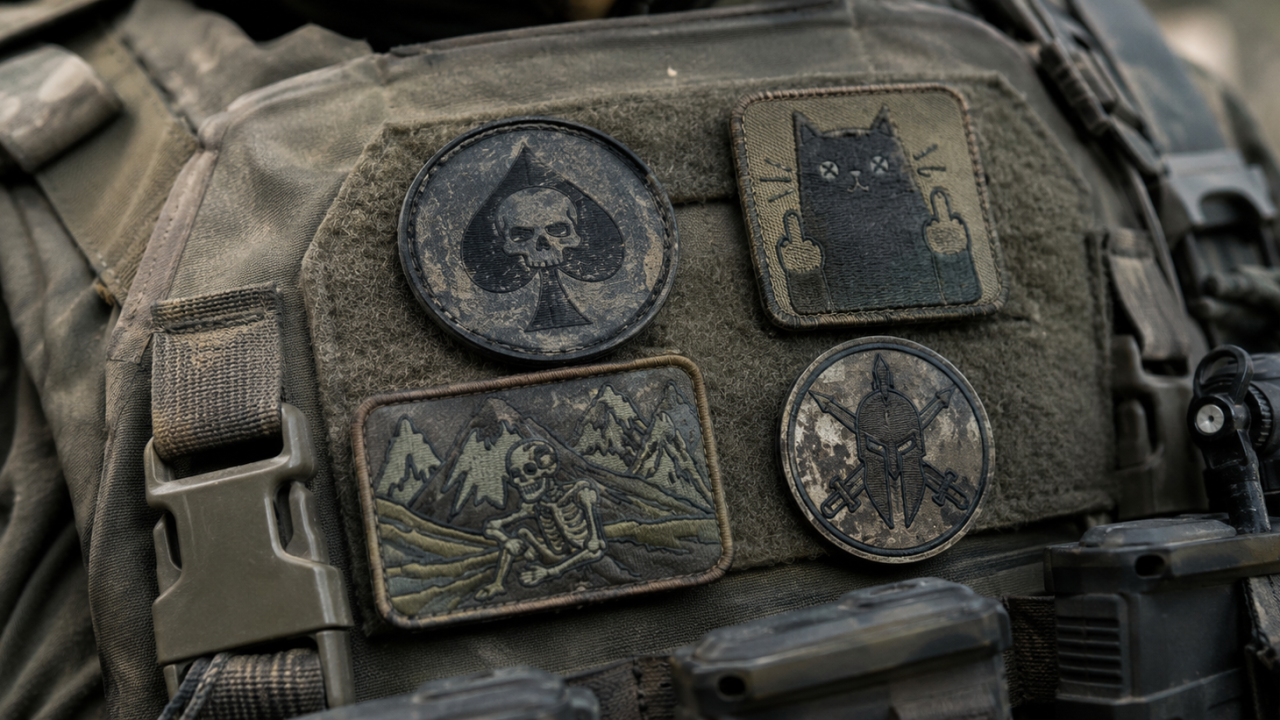
Walk through any operations building on a modern Army post, and you will see them: small rectangles of PVC or embroidered fabric stuck to plate carriers, ball caps, and admin pouches. Some are unit insignia. Some are inside jokes. A few are pointed enough to get a private smoked if the wrong sergeant major walks by. Morale patches are among the most visible elements of unofficial culture in the modern military, and they are not slowing down.
What changed between the Vietnam War-era squadron patch sewn onto a flight jacket and the loop-backed patch a 21-year-old buys off Instagram in 2026 is mostly the attachment system. The hook-and-loop field on tactical gear turned the patch from a permanent statement into a swappable one, and that small mechanical shift is what built the modern morale patch industry.
Key Takeaways
- Morale patches are unofficial unit insignia worn for esprit de corps, dark humor, or commemoration, distinct from authorized uniform patches.
- The category exploded during the Global War on Terror, when hook-and-loop fields became standard on plate carriers, MOLLE systems, and other tactical gear.
- Four production types dominate: PVC patches, embroidered patches, sublimated patches, and infrared (IR) patches.
- Wear is generally not authorized on the duty uniform but is widely tolerated on plate carriers, ball caps, range gear, and across military and law enforcement teams.
- Most modern unit patches are produced in small batches by specialty manufacturers rather than through official supply channels.
What Are Morale Patches?
A morale patch is an unofficial insignia worn on military or tactical gear, usually attached with a hook-and-loop fastener to Velcro on the host garment. Unlike authorized unit patches, rank, or qualification badges, morale patches are not issued through supply and are not part of the regulation uniform. They exist somewhere between a unit identifier and a bumper sticker.
In practice, the term covers a wide range: a platoon’s in-joke after a long rotation, a commemorative patch printed after a deployment, a vendor-designed patch sold to civilians and service members alike, and the unauthorized-but-tolerated tactical patches that show up on plate carriers at the range. The common thread is that the wearer chose it. That choice is what separates morale patches from the rest of the uniform patches a service member is required to display.

A Short History: From Squadron Patches to Velcro Morale Patches
The military history of unit-specific cloth insignia goes back further than the morale patch as we know it. The 81st Division Wildcats, formed during World War I, are widely credited with the first authorized shoulder sleeve insignia in U.S. Army history: a wildcat silhouette that survived a request from other units to have it removed and ultimately led to the practice being authorized across the entire force. From that point forward, unit insignia became part of how a soldier wore his identity.
Army Air Forces squadrons in World War II commissioned hand-embroidered patches with cartoon mascots, often through Disney studios, which produced over 1,200 designs for military units between 1942 and 1945 (Smithsonian National Air and Space Museum). These set the visual template: a unit identifier with personality, sewn onto a flight jacket and worn with obvious pride and loyalty.
One of the more interesting wartime insignia traditions was the blood chit, a cloth panel sewn into the lining of a flight crew’s jacket carrying a message in multiple languages asking local civilians to aid a downed pilot in exchange for a reward. Blood chits were not morale patches in the modern sense, but they share the DNA: a piece of cloth that meant something specific to the people who carried it.
The Vietnam War-era squadron patch carried the visual tradition forward, and for decades, patches were sewn directly to the garment. That meant a finite number of patches per uniform and a real cost to swapping them. The shift came in the mid-2000s, when plate carriers, combat shirts, and tactical headwear began shipping with hook-and-loop fields as a standard feature, often integrated with MOLLE systems for modular load-bearing. Once the attachment problem was solved, the floodgates opened.
During the Global War on Terror, units on rotation began commissioning their own custom military patches in small batches. Some commemorated specific operations. Some were team jokes that only made sense to the dozen people who were there. The economics worked because PVC injection molding had become cheap enough to produce 50 to 100 patches at a unit-affordable price point, and Velcro made them reusable across kit. Law enforcement tactical teams picked up the same habit not long after, for the same reasons.
““There are lots of great stories in these patches, and there are a lot of people all over the world who collect them.” – Bob Mitchell, curator at the U.S. Army Aviation Museum
The Types: PVC, Embroidered, Sublimated, and IR
Four production methods cover almost every patch in circulation, and each one signals something about how the patch is meant to be worn. The patch designs themselves can range from simple monochrome silhouettes to multi-color illustrations, but the substrate determines how they hold up over time.
PVC
Soft, rubbery, made from injection-molded polyvinyl chloride. PVC patches are weatherproof, hold detail well, and withstand sweat, mud, and saltwater in ways embroidery does not. They have become the default for plate carriers and field gear because they shrug off conditions that would chew up thread. A good morale patch manufacturer can hold registration on small text down to about 6 mil thickness, which is the practical floor for legibility.
Embroidered
Thread on twill. The traditional construction and still the right choice for dress uniforms, flight jackets, and patches where the textile feel is the point. Embroidered patches do not handle saltwater or hard abrasion as well as PVC, but they look correct on a leather jacket in a way PVC never will.
Sublimated
Dye is heat-pressed into a synthetic substrate, producing photo-quality color and gradients that embroidery and PVC cannot match. Used when the design requires a photograph, a complex illustration, or shading that thread count cannot render. The tradeoff is that sublimated patches feel flatter and less tactile than the other types.
Infrared (IR)
Designed to be visible only under night vision. IR patches use reflective materials that read clearly through a PVS-14 but appear muted or invisible in daylight. These are used for friendly identification, call signs, and unit markers during low-light operations, and their use is governed by unit SOP rather than general regulation.
The Etiquette: What’s Authorized, What’s Not
Are morale patches authorized? The short answer is almost never on the duty uniform, and almost always tolerated on the plate carrier. The rules also vary by military branch and by the specific command.
AR 670-1, the Army’s uniform regulation, governs what can be worn on the combat uniform and does not authorize morale patches. The Marine Corps Uniform Regulations (MCO 1020.34H) are stricter still. Air Force Instruction 36-2903 has historically taken a similar line. In practice, what this means is that morale patches stay off the duty blouse and off official insignia panels.
Plate carriers, range gear, ball caps in non-formation settings, and personal kit are where the patches actually live. Commanders have wide latitude here, and most allow patches that are not vulgar, do not depict explicit imagery, and do not embarrass the unit. The line is set locally, which is why a patch that is fine in one battalion will get a soldier counseled in another. For law enforcement teams, the same general principle applies: morale patches are tolerated on tactical kit and tactical flags carried by the unit, but stay off the formal uniform.
A few rules apply almost universally:
- No morale patches on the OCP, MultiCam, or service blouse.
- No patches that mock the chain of command, religion, or other units in a way that would not survive a SHARP brief.
- No patches in formation or on parade.
- When in doubt, ask the platoon sergeant before the first sergeant asks you.
Patch Placement, Care, and Collecting
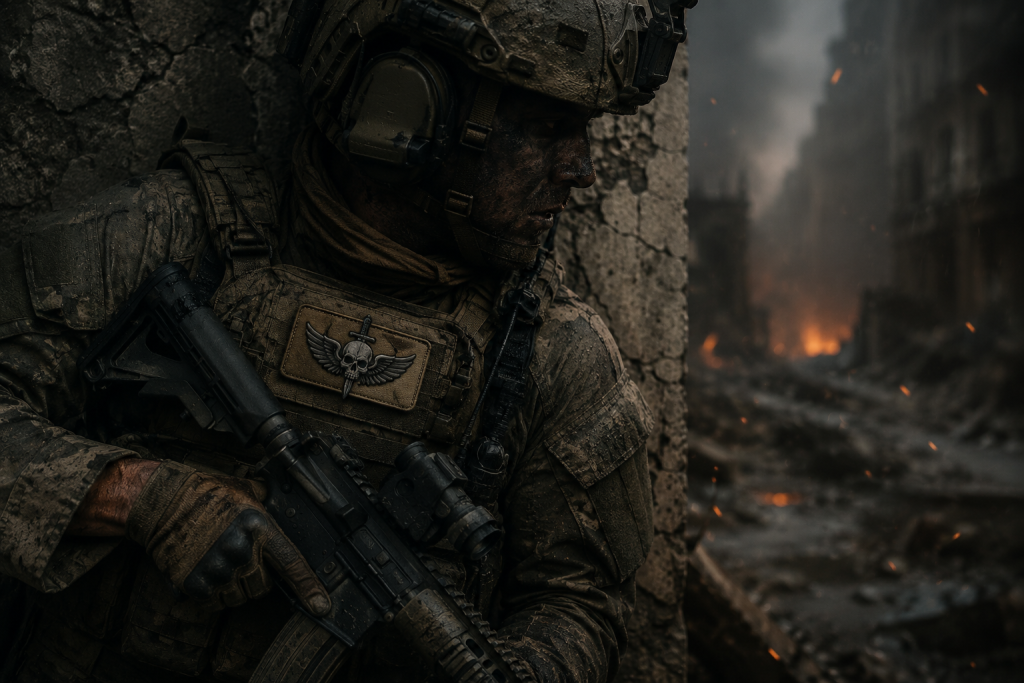
Patch placement on modern tactical gear is a loose convention rather than a regulation. Most operators put unit identifier patches on the front-left chest panel of the plate carrier, call signs on the right, and the rotating cast of joke patches on the back or on the helmet cover. Pouches and admin panels carry overflow. The hook velcro field that came factory-installed on the gear dictates where patches can physically go, and most users work within that.
Patch care is mostly about avoiding damage to the hook fastener and preventing the patch itself from fading. PVC handles washing fine and can be wiped clean. Embroidered patches survive a gentle cycle but lose color faster, especially the lighter threads. The hook side of the Velcro will collect lint and small debris over time and degrade if it is run through a washing machine repeatedly. Pulling lint out with a stiff brush every few months restores most of the grip.
Patch collecting has grown into a hobby of its own, both inside and outside the services. The patch culture that built up around tactical communities now extends to first responders across law enforcement, EMS, and fire, and to a wide civilian audience that displays patches on backpacks, jackets, and dedicated patch boards on the wall at home. A working patch board is just a fabric panel covered in loop material, framed or mounted, that lets a collector arrange a rotating display the same way a unit arranges patches on a plate carrier. Stickers serve a similar function for people who want the visual identity without committing to the textile.
For the people who design and trade patches as a form of personal expression, the appeal is the same thing that drove the 81st Division to fight for its wildcat in 1918: a small visible marker that says who you are and who you ran with.
Where Modern Units Get Theirs Made
Most unit patches in circulation today are produced in small batches by specialty manufacturers, not through the official supply system. The economics are straightforward: a platoon of 30 to 40 people wants 50 to 100 custom morale patches, with one or two design revisions, delivered in four to six weeks. Government supply was never built for that workflow.
The vendors that fill the custom patches niche tend to specialize. Some focus on PVC and run their own molds. Some are embroidery shops that have done unit work for decades. A handful do all four production types under one roof, which is useful when a unit wants a PVC version for the plate carrier and a matching embroidered version for the dress uniform.
What matters when commissioning a batch is the proof process. A good vendor will return a digital proof inside 48 hours, a physical sample if the order justifies it, and will not put the order into production until the unit point of contact has signed off in writing. The patches that end up in the trash can are almost always the ones where someone tried to skip that step.
Why the Tradition Endures
The morale patch survives because it does something the official insignia system cannot: it lets the people in the unit decide what the unit is about. The Army can tell a soldier what unit they are assigned to. It cannot tell them what their team’s in-joke is, or what call sign the section adopted after the third rotation, or which dog the platoon adopted in 2009 and still remembers.
That is what the patch carries. A century from now, somebody will pull a beat-up PVC patch out of a footlocker, and the only people who will fully understand what it means are the ones who were there. According to the Naval History and Heritage Command, unit insignia and squadron markings have always functioned this way: official enough to identify, personal enough to mean something. The Velcro just made it portable.
Buy Me A Coffee
The Havok Journal seeks to serve as a voice of the Veteran and First Responder communities through a focus on current affairs and articles of interest to the public in general, and the veteran community in particular. We strive to offer timely, current, and informative content, with the occasional piece focused on entertainment. We are continually expanding and striving to improve the readers’ experience.
© 2026 The Havok Journal
The Havok Journal welcomes re-posting of our original content as long as it is done in compliance with our Terms of Use.


