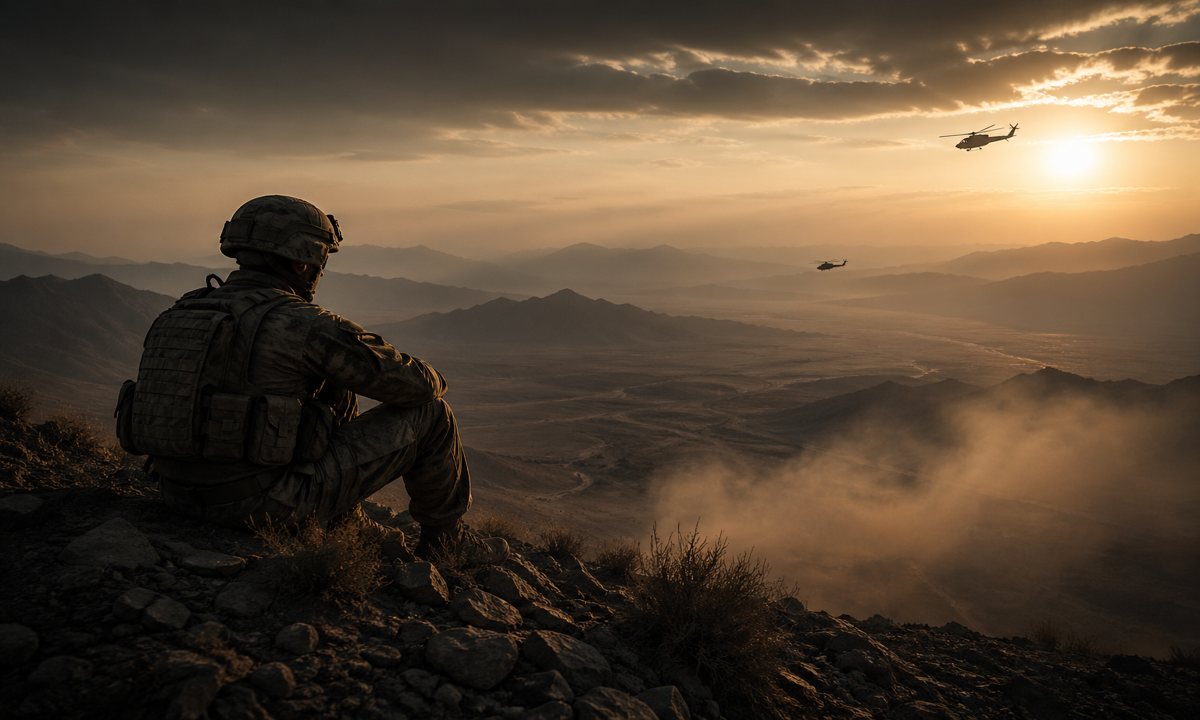
There’s a quiet brutality in the Latin phrase pulvis et umbra sumus—we are dust and shadow. It’s not motivational. It doesn’t belong on a recruiting poster or etched above a gym door. It doesn’t promise glory or legacy or meaning. It simply reminds us of the uncomfortable truth: whatever we build, whatever we fight for, whatever we believe we are—eventually, it all fades.
And yet, that truth sits at the very center of the military profession.
From the outside, service looks like permanence. Rank, ribbons, commands—these feel like markers of something lasting. But anyone who has worn the uniform long enough knows better. Units rotate. Leaders move on. Wars end, or just evolve into something less defined. The names on the door change. The guidon stays, but even that is just cloth and symbolism. Time grinds everything down.
Dust and shadow.
There’s a moment most leaders experience, though few talk about it openly. It’s when you realize that the institution doesn’t need you nearly as much as you thought it did. You leave a position you poured yourself into, and within weeks—sometimes days—someone else is in your seat, making decisions, running meetings, shaping outcomes. The machine keeps moving. It always does.
That realization can hit like a gut punch. Or it can set you free.
Because if we are dust and shadow, then the question shifts. It’s no longer about permanence. It’s about impact.
Not the kind that shows up in an evaluation report or a citation, but the kind that lives in people. The soldier you mentored who makes a better call under pressure. The NCO who learned to take ownership because you trusted them with it. The young officer who saw, maybe for the first time, what right looks like—not in doctrine, but in action.
Those things don’t last forever either. But they last longer than you will in any position. Longer than your name on a roster. Longer, even, than your career.
The irony is that once you accept the temporary nature of everything, you start to lead differently. You stop trying to control outcomes that are bigger than you. You stop clinging to authority like it’s something you can keep. Instead, you invest. You build. You pass things on knowing they will be changed, reshaped, maybe even undone.
And that’s okay.
Because the profession of arms has never been about individual permanence. It’s about continuity. One generation hands off to the next, not perfectly, not cleanly, but deliberately. We inherit problems we didn’t create and pass along solutions that won’t fully hold. That’s the deal.
Dust and shadow doesn’t mean meaningless. It means limited. And there’s a difference.
In combat, that reality sharpens. You see how quickly things can end—plans, missions, lives. There’s no illusion of permanence when you’re operating in environments where time feels compressed and consequences are immediate. What matters becomes brutally clear: your people, your decisions, your ability to act when it counts.
No one is thinking about legacy in those moments. They’re thinking about getting it right.
And maybe that’s the point.
We spend a lot of time in the military talking about legacy—what we’ll leave behind, how we’ll be remembered. But history is selective, and memory is short. Most of us won’t be remembered outside a small circle, and even that fades with time.
Pulvis et umbra sumus.
So if that’s true, then the value of service isn’t in being remembered. It’s in showing up—fully, consistently, and with purpose—while you’re here.
It’s in doing the job well, even when no one’s watching.
It’s in leading people, not for recognition, but because they deserve it.
It’s in accepting that you are a small part of something much larger—and choosing to give your best to it anyway.
There’s a strange kind of peace in that. Not resignation, but clarity.
You don’t have to be everything. You don’t have to fix everything. You don’t even have to last.
You just have to matter—right now, where you are, with what you’ve been given.
Because in the end, we are dust and shadow.
But while we’re here, we’re also something more.
_____________________________
Charles served over 27 years in the US Army, which included seven combat tours in Iraq and Afghanistan with various Special Operations Forces units and two stints as an instructor at the United States Military Academy at West Point. He also completed operational tours in Egypt, the Philippines, and the Republic of Korea and earned a Doctor of Business Administration from Temple University as well as a Master of Arts in International Relations from Yale University. He is the owner of The Havok Journal, and the views expressed herein are his own and do not reflect those of the US Government or any other person or entity.
As the Voice of the Veteran Community, The Havok Journal seeks to publish a variety of perspectives on a number of sensitive subjects. Unless specifically noted otherwise, nothing we publish is an official point of view of The Havok Journal or any part of the U.S. government.
Buy Me A Coffee
The Havok Journal seeks to serve as a voice of the Veteran and First Responder communities through a focus on current affairs and articles of interest to the public in general, and the veteran community in particular. We strive to offer timely, current, and informative content, with the occasional piece focused on entertainment. We are continually expanding and striving to improve the readers’ experience.
© 2026 The Havok Journal
The Havok Journal welcomes re-posting of our original content as long as it is done in compliance with our Terms of Use.


